
As the U.S. heads toward its midterm elections on November 3, control of both chambers of Congress is in play. Whatever the outcome, the scope for major legislation over the next two years may be limited, as divided or narrow congressional majorities typically constrain the ability to pass significant new legislation. Beyond control of Congress, the election results may offer insight into the economic and political forces shaping the investment landscape.
Over the past several years, three forces, among others, have shaped our investment outlook and global financial conditions: a more restrictive rates environment, influenced by the limits of debt-financed fiscal expansion; the dominance of AI as a macro and market driver; and a shifting global geopolitical regime driving global positioning and risk considerations. The midterm elections provide a useful read on how voter sentiment around these themes is evolving, even as the forces themselves extend beyond a single election cycle.
In this piece, we look beyond the electoral horse race to examine what the midterms could tell investors about these three forces, and what those signals mean for markets in 2027 and beyond.
The midterm math points to a shake-up
The November midterms put control of both chambers of Congress in play, with a divided government as the most likely outcome in our view. Republicans currently hold narrow majorities in both chambers: 218 Republican-held seats to 214 Democratic-held seats in the House, and a 53-47 advantage over the Democratic caucus in the Senate.1
While every House seat is contested during the midterms, roughly one-third of Senate seats are up for election. The nonpartisan Cook Political Report highlights greater vulnerability among Republican-held House districts, with 16 of the 21 races currently rated “Toss Ups” held by Republicans.2 The Senate has become increasingly competitive, with Cook rating six races as “Toss Ups,” five of which are currently held by Republicans.3 Still, Democrats face a higher hurdle to gain control of the Senate, requiring a net gain of four seats to secure a majority.
Midterms have rarely been kind to the party in the White House. History points to a persistent midterm challenge for the president’s party, which has lost House seats in 20 of the 22 midterm elections since 1938.4 Narrow congressional margins, a competitive electoral map, and the historical headwinds facing the president’s party leave control of Congress firmly in play.
Midterms have rarely been kind to the party in the White House
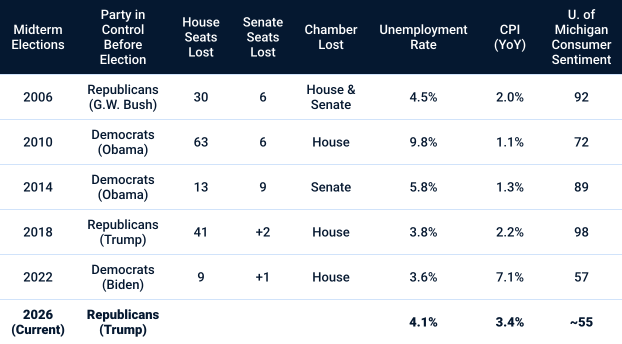
Sources: New York Life Investment Management Global Market Strategy, Bureau of Labor Statistics, University of Michigan, U.S. House of Representatives, U.S. Senate, September 2026.
Meaningful legislative action may remain limited
Historically, divided government has not always meant legislative paralysis. There are plenty of examples of consequential legislation born out of compromise post-midterm elections, including the 1983 Social Security reforms under President Reagan and the 1996 welfare reforms under President Clinton.5
A divided Congress would likely shift more policymaking toward executive action and could create more opportunities for political brinkmanship. Budget negotiations, government funding deadlines, and the debt ceiling are already recurring sources of uncertainty. A Democratic-controlled chamber could place greater emphasis on investigations and executive-branch oversight. Importantly, these risks are not unique to a divided government: the record 43-day government shutdown in 2025 occurred while Republicans controlled the White House and both chambers of Congress.
Fiscal risk is likely to reinforce today’s elevated rate environment
Congress holds the U.S. government’s purse strings, so it is natural that fiscal impact is usually the top investor question around the midterms. But this election year, fiscal considerations are even more relevant for investors as we expect a more restrictive rates environment to persist.
Over the past several decades, both political parties have added to the federal debt to similar degrees. In this sense, a sweep by either party would likely result in the highest proposed fiscal spending. In the more likely split Congress scenario, political gridlock is almost certain, but this gridlock must be broken when the debt ceiling is due to be raised – as soon as early 2027. The typical solution to congressional deadlock is compromise spending, in which both parties agree to fund certain priorities in exchange for raising the debt ceiling or passing budget resolutions.
U.S. federal debt has gone up no matter who is in charge - will it continue?
U.S. federal debt by the president's political party
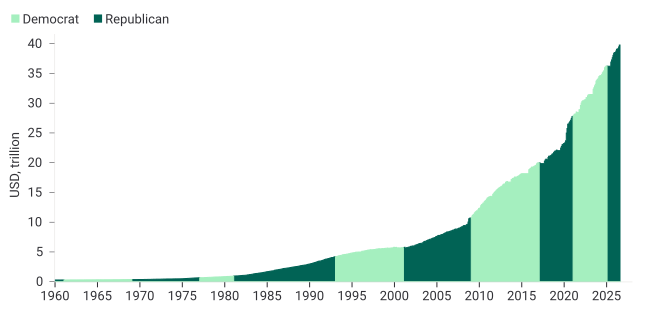
Sources: New York Life Investment Management, Global Market Strategy, Macrobond Financial AB, Federal Reserve Bank of Dallas, Macrobond, August 2026.
We expect the bond market to remain a live arbiter of fiscal health, and in the absence of greater bipartisan fiscal discipline, we expect market-determined interest rates to remain elevated and volatile. This midterm season occurs in the thick of a particularly vulnerable Treasury selloff, unprecedented Treasury intervention to contain yields, and a clear re-set in the term premium as investors demand greater compensation for duration. The average interest rate the U.S. government pays on its roughly $40 trillion public debt outstanding is now 3.5%, meaning that about 5% of real GDP goes to annual debt service payments.
Rising debt levels and financing rates are causing exponential growth in the U.S. interest burden
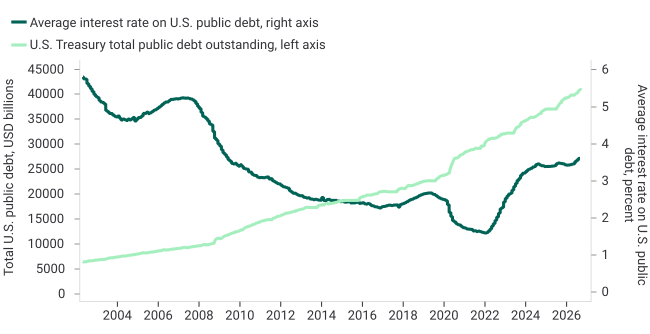
Sources: New York Life Investment Management, Global Market Strategy, U.S. Department of Treasury, Macrobond, September 2026.
The U.S. is not alone in facing severe fiscal tradeoffs. Governments across developed markets, including in Europe, Japan, and the UK, are also facing stubborn pressure on long-end rates. This global context is meaningful for investors because global interest rate differentials may remain compressed, creating a more ambiguous impact of fiscal risk on the dollar, rather than driving a clear case for depreciation.
Midterms may shed light on the popular pushback to the data center build
The investment implications of the midterms may extend well beyond new policy and into how voters are responding to policies currently underway. AI offers perhaps the clearest example: its physical footprint, from data centers to power demand, has expanded rapidly enough to turn a major investment theme into a local political issue.
Demand for AI infrastructure has outstripped supply, while new capacity increasingly brings questions around local electricity costs, water and land use, and noise. It stands to reason that Virginia and Texas, which have the most data center construction underway, would also have some of the loudest pushback.
However, our analysis of data center construction and the political salience of the AI theme across states, suggests that the intensity of the political response is not simply a function of how many data centers are being built. Michigan and Wisconsin, for example, have considerably less data center activity, yet data centers have generated high levels of political attention on par with those in Virginia and Texas. We believe the common thread is how visible the data center impact is to local communities, making AI a kitchen table issue.
Running against the machine
Data center construction volume vs. political salience
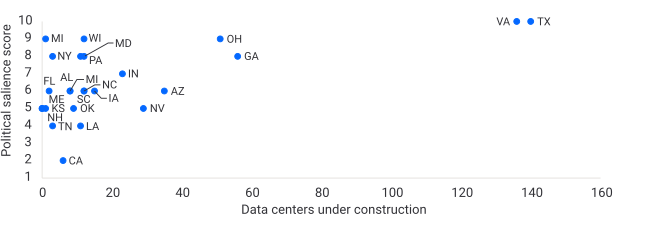
Footnote: Political salience is a 0 (least)–10 (most) directional score developed by the New York Life Investment Management Global Market Strategy team based on its review of news coverage regarding the extent to which data centers/AI have become an explicit issue in 2026 gubernatorial, congressional and state-level races. The scores reflect subjective assessments, are not based on a standardized quantitative methodology and should not be interpreted as predictions of election outcomes, public opinion or future policy actions. The chart shows only the 25 states with clear evidence of political salience; omission of a state does not indicate a score of zero. Other methodologies or information could produce different results.
Sources: New York Life Investment Management, Global Market Strategy, Aterio, NPR, Politico, CNBC, Newsweek, The Hill, Capital & Main, Data Center Watch, September 2026.
The politics of data centers are largely local and do not break neatly along party lines. Candidates and policymakers in both parties have supported a range of mitigating policies, including data center moratoriums, permitting restrictions, and utility ratepayer protections. State and local results may now be particularly relevant for investors, as local policy can influence where and how quickly new capacity gets built.
However, this does not change our view that the AI investment cycle is a durable, multi-year driver of U.S. growth and market conditions. Demand for AI infrastructure continues to outstrip supply. Election results may indicate where local resistance could affect the pace and geography of the buildout at the margin. For investors, they may also help distinguish between opposition that remains local and resistance that is becoming part of a broader political constraint on the AI buildout ahead of the 2028 presidential election.
Midterm results may influence, but not derail, geopolitical shifts at play
Strategic competition, economic nationalism, and a greater focus on national security are increasingly shaping global trade and investment. U.S. political parties may disagree on which policy tools to use, but there is broad bipartisan support for priorities such as competing with China, securing critical supply chains and technology, and strengthening the U.S. trade position.
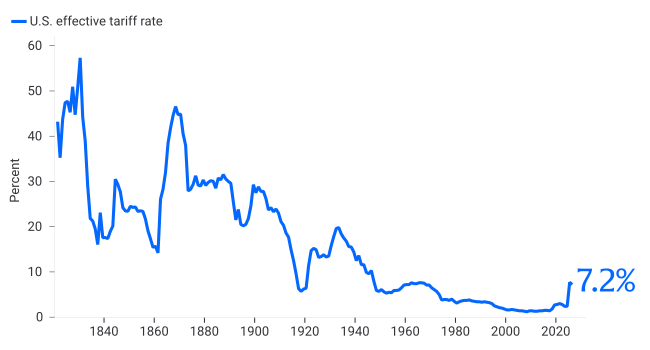
In our view, the midterms may matter more for the pace than direction of these global priorities. A divided Congress could increase oversight and seek to constrain executive authority, including on military operations. But doing so with tariffs, for example, could face a high hurdle, particularly given the broader bipartisan shift toward more assertive trade policy in recent years. Tariff rates could move higher as the administration continues to use existing trade authorities. Ultimately, the broader shift toward a more fragmented global economy is unlikely to hinge on which party controls Congress.
For investors, the continuation of this theme matters. A world shaped increasingly by geopolitics and economic security may bring greater differentiation across countries, potentially increasing the value of diversification and active management. We expect U.S. exceptionalism to remain an important driver of U.S. equity performance, supported by the AI investment cycle and the dollar's continued safe-haven role. At the same time, we see ex-U.S. equity exposure playing an increasingly important diversification role as the U.S. becomes more dominated by tech-related opportunities. Outside of equities, we expect to see a more dynamic environment in real assets, as oil, gold, and industrial commodities continue reflecting both the short- and long-term consequences of this realignment.
The effective tariff rate could move higher again
Sources: New York Life Investment Management, Global Market Strategy, Tax Foundation, The Budget Lab at Yale, Macrobond, September 2026.
What matters after November
The most important takeaway from the midterms may have little to do with who controls Congress. The election could shape the pace and implementation of policy, but the forces driving our outlook are bigger than a single election cycle. Fiscal pressures are likely to keep rates elevated, the AI investment boom remains firmly underway, and the global geopolitical shift toward great power competition continues to reshape trade, technology, and capital flows.
The election may also reveal where these forces are changing at the margin. Fiscal negotiations could create volatility in rates; local pushback could influence the pace and geography of the AI buildout; and a more fragmented global economy could increase differentiation across countries and asset classes. Despite the election outcome, the investment themes shaping 2027 and beyond are likely to endure.
1. U.S. House of Representatives and U.S. Senate, accessed September 2026.
2. Cook Political Report, 2026 CPR House Race Ratings, August 2026.
3. Cook Political Report, 2026 CPR Senate Race Ratings, August 2026
4. Brookings Institution, What history tells us about the 2026 midterm elections, August 2025.
5. U.S. Government Publishing Office, U.S. Statutes at Large, accessed September 2026.
IMPORTANT DISCLOSURES
The views expressed herein are those of New York Life Investment Management's Global Market Strategy team as of the date of this material and are subject to change without notice. The information presented represents current opinions and market observations and should not be considered predictions of future events or guarantees of future results.
This material is provided for informational purposes only and is not intended to constitute investment advice or a recommendation to buy or sell any security or to pursue any particular investment strategy. Investors should consider their individual investment objectives, risk tolerance and financial circumstances before making investment decisions. Any forward-looking statements are based on current expectations and assumptions and are subject to risks and uncertainties. Actual events and market conditions may differ materially from those anticipated. There can be no assurance that the trends, forecasts or expectations discussed herein will continue or be realized.
Diversification cannot assure a profit or protect against loss in a declining market.
Active management involves investment decisions that may prove incorrect, and there is no assurance that an actively managed strategy will outperform a relevant benchmark or achieve its investment objective. Investments are subject to market risk and may lose value.
Equity securities are subject to price fluctuation and market risk. International investments may involve additional risks, including currency fluctuations, differing regulatory standards, political and economic instability and less liquid markets. Investments in commodities and real assets may experience significant price volatility and are subject to risks specific to the relevant asset class.
Information and data contained herein have been obtained from sources believed to be reliable, but New York Life Investment Management does not guarantee their accuracy, completeness or reliability. Past performance is not indicative of future results.


By subscribing you are consenting to receive personalized online advertisements from New York Life Investments.