
Our latest monthly Macro Pulse report for September is now available.
The market backdrop remains constructive, but the path forward has narrowed. U.S. growth and corporate earnings are resilient and AI investment continues to expand. At the same time, inflation remains elevated, central bank policy has become less supportive, and long-term yields are moving higher across global markets. Strong fundamentals can continue to support markets, but higher financing costs and more volatile rates raise the bar for what performs well from here.
What’s happened & what’s next?
Over the summer, geopolitical and rates risks have remained in focus. The U.S.–Iran conflict is unresolved, keeping oil prices elevated and inflation risks live. Long end yields continue to move higher across major developed market economies. Long rates in the U.S., in particular, have been resistant even to the Treasury’s expansion of off-the-run buybacks.
This is not the first attempt by Treasury to contain long end yields. Starting in 2023, Treasury increased its T-bill issuance meaningfully. Ultimately, there is little evidence that further “twisting” of Treasury issuance toward the short end of the yield curve will contain long end yields.
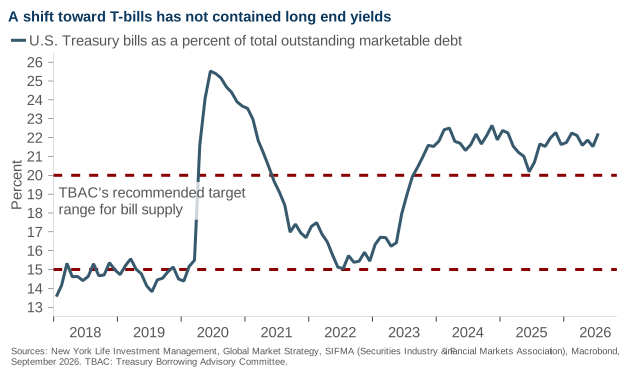
Actions by policymakers do little to address the fundamental problem: investors are requiring greater compensation for duration. We expect long-term yields to remain elevated and volatile, with inflation, elevated corporate and sovereign borrowing, and rising term premia pressuring global yields higher.
What’s our view?
1. Markets contend with a less supportive rates environment
We expect long-term yields to stay elevated and volatile as inflation risk, heavy sovereign borrowing, and higher term premia persist. Higher yields improve income opportunities for buy-and-hold investors, but argue for more selectivity around duration and rate-sensitive assets.
2. AI continues as a powerful catalyst
AI investment continues to support earnings, capex, and economic growth. But swings in leadership within the tech sector – most recently away from semiconductors – is a setup for ongoing volatility, reinforcing our preference for broader exposure across AI infrastructure and its beneficiaries.

Recent From the Desk responses
- A hawkish hold with a focus on price stability
- From blockade to breakthrough?
- May CPI: Energy prices keep pressure on inflation
Recent deep dive research
- Private Markets: Separating signal from noise in private credit
- The IPO wave that could reshape the market
- Trends in market structure: digital assets
- Geopolitics: Geopolitical risk in a shifting world order
- Geopolitics: Iran, markets, and the new age of geopolitical leverage
- Macro Pulse: Tech delivers, while diplomacy wavers
3. U.S. exceptionalism remains intact
The U.S. continues to benefit from stronger growth, stronger corporate profitability, energy independence, and greater exposure to AI than most developed-market peers. We expect those advantages to keep U.S. assets relatively well supported.
The main risk for markets
The biggest risk to our constructive view is that rates become restrictive faster than fundamentals can absorb them. Markets have so far been able to digest higher yields because earnings growth remains strong and economic activity is holding up. But that balance may become harder to sustain if financing costs move meaningfully higher. A further increase in long-term yields could pressure valuations, tighten financial conditions, and expose weaker balance sheets even without a significant deterioration in economic activity.
Portfolio strategy
We remain constructive on risk assets, but believe investors are prudent in being increasingly selective about where capital is deployed.
Within equities, we remain overweight U.S. assets with an emphasis on quality companies supported by resilient earnings and secular growth. We are neutral large-cap growth and developed ex-U.S. equities, while new capital can be used to broaden exposure toward AI infrastructure, materials, and higher-quality small caps. Financials are our top diversifying sector preference, providing both strong fundamentals and resilience to a steepening yield curve environment.
In fixed income, higher yields improve income generation opportunities, but volatility argues for discipline around duration. We see ongoing upside risks for long rates over the near term and would begin to extend portfolio duration with the U.S. 10-year yield around 4.70%. Buy-and-hold opportunities in short maturity credit look appealing, as absolute income opportunities are strong. We are looking through the recent bout of spread tightening, as this has been primarily driven by the Treasury selloff.
Finally, a more volatile inflation and rates environment increases the importance of diversification beyond traditional stock and bond exposure. Private markets and commodities can play a larger role in helping diversify against inflation and geopolitical risks, particularly when stock-bond correlations rise.
Recent From the Desk responses
- A hawkish hold with a focus on price stability
- From blockade to breakthrough?
- May CPI: Energy prices keep pressure on inflation
Recent deep dive research
- Private Markets: Separating signal from noise in private credit
- The IPO wave that could reshape the market
- Trends in market structure: digital assets
- Geopolitics: Geopolitical risk in a shifting world order
- Geopolitics: Iran, markets, and the new age of geopolitical leverage
- Macro Pulse: Tech delivers, while diplomacy wavers
This material contains general information only and does not take into account an individual’s financial circumstances. This information should not be relied upon as a primary basis for an investment decision. Rather, an assessment should be made as to whether the information is appropriate in individual circumstances and consideration should be given to talking to a financial advisor before making an investment decision.



By subscribing you are consenting to receive personalized online advertisements from New York Life Investment Management.

Finding Opportunities Amid Global Uncertainty
Understanding the Growth and Democratization of Private Equity
Chipflation: The Bottlenecks Driving a More Volatile Leg of Tech Leadership
Separating Signal from Noise in Private Credit
Tech Delivers, While Diplomacy Wavers