
- Tech earnings last week highlighted growing investor scrutiny of AI-related capex. Despite better-than-expected earnings results, concerns over the cost of AI investment weighed on equities, with the Nasdaq falling over 3% on Thursday. Broader risk aversion drove demand for safe-haven assets, pushing the 10-year Treasury below 5% for the first time since September. We share our team’s detailed views on the outlook for AI capex and financing in this week’s note.
- The Federal Reserve is widely expected to leave rates unchanged at its meeting this week, allowing policymakers more time to assess economic data. Persistent inflation pressures caused and resilient economic activity support our expectation for one additional rate hike this year, at the Fed’s December meeting.
Key Note
AI continues to be a defining theme of market performance in 2026 – sometimes for better, and sometimes for worse. From semiconductor volatility and the pipeline of AI-related IPOs to data center investment, we believe AI will remain a powerful market and economic catalyst, supporting corporate earnings, driving market performance, and bolstering economic growth in countries leading the AI buildout, particularly the United States.
But as AI spending accelerates and capital flows into the theme, the investment story is becoming more nuanced. What began largely as an equity story centered on semiconductors and hyperscalers is evolving into a broader capital formation cycle, with financing expanding into public and private credit, structured finance, and real assets, all while these growing investment commitments raise questions about whether AI adoption and monetization can generate sufficient returns to justify the capital being deployed.
In this note, we examine the expanding AI financing landscape, how AI has shaped markets and the economy in 2026, the outlook for translating investment into returns, and where we see the most compelling opportunities to gain exposure to this important theme.
The AI financing cycle continues expanding across public and private markets
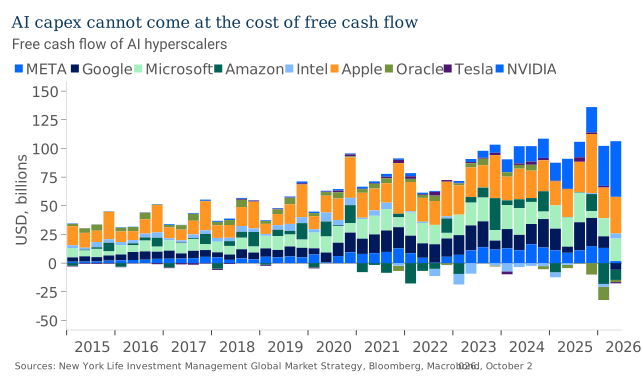
While much of the initial AI capex was funded through hyperscalers' operating cash flow, an increasing share of financing is coming from external sources of capital. Capex among the five largest hyperscalers is projected to exceed $800 billion in 2026, up from $97 billion in 2020, while the U.S. AI infrastructure buildout could require more than $10 trillion in capital through 2032.1
The AI ecosystem swim lanes by asset class

Recent From the Desk responses
- A hawkish hold with a focus on price stability
- From blockade to breakthrough?
- May CPI: Energy prices keep pressure on inflation
Recent deep dive research
- Private Markets: Separating signal from noise in private credit
- The IPO wave that could reshape the market
- Trends in market structure: digital assets
- Geopolitics: Geopolitical risk in a shifting world order
- Geopolitics: Iran, markets, and the new age of geopolitical leverage
- Macro Pulse: Tech delivers, while diplomacy wavers
This is creating opportunities across public and private markets. Investment-grade hyperscaler issuance has led the way: more than $225 billion year to date, surpassing their combined issuance over the past four years.2 But HY borrowing is also gaining momentum as neocloud providers (which supply computing capacity to hyperscalers and other AI companies) and data center developers increasingly turn to debt markets for financing
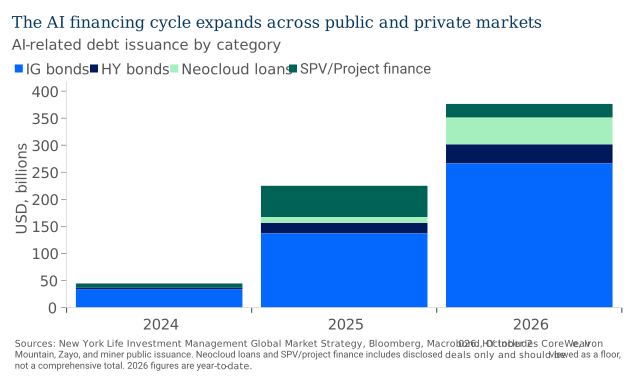
Private markets are also playing a growing role in financing the AI buildout, with estimates suggesting that private credit could fund roughly a quarter of global data center spending through 2028.3 Beyond direct lending, financing is expanding through project finance and securitization, which allows data center operators to issue bonds backed by their facilities and lease payments. Asset-based financing is also extending to chips and servers, with more than $60 billion in publicly identified GPU-backed financing commitments to date.4
The expansion of financing reflects the scale of the opportunity, but it also raises the stakes. As more capital flows into the AI ecosystem, the ability to translate AI demand into revenues becomes increasingly important.
AI’s economic promise does not guarantee investment returns
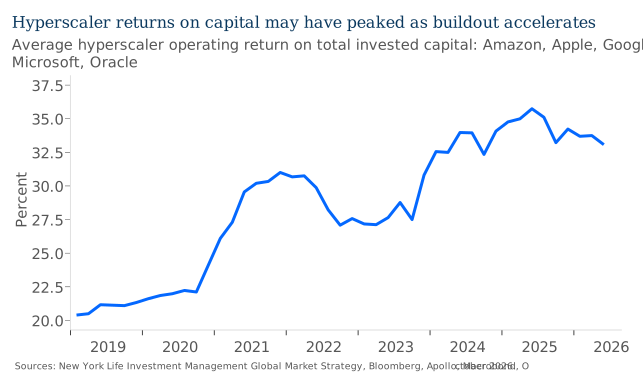
Investors are grappling with a harsh reality: AI has the potential to transform the economy and still produce disappointing returns for some investors. This distinction is becoming increasingly relevant as the companies funding much of the AI buildout face growing scrutiny over the returns on their investments. Hyperscaler equity performance has lagged in 2026 as returns on invested capital have fallen from recent highs as capex has grown faster than operating profits.
Even growing revenue commitments have yet to translate into a corresponding improvement in ROI – a phenomenon that is the result of a timing mismatch. Infrastructure investment is being made ahead of the revenue it is expected to generate, and the lag between capital deployment and monetization is likely to persist. A greater share of external financing (potentially reducing direct hyperscaler capex) relieves some pressure on hyperscaler free cash flow, but generates more sources of pressure for returns to be realized across financing streams.
However, there are encouraging signs that AI investments are beginning to translate into revenue. Cloud revenue growth and contracted backlogs are rising as customers commit to AI workloads, providing greater visibility into future demand. We continue to monitor how quickly AI-related revenue growth can translate into higher earnings, cash flow, and returns on capital – explored more in the portfolio implications section.
A nuanced public equity story: semiconductor leadership
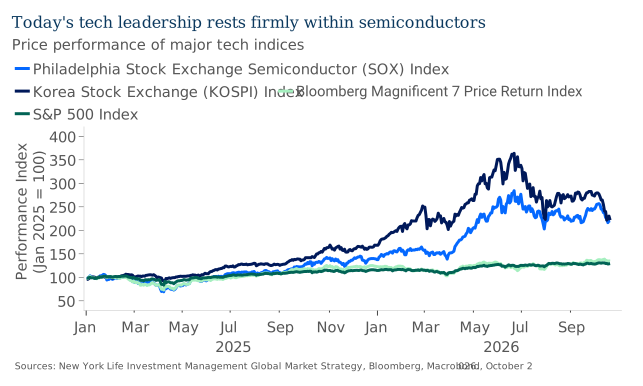
The benefits of AI investment have not translated into strong equity performance across the AI ecosystem. While semiconductor companies have benefited from demand and pricing power, performance among the hyperscalers, which are funding much of the buildout, has been more subdued.
The fundamentals behind this performance gap are astonishing. South Korean DRAM memory chip export values rising over 500% year over year, helping propel the Philadelphia Semiconductor Index and South Korea's KOSPI Index to strong but volatile year-to-date returns.
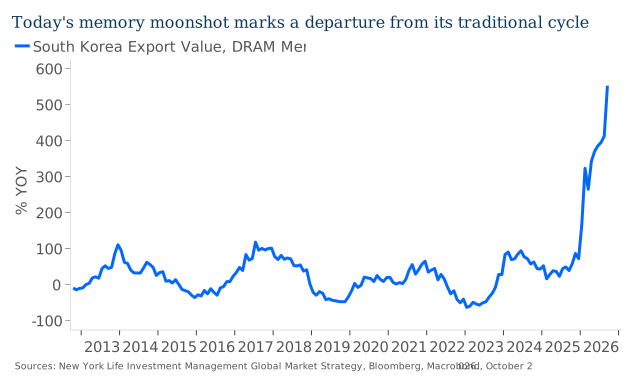
There are several drivers of this step-function in pricing. Supply shortages and growing demand for high-bandwidth memory for AI have supported exceptional pricing power, while longer-term supply agreements between memory suppliers and hyperscalers suggest a potential departure from the semiconductor industry's traditional boom-and-bust cycles. However, it remains unclear whether this represents a structural shift or a temporary supply-demand imbalance. Given the industry's historical cyclicality and higher volatility, we are cautious on memory-led market leadership. We believe some of the pressure on the semiconductor space in the trailing quarter is a healthy correction from over-levered memory positioning.
Portfolio implications: we favor financial strength and structural protection
As capital continues to flow into the AI ecosystem, selectivity is becoming increasingly important. The widening gap between AI-related spending and realized returns reinforces our preference for investments with stronger financial profiles and greater downside protection.
Recent spread widening among more highly leveraged AI borrowers, such as CoreWeave, suggests that the market is becoming more discerning about risks. We see the strongest opportunities in senior secured lending, where investors can benefit from structural protections and collateral backing. We also see opportunities in ABS, where structures can offer exposure to the AI theme while providing collateral protection and contractual cash flows.
We are more cautious down the capital stack. Subordinated and mezzanine debt may offer tactical opportunities where additional yield adequately compensates for risk. Similarly, select private equity opportunities may be attractive where there is strong conviction in a company's competitive position and long-term earnings potential, but we continue to believe it remains too early to identify the ultimate winners among AI models and applications.
Within public equities, we continue to favor large caps given established businesses and diversified sources of cash flow beyond AI. Their ability to fund significant capital expenditures through existing operations provides an advantage over more highly leveraged AI-focused companies. However, capital spending must be sufficient to support AI growth without putting excessive pressure on free cash flow. As the AI investment cycle matures, we expect investors to place greater emphasis on the ability to translate spending into sustainable earnings and returns, favoring companies with the financial flexibility to support investment through the cycle.
1. Stijn Van Nieuwerburgh, “Financing the AI Buildout,” Brookings Papers on Economic Activity, Fall 2026 conference draft (Brookings Institution, September 23, 2026), https://www.brookings.edu/articles/financing-the-ai-buildout/.
2. Includes issuance totals for Amazon, Alphabet, Meta, Apple, Microsoft and Oracle.
3. Morgan Stanley Research, Bridging a $1.5tr Data Center Financing Gap, July 16, 2025, 4–7, https://www.morganstanley.com/content/dam/msdotcom/en/assets/pdfs/Research_Bridging-Data-Center-Gap.pdf.
4. CCIR, “Compute Credit Tracker,” updated October 2026, accessed October 21, 2026, https://ccir.io/credit.
This material contains general information only and does not take into account an individual’s financial circumstances. This information should not be relied upon as a primary basis for an investment decision. Rather, an assessment should be made as to whether the information is appropriate in individual circumstances and consideration should be given to talking to a financial advisor before making an investment decision.



By subscribing you are consenting to receive personalized online advertisements from New York Life Investment Management.

Three Paths for Iran, High Stakes for Markets
A New Era in Global Liquidity
Resilience Meets Tighter Policy
Key Takeaways from the 2026 NYLIM Global Investor Summit
Midterms 2026: The Stakes Beyond the Ballot Box
Private Markets Outlook: Resilience in an Evolving Landscape