
- October’s strong jobs print of 165k payrolls, relative to 70k expected, was also accompanied by strong upward revisions to the prior two months of job creation figures. However, the upside surprise has not driven greater expectations for Fed hikes. We believe one further hike is likely for December, but a persistent equity market selloff as markets digest the midterm elections could be a risk to this view.
- Markets continue to digest the policy implications of the Democratic midterm election sweep in the U.S. Our rapid response on November 4 covered the complete range of policy that we expect to stem from the election; in today’s note, we focus on the AI selloff stemming from concerns around data center regulation.
Key Note
Updated results roundup
As of 9am Eastern, Friday, November 6, per the Associated Press, Democrats gained at least:
- Seven seats in the Senate, for a minimum of 54 out of 100 total seats (including two independents, who caucus with the Democrats);
- 41 seats in the House, with a minimum of 253 seats out of 435; and
- Five governorships.
Senate races in both Mississippi and Alaska remain too close to call and may not be settled for several weeks, but are currently leaning toward the Democratic candidates.
A swift focus on data centers raises critical policy and investment questions
As expected, voters clearly rebuked unchecked data center expansion at the local and state levels. What was less expected is how quickly pushback on data centers has become a central policy agenda for Democratic leadership.
Now, investors are left to digest the following questions:
- Will data center moratoria actually go into effect? The new governors of Ohio, Texas, and Georgia have already called for moratoria on data center building. Will these calls expand to other states or even be pulled up to the federal level?
- Will the immediate expensing of capex under the One Big Beautiful Bill Act be repealed? How dependent has strong capex been on this tax benefit?
- If tax benefits to AI capex remain, will they be conditional? For example, there are differing proposals at the federal level for data center builders to keep existing tax incentives if they meet certain environmental standards.
- Will data center builders now be subject to upgrading utility and grid capacity in the areas they build? Will they be subject to providing additional community benefits such as the establishment of community investment funds?
Though the shape and level (federal v. state v. local) of data center regulation is still uncertain, we can expect data center building costs and regulatory hurdles to rise as a result of this election.
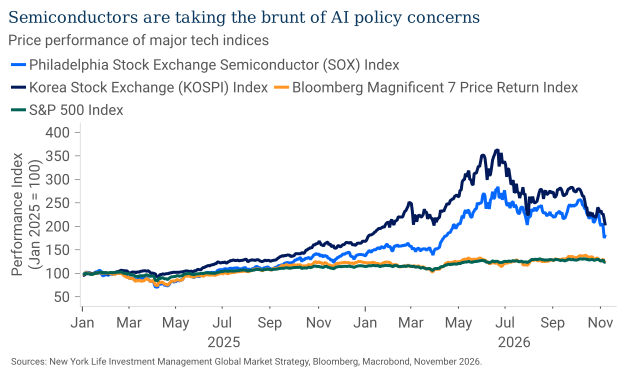
Investors are increasingly pricing in higher costs and regulatory hurdles to the AI buildout, contributing to the sharp selloff concentrated in semiconductors. A number of questions remain:
- Higher data center development costs raise further questions about the timing and magnitude of returns.
- Regulatory pushback throws the pace of the broader AI buildout into question.
- Semiconductor prices had benefitted from long-term contracts; those contracts may no longer be viable if the data center buildout slows meaningfully.
- AI investment contributed roughly 0.5 percentage points to GDP in 1H 2026. A slower pace of AI investment may pressure U.S. economic growth more broadly.
Recent From the Desk responses
- A hawkish hold with a focus on price stability
- From blockade to breakthrough?
- May CPI: Energy prices keep pressure on inflation
Recent deep dive research
- Private Markets: Separating signal from noise in private credit
- The IPO wave that could reshape the market
- Trends in market structure: digital assets
- Geopolitics: Geopolitical risk in a shifting world order
- Geopolitics: Iran, markets, and the new age of geopolitical leverage
- Macro Pulse: Tech delivers, while diplomacy wavers
We remain constructive on the AI trade, now with increased nuance
We believe political pushback on data centers may decelerate the AI investment theme, but is unlikely to derail it. We emphasize that the shape of AI regulation is still unknown, and AI capex plans may shift (namely, toward AI-friendly states), but we do not yet have conviction that overall AI capex levels will decline precipitously. We also recall that excessive capex plans have already harmed the AI investment thesis in 2026; these plans coming into better balance may be constructive for the health of the AI buildout, even if they create meaningful market bumps along the way.
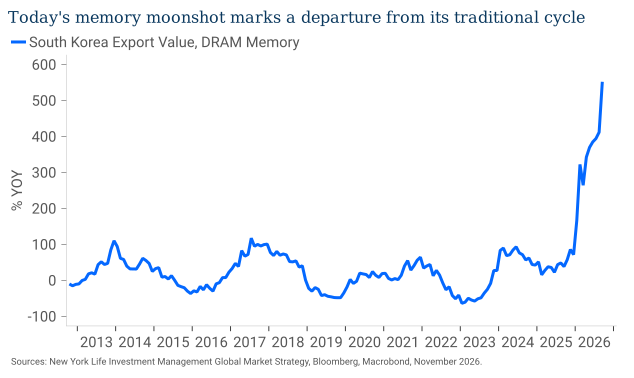
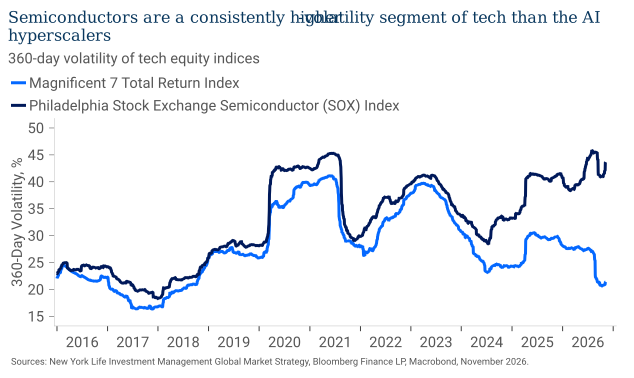
Semiconductors have born the brunt of the selloff, down -12% between market close on November 3rd and 11am Friday, November 6. Throughout 2026, we have warned that semiconductor equity leadership carried significant risks. First, the pricing of semiconductors themselves has completely disconnected from past cycles. Second, semiconductor equities are a higher-volatility play on the AI trade. We shared our view that although this leadership was based on strong pricing power and earnings, it would likely prove tactical.
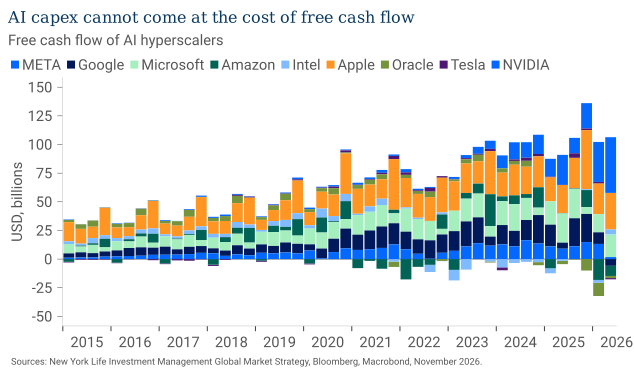
In lieu of semiconductors, we have long been partial to high-quality hyperscalers. We doubled down on this view a few weeks ago, now with that quality lens tilted firmly toward positive free cash flow. Our preference for hyperscalers with positive free cash flow, strong cloud revenues, and diversified financing does narrow our conviction on the AI equity play, but we expect the hyperscalers consistently generating negative free cash flow may face valuation discounts.
Outside of equities: we remain bullish on AI infrastructure, as a slower buildout could rebalance supply and demand and ease semiconductor pricing dislocation without undermining the broader AI trade. However, as capital continues to flow into the AI buildout, selectivity has become increasingly important. We see some of the strongest opportunities in senior secured lending, where investors can benefit from structural protections. We also see opportunities in ABS, where structures can offer exposure to the AI theme while providing collateral protection. For a broader perspective on the infrastructure opportunities extending beyond data centers, including power generation, transmission, and connectivity, see our H2 2026 Private Markets Outlook.
This material contains general information only and does not take into account an individual’s financial circumstances. This information should not be relied upon as a primary basis for an investment decision. Rather, an assessment should be made as to whether the information is appropriate in individual circumstances and consideration should be given to talking to a financial advisor before making an investment decision.



By subscribing you are consenting to receive personalized online advertisements from New York Life Investment Management.

Halloween Special: The AI Boom Gets Spooky
Follow the Capital: A Dive into AI Buildout Financing
Three Paths for Iran, High Stakes for Markets
A New Era in Global Liquidity
Resilience Meets Tighter Policy
Key Takeaways from the 2026 NYLIM Global Investor Summit