
Executive Summary
Quasi-sovereigns occupy a distinctive and important position within emerging market credit. Today there are around 140 emerging market quasi sovereigns1. Neither fully sovereign nor fully corporate, they own many of the assets that underpin economic activity, including energy infrastructure, transportation networks, utilities and strategic resource franchises.
Traditionally, investors assessed these issuers primarily through the lens of government ownership and implied state support. Today, we believe that framework is no longer sufficient. As governments increasingly rely on national champions to drive diversification, industrial development and energy security, quasi-sovereigns have become key instruments of national strategy rather than simply state-owned enterprises.
For investors, the critical distinction is not ownership, but the relationship between strategic importance and standalone credit quality. Strategic relevance may strengthen the likelihood of support, but it does not necessarily create financial strength or creditor protection. In our view the strongest quasi-sovereign issuers combine high-quality assets, resilient business models and credible sovereign backing. The weakest rely largely on support expectations. Understanding where an issuer sits along this spectrum is increasingly one of the most important drivers of risk and return in emerging market credit.
The corporate face of national ambition
The traditional rationale for state ownership was straightforward. Governments retained control of assets deemed critical to economic development, energy security or public welfare.
Today, however, many quasi-sovereigns serve a broader purpose.
Across the Gulf, companies such as DP World, Abu Dhabi Ports and Saudi Energy have evolved beyond their original mandates to become instruments of national transformation. They sit at the centre of economic diversification programmes designed to broaden growth beyond hydrocarbons. In Saudi Arabia, non-oil activities now account for roughly 55% of GDP2, underscoring the scale of the transformation underway.
Similar dynamics can be observed elsewhere. Across Asia, quasi-sovereigns are often tasked with facilitating industrialisation, urbanisation and energy security. In Latin America, they remain central to resource development and fiscal generation. In Africa, many continue to provide essential services that are critical to economic functioning.
In many emerging markets, some of the most consequential capital allocation decisions are no longer being made inside government ministries. They are being made within quasi-sovereigns.
For investors, these institutions offer a unique proposition: exposure to strategically important assets with the potential for sovereign support, often accompanied by a meaningful spread premium over sovereign debt.
Strategic importance is not the same as credit quality
One of the most persistent misconceptions in emerging market credit is the assumption that strategically important companies should exhibit similar risk profiles.
The oil sector offers perhaps the clearest illustration. Petrobras (Brazil) and Pemex (Mexico) are the two largest state-controlled energy and petroleum companies in Latin America. Both occupy pivotal roles within their domestic economies, support energy security, contribute materially to government revenues, and are widely regarded as national champions.
From a credit perspective, however, they are fundamentally different.
Figure 1: Petrobras spread trades almost flat to Brazil sovereign due to its strong quality
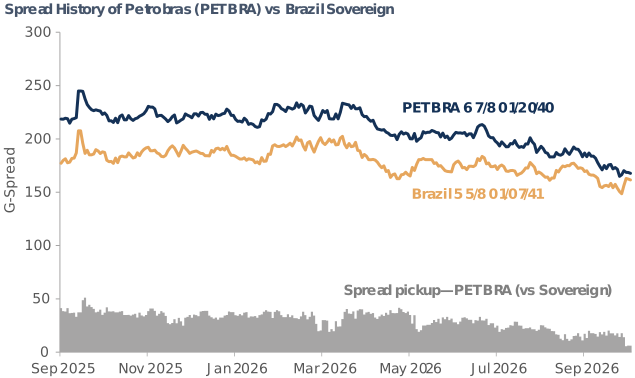
Data as of September 30, 2026.
Source: Bloomberg
Petrobras increasingly resembles a globally competitive energy company that happens to be state-controlled. Supported by world-class pre-salt assets, strong operating economics and substantial hard-currency revenues, it possesses a compelling standalone investment case. Production from its pre-salt portfolio reached approximately 2.6 million3 barrels of oil equivalent per day in 2025, highlighting the quality of its franchise.
Pemex, by contrast, remains heavily dependent on sovereign support. Despite its strategic importance to Mexico, years of underinvestment, policy burdens, leverage accumulation and balance-sheet pressure have left investors evaluating the sovereign's commitment to support the company as closely as, if not more than, they evaluate the company itself.
The distinction is important. Strategic relevance may reduce the probability of default. It does not necessarily create financial strength. The strongest quasi-sovereigns are those where strategic importance and corporate quality reinforce one another.
Figure 2: Pemex spread offers meaningful pickup vs Mexico sovereign given its weak standalone quality
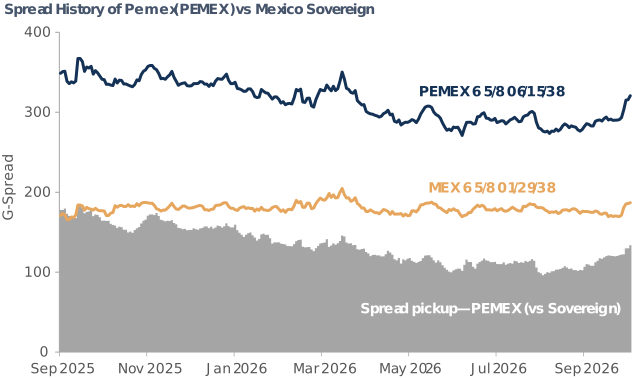
Data as of September 30, 2026.
Source: Bloomberg
The three dimensions of sovereign support
Investors often analyse sovereign support through two dimensions: willingness and ability. The reality is more nuanced.
The experience of Eskom demonstrates why. South Africa's commitment to supporting its national electricity provider has rarely been questioned. The more relevant issue has been the state's financial capacity to do so without impairing its own balance sheet.
The opposite lesson emerged from China's property downturn. According to the IMF, historically, real-estate-related activity accounted for roughly one quarter of China's economy when related sectors are included, making it one of the country's most systemically important industries.4 Yet policymakers allowed several major developers to restructure while directing support towards housing completion, social stability and the financial system. The implication was profound. China did not lack the resources to intervene. Rather, it demonstrated that governments may support a system without supporting every participant within that system.
Viewed through this lens, Eskom and Chinese real estate represent opposite sides of the same sovereign-support equation. In Eskom’s case, willingness exceeded fiscal flexibility. In Chinese real estate’s case, fiscal flexibility exceeded willingness to protect creditors.
For investors, this introduces a third dimension to support analysis: Who is the sovereign actually trying to protect?
Bondholders, consumers, financial institutions, taxpayers and social stability do not always have aligned interests. Understanding that distinction has become increasingly important in emerging market credit.
Figure 3: Pemex currently offers c.150bps spread pickup over Petrobars, both rated at BB
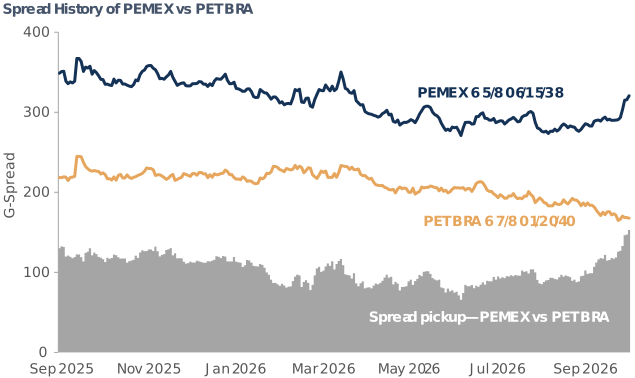
Data as of September 30, 2026.
Source: Bloomberg
When the child becomes stronger than the parent
Perhaps the most fascinating phenomenon within the quasi-sovereign universe occurs when investors conclude that a company is a better credit than the sovereign itself.
Conventional theory suggests this should be highly unlikely. Sovereigns possess taxation authority, policy flexibility and ultimate control over the legal framework. However, markets sometimes take a different view.
YPF, a majority state-owned Argentine energy company, illustrates the point. While closely linked to the Argentine state, investors increasingly view the company through the lens of Vaca Muerta, one of the world's most significant unconventional hydrocarbon resources. According to the U.S. Energy Information Administration, Vaca Muerta contains approximately 308 trillion cubic feet of technically recoverable shale gas and 16 billion barrels of technically recoverable shale oil.5
Increasingly, investors are underwriting the quality of the resource rather than solely the fundamentals of the Argentina sovereign. At various points, this has allowed YPF bonds to trade through Argentina's sovereign curve.
A similar dynamic has emerged in Autopistas de Panamá (AUTOPA, Panama Canal Authority). Supported by concession-based toll-road assets and highly visible cash flows, AUTOPA's valuation often reflects the economics of the underlying infrastructure rather than broader Panama sovereign considerations. As a result, AUTOPA bonds typically trade tighter than Panama sovereign.
These examples reveal an important truth about modern EM credit investing: Sovereign support may provide the floor, but asset quality ultimately determines where valuation settles. The best quasi-sovereigns are not simply beneficiaries of sovereign support. They are owners of assets that investors would be comfortable financing under almost any ownership structure.
Figure 4: YPF spread trades tighter than Argentina Sovereign, leading to negative spread pickup
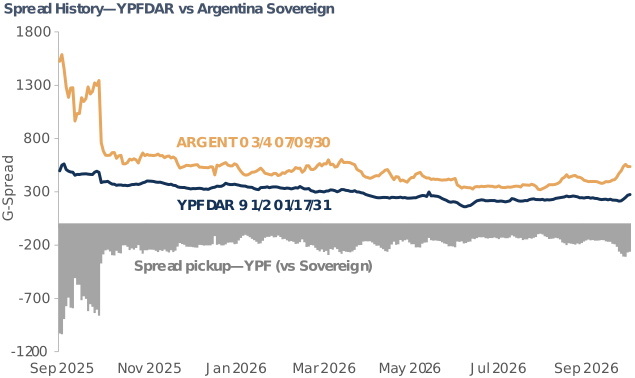
Data as of September 30, 2026.
Source: Bloomberg
Figure 5: AUTOPA spread trades tighter than Panama Sovereign, leading to negative spread pickup
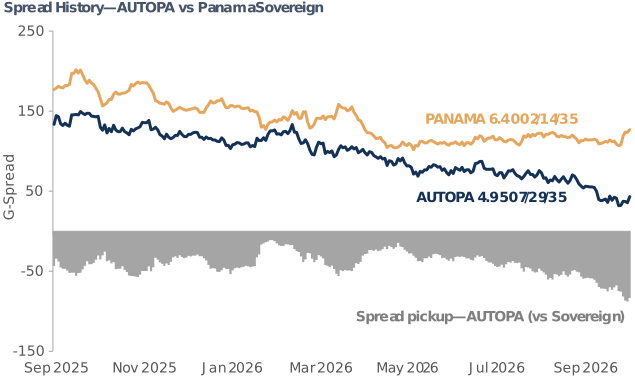
Data as of September 30, 2026.
Source: Bloomberg
What matters most for investors
We believe successful quasi-sovereign investing requires balancing three distinct considerations.
The first is strategic importance. The more critical the asset is to economic activity, fiscal revenues or political stability, the stronger the sovereign linkage is likely to be.
The second is standalone business quality. Asset quality, competitive positioning, cash-flow generation and balance-sheet strength ultimately determine long-term credit resilience.
The third is sovereign behaviour. Investors must assess not only whether support can be provided, but also whether policymakers are likely to prioritise creditors when stress emerges.
Equally important, many of the largest risks do not arise through outright default. They emerge through political decisions, such as subsidised pricing, non-economic investments, employment mandates, strategic acquisitions or aggressive dividend extraction. Such actions rarely trigger immediate credit events but can gradually weaken credit quality over time.
Conclusion
Quasi-sovereigns are among the most important, and often most misunderstood, segments of the emerging market debt universe.
The experience of Petrobras, Pemex, YPF, AUTOPA, Eskom and China's property sector demonstrates that government ownership alone is an incomplete credit framework. Asset quality, policy objectives and sovereign behaviour matter just as much.
The most resilient quasi-sovereigns are not simply those that are too important to fail. They are those where strategic relevance, commercial strength and sovereign support reinforce one another. In such cases, government backing serves as an additional layer of protection rather than the foundation of the investment case.
For investors, the central challenge is therefore not determining whether support exists, but understanding the interaction between asset quality, sovereign incentives and policy priorities. As emerging economies continue to pursue diversification, industrialisation and energy-transition objectives, this distinction is likely to become even more important.
Ultimately, quasi-sovereigns offer a window into how countries allocate capital, pursue growth and shape their economic futures. For that reason, they remain one of the most compelling areas within emerging market fixed income.
1. Source: https://news.bloomberglaw.com/international-trade/brazil-govt-publishes-decree-with-gasoline-subsidy
2. Source: https://valorinternational.globo.com/politics/news/2026/08/13/chamber-and-senate-approve-fuel-tax-bill.ghtml
IMPORTANT DISCLOSURE
Availability of products and services provided by MacKay Shields may be limited by applicable laws and regulations in certain jurisdictions and this document is provided only for persons to whom this document and the products and services of MacKay Shields may otherwise lawfully be issued or made available. None of the products and services provided by MacKay Shields are offered to any person in any jurisdiction where such offering would be contrary to local law or regulation. This document is provided for information purposes only. It does not constitute investment advice and should not be construed as an offer to buy securities. The contents of this document have not been reviewed by any regulatory authority in any jurisdiction. All investments contain risks and may lose value and these materials do not undertake to explain all of the risks associated with any investment strategy referred to herein. Clients and investors should not invest in any strategy referred to herein unless satisfied that they and/or their representatives have requested and received all information that would enable them to evaluate the merits and risks thereof. Any forward-looking statements speak only as of the date they are made, and MacKay Shields assumes no duty and does not undertake to update forward looking statements. Any opinions expressed are the views and opinions of certain investment professionals at MacKay Shields which are subject to change without notice. There may have been, and may in the future be, changes to the investment personnel responsible for the management of the strategy(ies) described herein, as well as changes to the investment process utilized by such investment personnel. Past performance is not indicative of future results.
Information included herein should not be considered predicative of future transactions or commitments made by MacKay Shields LLC nor as an indication of current or future profitability. There is no assurance investment objectives will be met.
Past performance is not indicative of future results.
NOTE TO UK AND EUROPEAN UNION AUDIENCE
This document is intended only for the use of professional investors as defined in the Alternative Investment Fund Manager’s Directive and/or the UK Financial Conduct Authority’s Conduct of Business Sourcebook. To the extent this document has been issued in the United Kingdom, it has been issued by NYL Investments UK LLP, 200 Aldersgate Street, London UK EC1A 4HD, which is authorised and regulated by the UK Financial Conduct Authority. To the extent this document has been issued in the EEA, it has been issued by NYL Investments Europe Limited, 77 Sir John Rogerson's Quay, Block C Dublin D02 VK60 Ireland. NYL Investments Europe Limited is authorized and regulated by the Central Bank of Ireland (i) to act as an alternative investment fund manager of alternative investment funds under the Alternative Investment Fund Managers Directive (Directive 2011/61/EU) and (ii) to provide the services of individual portfolio management, investment advice and the receipt and transmission of orders as defined in Regulation 7(4) of the AIFMD Regulations to persons who meet the definition of “professional client” as set out in the MiFID Regulations. It has passported its license in additional countries in the EEA.
This document only describes capabilities of certain affiliates of New York Life Investment Management and/or MacKay Shields LLC. No such affiliates will accept subscriptions in any funds not admitted to marketing in your country or provide services to potential customers in your country, including discretionary asset management services, except where it is licensed to do so or can rely on an applicable exemption.
MacKay Shields LLC is a wholly owned subsidiary of New York Life Investment Management Holdings LLC, which is wholly owned by New York Life Insurance Company. "New York Life Investment Management" is both a service mark, and the common trade name of certain investment advisers affiliated with New York Life Insurance Company. Investments are not guaranteed by New York Life Insurance Company or New York Life Investment Management.
NOTE TO CANADIAN RECIPIENTS
The information in these materials is not an offer to sell securities or a solicitation of an offer to buy securities in any jurisdiction of Canada. In Canada, any offer or sale of securities or the provision of any advisory or investment fund manager services will be made only in accordance with applicable Canadian securities laws. More specifically, any offer or sale of securities will be made in accordance with applicable exemptions to dealer and investment fund manager registration requirements, as well as under an exemption from the requirement to file a prospectus, and any advice given on securities will be made in reliance on applicable exemptions to adviser registration requirements.
Information included herein should not be considered predicative of future transactions or commitments made by MacKay Shields LLC nor as an indication of current or future profitability. There is no assurance investment objectives will be met. Past performance is not indicative of future results.
NOTE TO JAPANESE RECIPIENTS
In Japan, this is issued by New York Life Investment Management Asia Limited (Financial Instruments Business Operator, Kanto Local Finance Bureau (FIBO) No. 2964, Member of the Investment Management Association of Japan and the Type 2 Financial Instruments Firms Association) for institutional investors only. As costs and/or fees to be borne by investors vary depending on circumstances such as products, services, investment period and market conditions, the total amount nor the calculation methods cannot be disclosed in advance. All investments involve risks, including market fluctuation and investors may lose the principal amount invested. Investors should obtain and read the prospectus and/or information set forth in Article 37-3 of the Financial Instruments and Exchange Act carefully before making investment decisions. MacKay Shields LLC is a wholly owned subsidiary of New York Life Investment Management Holdings LLC, which is wholly owned by New York Life Insurance Company. "New York Life Investments" is both a service mark, and the common trade name of certain investment advisers affiliated with New York Life Insurance Company. Investments are not guaranteed by New York Life Insurance Company or New York Life Investments.
SOURCE INFORMATION
“Bloomberg®”, “Bloomberg Indices®”, Bloomberg Fixed Income Indices, Bloomberg Equity Indices and all other Bloomberg indices referenced herein are service marks of Bloomberg Finance L.P. and its affiliates, including Bloomberg Index Services Limited (“BISL”), the administrator of the indices (collectively, “Bloomberg”) and have been licensed for use for certain purposes by MacKay Shields LLC (“MacKay Shields”). Bloomberg is not affiliated with MacKay Shields, and Bloomberg does not approve, endorse, review, or recommend MacKay Shields or any products, funds or services described herein. Bloomberg does not guarantee the timeliness, accurateness, or completeness of any data or information relating to MacKay Shields or any products, funds or services described herein.
Subscribe to get MacKay Shields insights delivered to your inbox.
Related Thought Leadership