
Global growth has remained remarkably resilient despite elevated geopolitical uncertainty, higher energy costs, and tighter financial conditions. Yet beneath the surface, the environment looks less benign than it did six months ago. Global bond yields continue to move higher, inflation risks are being rebuilt, and central banks are becoming increasingly cautious about potential increases in price pressures.
The most important shift has been in rates markets. Earlier in the summer, rising US yields were largely a term-premium story. More recently, markets have been forced to reprice the path of policy itself. Investors are confronting a world where inflation proves more persistent, energy-related supply shocks remain unresolved, and central banks may need to keep policy restrictive for longer.
At the same time, the lesson from the summer is that markets have become remarkably resilient. Credit spreads have absorbed multiple shocks without experiencing sustained decompression. Even with spreads near historical tights, all-in yields remain significantly more attractive than those available during the pre-covid decade. Investors continue to step in on weakness, and that demand has prevented risk-off episodes from turning into broader dislocations.
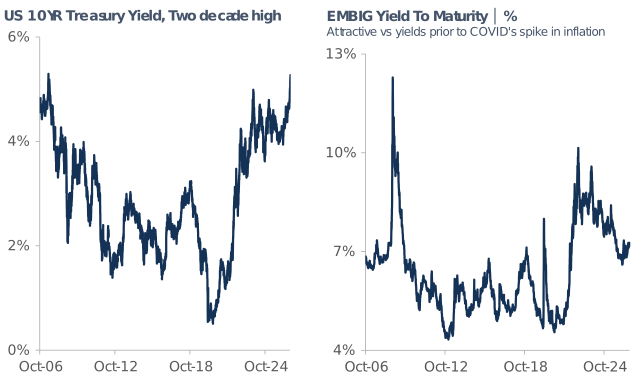
Data as of June 26, 2026
Source: Bloomberg
Global growth is stronger than feared
Global growth has remained surprisingly resilient despite geopolitical tensions, higher energy prices and tighter financial conditions. However, the benefits have been unevenly distributed.
Asia continues to be the main beneficiary of the AI investment cycle, with Taiwan, South Korea and Singapore leveraging their positions in semiconductor and technology supply chains. Malaysia and Vietnam have also gained from manufacturing and data-center investment, helping offset higher energy costs.
By contrast, much of Latin America, Emerging Europe and frontier markets remain more exposed to food and energy inflation than to AI-driven growth. El Niño risks add to these vulnerabilities, particularly in economies where food has a large weight in consumer baskets.
Inflation dynamics are also becoming more fragmented. Parts of South Asia and Latin America continue to face pressure from higher food and energy prices, while Europe and Central and Eastern Europe (“CEE”) are contending with resilient growth, persistent core inflation and rising energy costs. As a result, the path back to inflation targets is becoming more challenging, reinforcing the likelihood that policy rates will remain restrictive for longer across much of the EM universe.
Central banks are turning more cautious
The most notable policy shift of recent months has been the increasingly hawkish tone across parts of the emerging-market universe. Inflation concerns, stronger growth than expected, and a more restrictive global backdrop have forced policymakers to reassess earlier assumptions about easing cycles. Markets now find themselves in an environment where fewer cuts are likely to be made and where some countries still face meaningful tightening risks. This does not necessarily imply a broad hiking cycle. Rather, it suggests that monetary policy is becoming increasingly country specific.
Countries with stronger policy credibility, lower inflation persistence, and healthier external positions should retain flexibility. Others may be forced to maintain tighter settings for longer, particularly if the Federal Reserve remains cautious or if the US dollar strengthens further.
The inflation story is becoming more complicated. While lower energy prices relative to peak levels have provided some relief, pressures are beginning to build elsewhere. Food inflation risks remain elevated, particularly given the possibility of weather-related disruptions associated with El Niño. Higher transportation costs, fertilizer prices, and energy inputs continue to influence supply chains. In addition, stronger global investment demand linked to AI infrastructure is beginning to place upward pressure on industrial inputs and power markets.
This creates a difficult environment for policymakers. Many central banks entered the second half of the year expecting inflation to continue declining steadily. Instead, they are increasingly confronted with upside risks. Some may need to delay easing cycles, while others could ultimately face renewed tightening pressure if inflation expectations begin to move higher. The challenge is greatest for net energy importers.
Outlook
The broad spread-compression phase is becoming harder to sustain. Although spreads have recently widened, particularly in high-yield credits such as Argentina, Ecuador and Ukraine, they remain tight by historical standards across much of the EM sovereign universe. Carry should continue to provide support, but elevated global rates and demanding valuations leave limited room for policy errors or external shocks. Ecuador and Argentina remain attractive where commitment to IMF-backed adjustment and constructive external engagement can reinforce policy credibility, while commodity exposure offers some protection against inflation shocks. Angola and Nigeria also benefit from stronger terms of trade, with Nigeria’s improving policy direction creating scope for further credit reappraisal.
Selective opportunities remain among more idiosyncratic credits. Hungary offers score for further spread compression on the back of political change that the longer-term prospect of euro adoption. Suriname’s restructuring progress and reform implementation underpin its recovery story, while improving macroeconomic stability in Côte d’Ivoire should sustain positive rating momentum. Romania continues to face fiscal, inflation and downgrade risks, but current valuations already incorporate substantial pessimism and could recover if policy adjustment proves sufficient. By contrast, frontier sovereigns with large external financing needs, weak fiscal positions or uncertain multilateral support remain particularly vulnerable to prolonged high global rates. With broad valuations still compressed, the most compelling opportunities are those where improving reform credibility and external buffers are not yet fully reflected in spreads.
IMPORTANT DISCLOSURE
Availability of products and services provided by MacKay Shields may be limited by applicable laws and regulations in certain jurisdictions and this document is provided only for persons to whom this document and the products and services of MacKay Shields may otherwise lawfully be issued or made available. None of the products and services provided by MacKay Shields are offered to any person in any jurisdiction where such offering would be contrary to local law or regulation. This document is provided for information purposes only. It does not constitute investment advice and should not be construed as an offer to buy securities. The contents of this document have not been reviewed by any regulatory authority in any jurisdiction. All investments contain risks and may lose value and these materials do not undertake to explain all of the risks associated with any investment strategy referred to herein. Clients and investors should not invest in any strategy referred to herein unless satisfied that they and/or their representatives have requested and received all information that would enable them to evaluate the merits and risks thereof. Any forward-looking statements speak only as of the date they are made, and MacKay Shields assumes no duty and does not undertake to update forward looking statements. Any opinions expressed are the views and opinions of certain investment professionals at MacKay Shields which are subject to change without notice. There may have been, and may in the future be, changes to the investment personnel responsible for the management of the strategy(ies) described herein, as well as changes to the investment process utilized by such investment personnel. Past performance is not indicative of future results.
Information included herein should not be considered predicative of future transactions or commitments made by MacKay Shields LLC nor as an indication of current or future profitability. There is no assurance investment objectives will be met.
Past performance is not indicative of future results.
NOTE TO UK AND EUROPEAN UNION AUDIENCE
This document is intended only for the use of professional investors as defined in the Alternative Investment Fund Manager’s Directive and/or the UK Financial Conduct Authority’s Conduct of Business Sourcebook. To the extent this document has been issued in the United Kingdom, it has been issued by NYL Investments UK LLP, 200 Aldersgate Street, London UK EC1A 4HD, which is authorised and regulated by the UK Financial Conduct Authority. To the extent this document has been issued in the EEA, it has been issued by NYL Investments Europe Limited, 77 Sir John Rogerson's Quay, Block C Dublin D02 VK60 Ireland. NYL Investments Europe Limited is authorized and regulated by the Central Bank of Ireland (i) to act as an alternative investment fund manager of alternative investment funds under the Alternative Investment Fund Managers Directive (Directive 2011/61/EU) and (ii) to provide the services of individual portfolio management, investment advice and the receipt and transmission of orders as defined in Regulation 7(4) of the AIFMD Regulations to persons who meet the definition of “professional client” as set out in the MiFID Regulations. It has passported its license in additional countries in the EEA.
This document only describes capabilities of certain affiliates of New York Life Investment Management and/or MacKay Shields LLC. No such affiliates will accept subscriptions in any funds not admitted to marketing in your country or provide services to potential customers in your country, including discretionary asset management services, except where it is licensed to do so or can rely on an applicable exemption.
MacKay Shields LLC is a wholly owned subsidiary of New York Life Investment Management Holdings LLC, which is wholly owned by New York Life Insurance Company. "New York Life Investment Managements" is both a service mark, and the common trade name of certain investment advisers affiliated with New York Life Insurance Company. Investments are not guaranteed by New York Life Insurance Company or New York Life Investment Managements.
NOTE TO CANADIAN RECIPIENTS
The information in these materials is not an offer to sell securities or a solicitation of an offer to buy securities in any jurisdiction of Canada. In Canada, any offer or sale of securities or the provision of any advisory or investment fund manager services will be made only in accordance with applicable Canadian securities laws. More specifically, any offer or sale of securities will be made in accordance with applicable exemptions to dealer and investment fund manager registration requirements, as well as under an exemption from the requirement to file a prospectus, and any advice given on securities will be made in reliance on applicable exemptions to adviser registration requirements.
Information included herein should not be considered predicative of future transactions or commitments made by MacKay Shields LLC nor as an indication of current or future profitability. There is no assurance investment objectives will be met. Past performance is not indicative of future results.
NOTE TO JAPANESE RECIPIENTS
In Japan, this is issued by New York Life Investment Management Asia Limited (Financial Instruments Business Operator, Kanto Local Finance Bureau (FIBO) No. 2964, Member of the Investment Management Association of Japan and the Type 2 Financial Instruments Firms Association) for institutional investors only. As costs and/or fees to be borne by investors vary depending on circumstances such as products, services, investment period and market conditions, the total amount nor the calculation methods cannot be disclosed in advance. All investments involve risks, including market fluctuation and investors may lose the principal amount invested. Investors should obtain and read the prospectus and/or information set forth in Article 37-3 of the Financial Instruments and Exchange Act carefully before making investment decisions.
SOURCE INFORMATION
“Bloomberg®”, “Bloomberg Indices®”, Bloomberg Fixed Income Indices, Bloomberg Equity Indices and all other Bloomberg indices referenced herein are service marks of Bloomberg Finance L.P. and its affiliates, including Bloomberg Index Services Limited (“BISL”), the administrator of the indices (collectively, “Bloomberg”) and have been licensed for use for certain purposes by MacKay Shields LLC (“MacKay Shields”). Bloomberg is not affiliated with MacKay Shields, and Bloomberg does not approve, endorse, review, or recommend MacKay Shields or any products, funds or services described herein. Bloomberg does not guarantee the timeliness, accurateness, or completeness of any data or information relating to MacKay Shields or any products, funds or services described herein.
All ICE Data indices referenced herein (each such index, the “Index”), are products of ICE data indices, LLC (“ICE Data”), and are used with permission. ICE® is a registered trademark of ICE Data or its affiliates, and BofA® is a registered trademark of Bank of America Corporation licensed by Bank of America Corporation and its affiliates (“BofA”) and may not be used without BofA’s prior written approval. ICE Data, its affiliates and their respective third party suppliers disclaim any and all warranties and representations, express and/or implied, including any warranties of merchantability or fitness for a particular purpose or use, including the indices, index data and any data included in, related to, or derived therefrom. Neither ICE Data, its affiliates nor their respective third party suppliers shall be subject to any damages or liability with respect to the adequacy, accuracy, timeliness or completeness of the indices or the index data or any component thereof, and the indices and index data and all components thereof are provided on an “as is” basis and your use is at your own risk. Inclusion of a security within an index is not a recommendation by ICE Data to buy, sell, or hold such security, nor is it considered to be investment advice. ICE Data, its affiliates and their respective third party suppliers do not sponsor, endorse, or recommend MacKay Shields LLC, or any of its products or services.
Subscribe to get MacKay Shields insights delivered to your inbox.
Related Thought Leadership