
The war involving Iran has unleashed a sharp supply shock that extends well beyond oil and gas. Disruptions now affect a broad range of petrochemical products, from fertilizers to helium, compounding pressure across global production chains. Prices reacted swiftly: Brent crude traded well above $1001, while freight rates surged as shipping routes adjusted to constrained passage through the Strait of Hormuz.
More recently, however, markets have responded positively to the agreement on a two-week ceasefire and the reopening of the Strait of Hormuz. Brent crude has fallen back below $951, while sovereign credit, rates, and FX markets have rallied sharply as investors unwind some of the geopolitical risk premium that had built up during the conflict. That said, it is still too early to conclude that the shock has fully reversed. Much will depend on whether the ceasefire holds, whether shipping flows normalize in practice, and whether negotiations continue to move toward a more durable de-escalation.
The macro impulse from Iran war is stagflationary. Rising input costs threaten to slow growth just as inflationary pressures begin to re-emerge, placing policymakers in an increasingly uncomfortable position. However, the economic fallout is far from uniform. The shock is reinforcing a familiar fault line between net energy exporters and net energy importers, a divergence that is particularly pronounced across emerging markets.
The rally in oil prices inevitably revives memories of 2022, when Russia’s invasion of Ukraine triggered a sharp spike in energy prices and a broad-based sell-off across emerging market assets. That episode exposed vulnerabilities in external balances, pushed inflation sharply higher, and coincided with rapid tightening in global financial conditions. Market stress was swift and indiscriminate: sovereign spreads widened by roughly 140bp1 within weeks as investors reassessed risk across the asset class.
So far, the reaction has been notably more restrained. Since the start of the current conflict, emerging market sovereign debt spreads at the time of writing roughly 25bp wider compared with end February1. This more measured response reflects a fundamentally different starting point. Global interest rates are already much higher, fundamentals have been on the mend, and investor positioning is less crowded.
Market pressure has also been more selective. Stress has concentrated in countries with direct exposure to the conflict and among structurally vulnerable energy importers. In contrast, oil exporting economies, particularly those outside the immediate theater of conflict, have generally outperformed.
Figure 1: EM sovereign debt spread
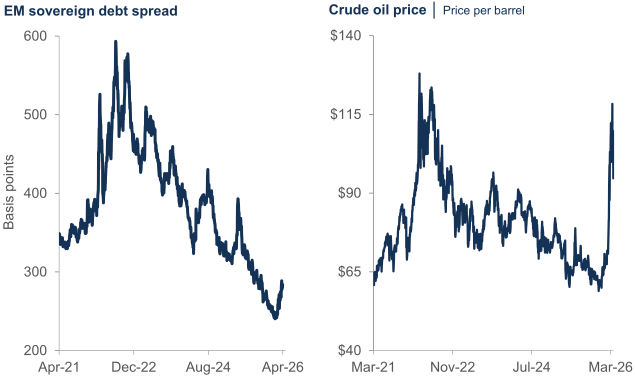
Source JPM EMBIG Index, via Bloomberg
Taken together, these dynamics argue for caution rather than alarm. While geopolitical uncertainty and elevated energy prices warrant close monitoring, current conditions do not point to a repeat of the broad-based emerging market dislocation seen in 2022. This adjustment is more targeted, reflecting both the nature of the shock and a markedly different global macro and market backdrop.
Emerging markets show increased fundamental resilience
Emerging markets were once among the most vulnerable segments of the global economy, prone to sudden stops in capital flows that triggered currency collapses, inflation spikes, and painful policy tradeoffs. Over time, however, the asset class has evolved. Stronger monetary frameworks, more credible fiscal policies, more flexible exchange rates, and tighter financial regulation have materially improved resilience.
The stress tests of recent years, from the pandemic to the global rate shock of 2022, exposed weaknesses but also forced adjustment. Many sovereigns responded by tightening policy, allowing greater exchange rate flexibility, rebuilding foreign exchange reserves, and strengthening balance sheets, often through IMF led programs. As a result, a number of emerging markets enter the current shock with meaningfully stronger buffers than in the past.
That said, a new test is now taking shape. Governments across emerging markets are moving to cushion the impact of higher energy costs through subsidies, tax cuts, and other interventions that provide near term relief but risk slowing fiscal consolidation. Measures to curb energy demand may help limit inflation in the short run, but if sustained, they could weigh on productivity and medium term growth.
As a result, even though fundamentals are stronger, we believe a prolonged shock would still revive familiar pressures: strained public finances, draws on foreign exchange buffers, and higher costs of external borrowing, all against the backdrop of debt burdens that remain elevated relative to pre pandemic levels.
The longer the conflict persists, the greater the drag on fiscal accounts
If the shock were to persist, fiscal risks across emerging markets would inevitably rise. For now, however, the impact appears contained. Many EM countries enter this episode with stronger fiscal frameworks than in the past, providing useful safeguards against abrupt deterioration. The main areas of vulnerability lie among net energy importing economies with a history of intervening in fuel, electricity, and other energy related markets, where subsidies and tax relief can quickly erode public finances if elevated prices endure. These risks are amplified in countries with weaker external positions, particularly where subsidy reform remains incomplete or political constraints complicate adjustment.
By contrast, fiscally stronger economies are better placed to absorb temporary intervention, while net energy exporting emerging markets remain relatively well insulated. In parts of Latin America, Africa, and Asia, higher commodity revenues provide a meaningful offset, helping to contain the fiscal cost of support measures. This divergence underscores a broader reality: resilience across emerging markets is no longer uniform, but increasingly shaped by energy exposure, policy credibility, and the willingness to prioritize medium term stability over near term relief.
That said, a new challenge is beginning to emerge. Governments across emerging markets have already begun deploying measures to cushion the impact of higher energy prices: steps that carry a fiscal cost. Fuel subsidies and tax cuts may offer short term relief, but they weigh on budgets at a time when fiscal consolidation remains challenging for many sovereigns. As a result, even with stronger fundamentals and energy prices still below the extremes of 2022, a prolonged shock would bring familiar pressures back into focus: widening fiscal strains, increased reliance on foreign exchange buffers to smooth currency weakness, and higher external financing costs, all against a backdrop of debt burdens that remain elevated relative to pre pandemic levels.
Markets turn hawkish, but central banks remain in wait and see mode
The current supply disruptions pose a risk of a synchronised tightening of monetary policy across emerging markets, as central banks move to anchor inflation expectations and shore up financial stability. That risk cannot be dismissed should energy disruptions persist. For now, however, EM central banks are more likely to adopt a largely wait and see approach rather than risk responding to the supply driven shock prematurely. This is supported by the elevated real policy rates across emerging markets providing room to assess the fallout before adjusting monetary policy.
In addition, demand pressures are far more contained than in 2022, reducing the risk of second round effects that were a key driver of inflation during that episode Back then, energy price shocks coincided with post pandemic reopening, strong fiscal support, high accumulated savings and strong wage growth. Today’s environment is very different, with softer labour dynamics and tighter financial conditions limiting pass through into wage-inflation cycle.
Both factors suggest that current market pricing overstates both the likelihood and the scale of EM policy tightening. Recent moves in rates markets appear driven more by positioning, and short term dislocations than by a realistic assessment of central bank reaction functions. Provided the shock does not prove long lasting, fiscal deterioration should also remain manageable, limiting the risk of a sustained need in monetary policy tightening.
Alpha opportunities in EM sovereigns.
Amid heightened market volatility driven by geopolitical risks and sharp swings in commodity markets, our focus is on countries where fundamentals are improving and where political developments, market access, and rating trajectories offer asymmetric upside. In this context, we hold a constructive view on Ecuador and Argentina. In both cases, strong political commitment to reform under IMF programs is reinforced by constructive relations with the United States, providing an important external anchor. As commodity exporters, both countries also stand to benefit from higher prices, improving the macro backdrop.
We are similarly encouraged by recent polling in Hungary, which suggests that the opposition has a credible chance of winning next year’s elections. We believe markets appear to underprice the probability of a favourable political outcome that could unlock EU fund flows and materially improve the outlook for local assets, creating asymmetric upside potential. We also see value in Suriname, where recent liability management efforts have addressed key investor concerns and offer attractive compensation for investors willing to support a multi year reform agenda.
Beyond these cases, we expect continued rating improvements in Ivory Coast, supported by robust economic growth and improved macro stability. We also believe the relative value in oil exporting economies such as Angola and Nigeria, where higher energy revenues provide a buffer, and where Nigeria in particular, is showing encouraging progress on fiscal reforms and tax collection. Finally, in Romania, while downgrade risks persist, current valuations more than compensate investors for this uncertainty, offering what we believe is an attractive risk reward profile at current levels.
1. JP EMBIG Index, via Bloomberg
IMPORTANT DISCLOSURE
Availability of products and services provided by MacKay Shields may be limited by applicable laws and regulations in certain jurisdictions and this document is provided only for persons to whom this document and the products and services of MacKay Shields may otherwise lawfully be issued or made available. None of the products and services provided by MacKay Shields are offered to any person in any jurisdiction where such offering would be contrary to local law or regulation. This document is provided for information purposes only. It does not constitute investment advice and should not be construed as an offer to buy securities. The contents of this document have not been reviewed by any regulatory authority in any jurisdiction. All investments contain risks and may lose value and these materials do not undertake to explain all of the risks associated with any investment strategy referred to herein. Clients and investors should not invest in any strategy referred to herein unless satisfied that they and/or their representatives have requested and received all information that would enable them to evaluate the merits and risks thereof. Any forward-looking statements speak only as of the date they are made, and MacKay Shields assumes no duty and does not undertake to update forward looking statements. Any opinions expressed are the views and opinions of certain investment professionals at MacKay Shields which are subject to change without notice. There may have been, and may in the future be, changes to the investment personnel responsible for the management of the strategy(ies) described herein, as well as changes to the investment process utilized by such investment personnel. Past performance is not indicative of future results.
At the time of writing, MacKay Shields LLC maintains investments in the securities, issuers and/or companies cited herein. References to such securities, issuers and/or companies for educational and informational purposes only, and are intended to convey factual information and current market conditions. Such names are not intended, nor should they be construed as, a recommendation to buy and sell any individual security.
Information included herein should not be considered predicative of future transactions or commitments made by MacKay Shields LLC nor as an indication of current or future profitability. There is no assurance investment objectives will be met.
Past performance is not indicative of future results.
NOTE TO UK AND EUROPEAN UNION AUDIENCE
This document is intended only for the use of professional investors as defined in the Alternative Investment Fund Manager’s Directive and/or the UK Financial Conduct Authority’s Conduct of Business Sourcebook. To the extent this document has been issued in the United Kingdom, it has been issued by NYL Investments UK LLP, 200 Aldersgate Street, London UK EC1A 4HD, which is authorised and regulated by the UK Financial Conduct Authority. To the extent this document has been issued in the EEA, it has been issued by NYL Investments Europe Limited, 77 Sir John Rogerson's Quay, Block C Dublin D02 VK60 Ireland. NYL Investments Europe Limited is authorized and regulated by the Central Bank of Ireland (i) to act as an alternative investment fund manager of alternative investment funds under the Alternative Investment Fund Managers Directive (Directive 2011/61/EU) and (ii) to provide the services of individual portfolio management, investment advice and the receipt and transmission of orders as defined in Regulation 7(4) of the AIFMD Regulations to persons who meet the definition of “professional client” as set out in the MiFID Regulations. It has passported its license in additional countries in the EEA.
This document only describes capabilities of certain affiliates of New York Life Investments and/or MacKay Shields LLC. No such affiliates will accept subscriptions in any funds not admitted to marketing in your country or provide services to potential customers in your country, including discretionary asset management services, except where it is licensed to do so or can rely on an applicable exemption.
MacKay Shields LLC is a wholly owned subsidiary of New York Life Investment Management Holdings LLC, which is wholly owned by New York Life Insurance Company. “New York Life Investment Management” is the brand name and service mark used to represent a group of affiliated investment advisors of New York Life Insurance Company, including New York Life Investment Management LLC, a registered investment advisor.
NOTE TO CANADIAN RECIPIENTS
The information in these materials is not an offer to sell securities or a solicitation of an offer to buy securities in any jurisdiction of Canada. In Canada, any offer or sale of securities or the provision of any advisory or investment fund manager services will be made only in accordance with applicable Canadian securities laws. More specifically, any offer or sale of securities will be made in accordance with applicable exemptions to dealer and investment fund manager registration requirements, as well as under an exemption from the requirement to file a prospectus, and any advice given on securities will be made in reliance on applicable exemptions to adviser registration requirements.
Information included herein should not be considered predicative of future transactions or commitments made by MacKay Shields LLC nor as an indication of current or future profitability. There is no assurance investment objectives will be met. Past performance is not indicative of future results.
NOTE TO JAPANESE RECIPIENTS
In Japan, this is issued by New York Life Investment Management Asia Limited (Financial Instruments Business Operator, Kanto Local Finance Bureau (FIBO) No. 2964, Member of Japan Investment Advisers Association and Type 2 Financial Instruments Firms Association) for institutional investors only. As costs and/or fees to be borne by investors vary depending on circumstances such as products, services, investment period and market conditions, the total amount nor the calculation methods cannot be disclosed in advance. All investments involve risks, including market fluctuation and investors may lose the principal amount invested. Investors should obtain and read the prospectus and/or information set forth in Article 37-3 of the Financial Instruments and Exchange Act carefully before making investment decisions.
MacKay Shields LLC is a wholly owned subsidiary of New York Life Investment Management Holdings LLC, which is wholly owned by New York Life Insurance Company. “New York Life Investment Management” is the brand name and service mark used to represent a group of affiliated investment advisors of New York Life Insurance Company, including New York Life Investment Management LLC, a registered investment advisor.
SOURCE INFORMATION
“Bloomberg® ”, “Bloomberg Indices® ”, Bloomberg Fixed Income Indices, Bloomberg Equity Indices and all other Bloomberg indices referenced herein are service marks of Bloomberg Finance L.P. and its affiliates, including Bloomberg Index Services Limited (“BISL”), the administrator of the indices (collectively, “Bloomberg”) and have been licensed for use for certain purposes by MacKay Shields LLC (“MacKay Shields”). Bloomberg is not affiliated with MacKay Shields, and Bloomberg does not approve, endorse, review, or recommend MacKay Shields or any products, funds or services described herein. Bloomberg does not guarantee the timeliness, accurateness, or completeness of any data or information relating to MacKay Shields or any products, funds or services described herein.
INDEX DEFINITIONS
JMP EMBIG Index ― The J.P. Morgan Emerging Markets Bond Index (EMBI) is a family of benchmark indices tracking liquid, U.S. dollar-denominated debt instruments issued by emerging market sovereign and quasi-sovereign entities. They measure total return performance, including Brady bonds, Eurobonds, and traded loans, acting as a standard for portfolio management in this sector.
Subscribe to get MacKay Shields insights delivered to your inbox.
Related Thought Leadership