
In our view, public credit is increasingly attractive because today’s market places greater value on transparency, liquidity, diversification, and the ability to reposition quickly. Those advantages are structural, but are especially important in this phase of the cycle.
For allocators, the relevant question is no longer simply where yields are highest. It is which form of credit now offers the stronger combination of income, visibility, flexibility, and governance.
Executive summary
The environment has changed in ways that make the benefits of public credit more valuable. Higher rates, wider dispersion, and greater macroeconomic uncertainty have increased the premium on transparency, liquidity, and the ability to reposition. Public credit markets now offer compelling all-in income—the U.S. high-yield market delivered an 8.5% total return in 20251—without requiring investors to sacrifice visibility or flexibility. At the same time, the illiquidity premium available in private markets has compressed to levels that may no longer compensate for the trade-offs involved.
This paper examines why public credit’s structural advantages—continuous price discovery, daily liquidity, broad diversification, and governance simplicity—are particularly well-suited to the current phase of the cycle. It presents data on the convergence of public and private credit yields, the divergence in credit quality and default experience, and the practical implications for portfolio construction.
What has changed
For much of the past decade, private credit offered a straightforward value proposition: meaningfully higher yields in exchange for illiquidity and limited transparency. That trade-off was easier to accept when base rates were near zero, defaults were low, and the illiquidity premium exceeded 400 basis points over broadly syndicated loans. The environment today is materially different.
The Illiquidity premium has compressed
The spread differential between private direct lending and broadly syndicated loans has narrowed from approximately 400 basis points in 2022 to roughly 150–200 basis points in senior secured structures today (see Figure 1). In higher-quality “jumbo” transactions where private lenders compete directly with the syndicated market, pricing and documentation terms have become nearly indistinguishable. At the investment-grade level, the premium has similarly compressed.
Figure 1: Illiquidity premium for private credit continue to compress | Private credit vs. Single-B BSL spread basis
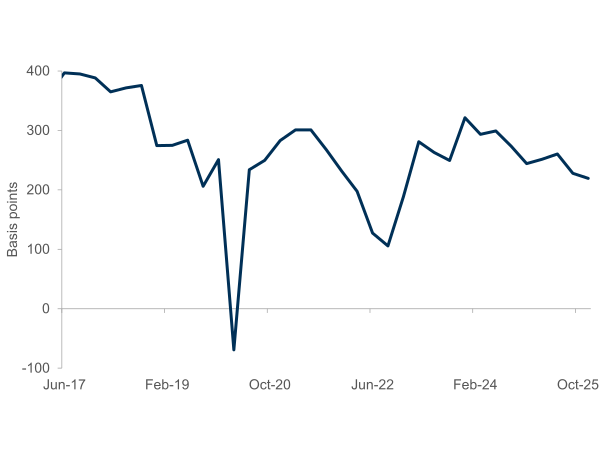
Data as of December 31, 2025
Source: Pitchbook LCD, Morgan Stanley Research
This compression reflects competitive dynamics as much as market conditions. Private credit has grown rapidly, with global private debt fund AUM reaching approximately $2 trillion and U.S. direct lending alone now estimated at roughly $1.3 trillion, or 30% of the U.S. leveraged finance market, up from 13% a decade ago.2 That capital growth has given borrowers greater negotiating leverage, driving spreads tighter and narrowing the covenant protections that once differentiated private structures. Many private loans are now “covenant-lite”—with cov-lite structures representing the majority of upper middle-market deals in recent vintages—and first-lien leverage multiples in sponsored transactions have risen accordingly.
Quantifying the Cost of Illiquidity
The true cost of illiquidity extends beyond the headline spread differential. It encompasses:
- Forgone rebalancing alpha: Locked capital cannot rotate into better opportunities as relative value shifts. Over a full cycle, the inability to sell deteriorating credits and reinvest in dislocated sectors represents a meaningful opportunity cost.
- Shortfall risk: Illiquid positions cannot be trimmed to meet cash needs, regulatory changes, or strategic reallocations without accepting secondary-market discounts of 20–40 cents on the dollar.
- Valuation lag: Mark-to-model pricing delays the recognition of deterioration, potentially leading to misinformed allocation decisions at the total-portfolio level.
- Industry estimates place the aggregate cost of illiquidity at approximately 200 basis points per year. At a yield premium of 150–200 bps, many direct lending segments no longer offer enough additional compensation to offset that cost. (see Figure 1)
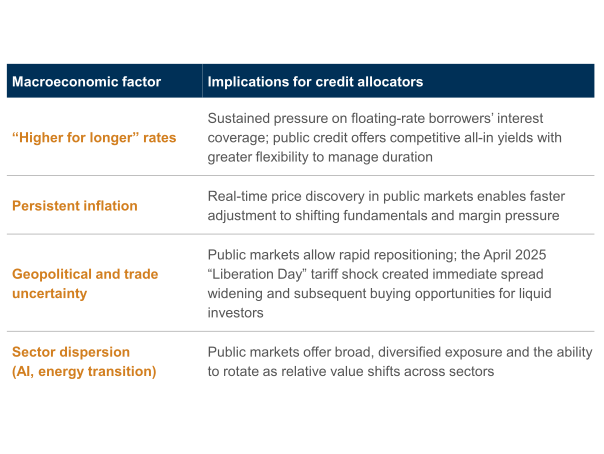
Figure 2: The macro environment favors transparency and flexibility
Source: MacKay Shields analysis
The income opportunity in public credit
Public credit markets now offer compelling income across the quality and structural spectrum—high-yield bonds, broadly syndicated loans, investment-grade corporates, and securitized credit—with the added benefit of daily liquidity and transparent pricing. Across these segments, all-in yields remain attractive by historical standards.
A common thread runs through each of these segments: public credit markets offer not only competitive income, but a combination of structural protections, transparency, and market depth that is distinctive to publicly trade instruments. Across investment-grade corporates, high-yield bonds, syndicated loans, CLOs, ABS, and non-agency mortgage-backed securities, investors benefit from standardized disclosure, continuous price discovery, and the ability to access and exit positions on any trading day. Monthly trustee, servicer, and issuer reporting provides granular, loan-level or property-level visibility into collateral performance. These features—structural rigor, observable data, and genuine liquidity—are foundational to informed portfolio management and are inherent to the public credit ecosystem.
Figure 3: Yields
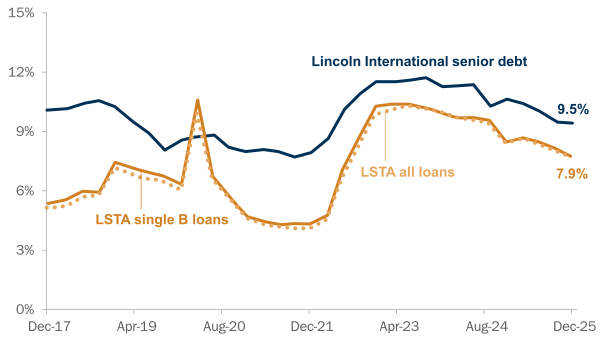
Data as of December 2025
Source: KBRA, Pitchbook | LCD, Morgan Stanley Research
Figure 4: Public credit indicative yields
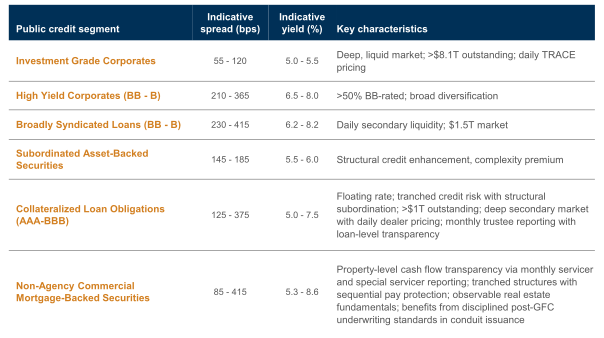
Data as of March 30, 2026
Indicative yield ranges reflect varying maturities and credit quality, but none below single-B.
Credit quality: a diverging picture
One of the advantages of public credit is the transparency and consistency with which credit quality can be assessed. Public markets offer standardized measurement, continuous surveillance, and a track record of improving fundamentals—advantages that are especially relevant as the credit quality picture across public and private markets continues to evolve.
Public credit: a strong and improving default picture
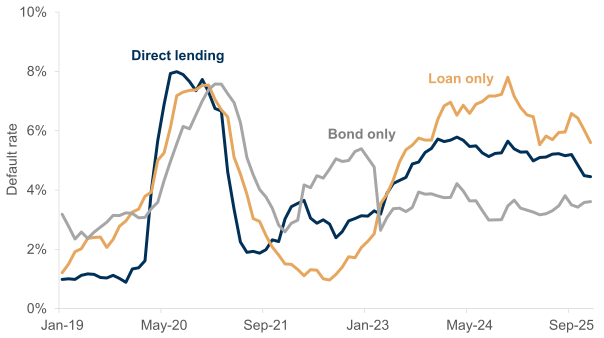
The public high-yield bond market has experienced a meaningful up-in-quality shift. As of late 2025, over 50% of the high-yield market was composed of BB-rated bonds. The trailing 12-month high-yield bond default rate declined to 2.8% as of November 2025. Industry forecasts place U.S. high-yield defaults in the 2.5–3.0% range through 2026, with U.S. speculative-grade defaults projected to decline to approximately 3.0% by late 2026. (see Figure 6 on next page)
Figure 5: Trailing 12-month default rates
Data as of December 31, 2025
Source: S&P, Moody’s, Morgan Stanley Research.
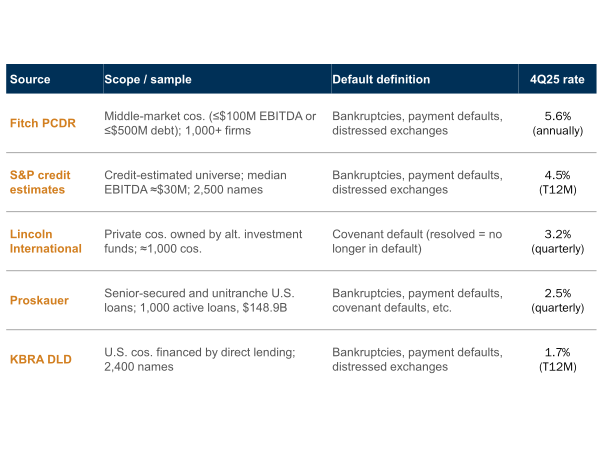
Figure 6: Five sources, five answers: private credit default rates
Source: Fitch; S&P; Lincoln International; Proskauer; KBRA; as compiled by Morgan Stanley Research.
Default measurement: the value of a standardized framework
A critical advantage of public credit default data is its consistency and comparability. High-yield bond and broadly syndicated loan defaults are tracked by multiple rating agencies using well-established, standardized methodologies applied to publicly registered securities with CUSIP identifiers and continuous surveillance. While agencies may produce modestly different figures due to definitional nuances—particularly around the treatment of distressed exchanges—the universe of issuers is clearly defined, default events are publicly observable, and the resulting data series are broadly comparable over time.
In private credit, by contrast, default rates vary significantly depending on the source, reflecting fundamental differences in sample composition, default definitions, and methodology. As of 4Q25, reported default rates across the major trackers ranged from 1.7% to 5.6% (see Figure 6 above).
These differences are not trivial. The wide dispersion reflects variation in which borrowers are included (smaller, lower-quality cohorts versus larger, sponsor-backed middle market), how defaults are defined (whether covenant breaches and PIK conversions count), and how rates are calculated (issuer-weighted versus size-weighted, trailing 12-month versus quarterly). For allocators, this variability in measurement underscores a key advantage of public credit: it is difficult to benchmark, compare, or stress-test a private credit allocation when the fundamental credit metric—the default rate—varies by a factor of three depending on the source. Public markets, by contrast, offer a single observable framework, resulting in a much tighter range of estimated defaults.
That transparency in default measurement is not a minor administrative convenience. It is a foundational element of informed portfolio management.
Fundamental credit metrics: public credit’s advantage
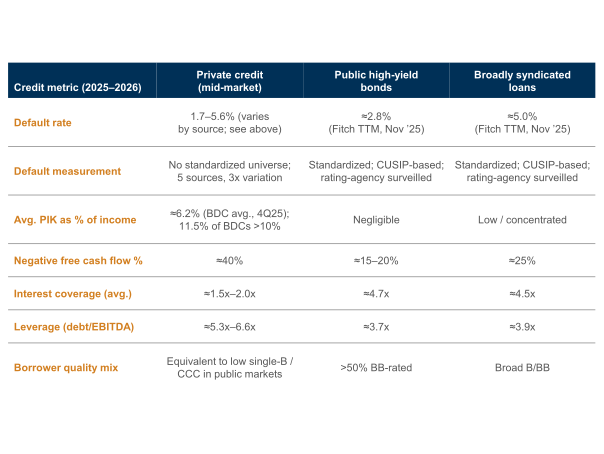
Beyond headline default rates, public credit borrowers exhibit meaningfully stronger fundamental profiles. Average interest coverage stands at 4.7x for public high-yield borrowers and 4.5x for broadly syndicated loan borrowers—levels that reflect substantial capacity to service debt. Leverage is moderate at 3.7x and 3.9x, respectively, and over 50% of the high-yield index carries BB ratings. Negative free cash flow is present in roughly 15–20% of public high-yield issuers (see Figure 7)—a manageable share that reflects the market’s higher credit quality composition.
Private credit borrowers, by comparison, carry higher leverage (5.3x–6.6x) and lower interest coverage (1.5x–2.0x)—metrics broadly comparable to low single-B to CCC profiles in the public market. Several indicators provide additional context. Payment-in-Kind (PIK) usage across public BDCs averaged 6.2% of investment income as of 4Q25, with 11.5% of BDCs receiving over 10% in PIK income. Approximately 40% of private credit borrowers now have negative free cash flow, up from 25% in 2021. (see Figure 7) These metrics are worth monitoring, though it is important to note that many of these pressures are cyclical in nature—driven by elevated base rates and slowing economic growth rather than structural impairment. A sustained period of economic expansion or rate relief could meaningfully improve coverage ratios and cash flow dynamics for private credit borrowers.
Sector concentration is also a factor. Software and IT services account for approximately 26% of public BDC holdings, and these borrowers carry the highest leverage (median 8.0x) and lowest interest coverage (1.4x) of any major sector. With AI-driven disruption beginning to reshape software business models and a front-loaded maturity wall—roughly a third of direct lending software loans are due by year-end 2028—this concentration is a dynamic worth monitoring. Public credit markets, by contrast, offer broad sector diversification and the flexibility to adjust exposure as these trends evolve.
Figure 7: Credit fundamentals at a glance: private vs. public
Source: Fitch; S&P; Lincoln International; Proskauer; KBRA; as compiled by Morgan Stanley Research.
Liability management and creditor risk
As refinancing conditions have tightened, aggressive liability management exercises (LMEs) have become more prevalent across the credit landscape. These transactions—including uptier exchanges, asset drop-downs, and out-of-court restructurings—allow borrowers to secure new liquidity, sometimes at the expense of existing lenders. While LMEs were originally concentrated in the broadly syndicated loan market, they have migrated into larger private credit “club” deals, introducing a form of creditor-on-creditor risk that is still being absorbed by the market.
Recent court decisions have broadly upheld the enforceability of these maneuvers where documentation permitted them, leaving minority lenders with limited legal recourse. For public credit investors, the implications are more contained: the broader and more dispersed creditor base in syndicated markets, combined with more standardized documentation and established legal precedent, provides a more predictable framework for navigating distressed situations.
Transparency as a portfolio management advantage
Public credit provides continuous price discovery through secondary-market trading, such as TRACE reporting and Bloomberg pricing. Investors can observe changing conditions in real time, differentiate between stronger and weaker issuers, and act when spreads or fundamentals shift. That transparency is not merely informational—it is a portfolio management advantage that enables earlier identification of deterioration and more timely risk management.
The distinction is particularly important in the current environment. Public markets benefit from SEC-mandated disclosures, continuous rating-agency surveillance, and standardized reporting. These mechanisms allow allocators to monitor risk with a level of precision and timeliness that is unique to publicly traded instruments. When the April 2025 tariff shock hit markets, public credit prices adjusted within days, enabling informed reallocation. Private credit valuations—which rely on quarterly or less frequent mark-to-model estimates—operate on a different timeline, and may not reflect comparable economic changes for months.
This valuation lag has drawn increasing attention from regulators, who have renewed their focus on valuation practices at private funds and the consistency of NAV reporting. For allocators, the takeaway is practical: governance and fiduciary obligations are easier to meet when portfolio marks reflect current market conditions, and public credit provides that visibility by design.
Key Point
Mark-to-market is not the same as economic risk. It is the mechanism through which risk becomes visible soon enough to be managed. A portfolio that marks to model may appear less volatile, but the underlying cash flows and credit quality are the same. The difference is when—and how precisely—the investor can observe and respond to changing conditions.
The strategic value of liquidity
Liquidity is often characterized as a defensive feature—a way to exit positions in a downturn. That framing understates its value. Liquidity is also what gives investors optionality: the ability to raise cash, rebalance exposures, add risk on weakness, and rotate across sectors as relative value changes. In a higher-dispersion environment, that flexibility is a source of alpha, not merely a safety valve.
Public credit provides that flexibility across the full market—investment grade, high yield, bank loans, municipals, and securitized credit can all be accessed, resized, or exited on any trading day. The April 2025 tariff-related volatility illustrated this clearly: public credit spreads widened and then recovered, rewarding investors who had the liquidity to act. Investors in less liquid structures may have faced the opposite experience—watching opportunities emerge without the ability to capitalize on them.
The liquidity challenge in semi-liquid vehicles
The growth of semi-liquid private credit vehicles—including interval funds and non-traded BDCs marketed to the wealth channel—has introduced an additional dimension of liquidity risk.
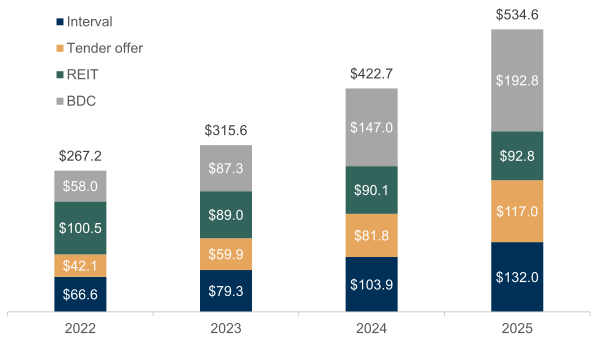
These vehicles have grown rapidly, with unlisted semi-liquid fund AUM exceeding $500 billion (see Figure 8). They offer periodic redemption windows, typically capped at 5% of NAV per quarter, but the underlying assets remain fundamentally illiquid.
Figure 8: The scale of liquidity mismatch: unlisted semi-liquid fund AUM | $billions, 2022-2025
Source: Pitchbook
In early 2026, redemption requests across private credit products rose sharply, with some of the largest direct lending evergreen funds receiving requests well in excess of their 5% quarterly liquidity provisions. Several managers activated gating mechanisms, limiting withdrawals during a period when investors may have preferred greater flexibility. These structures have never been tested through a prolonged economic downturn, and the current episode is the first significant stress event for private credit’s semi-liquid vehicles since their rapid growth beginning in 2021.
The contrast with public markets is instructive. In a public bond or loan fund, liquidity is provided by the market itself—buyers and sellers transact on an exchange or through dealers, and the fund manager bears no obligation to maintain cash for redemptions. In a semi-liquid vehicle, the fund manager must constantly manage cash reserves against quarterly redemption windows, creating a tension between liquidity provision and capital deployment that can weigh on performance. The structural elegance of public credit is that investors can enter and exit at market-determined prices on any trading day, without imposing cash management demands on the portfolio.
This structural difference has a practical corollary in the market today. Because public BDCs offer genuine market-provided liquidity, their prices adjust in real time to reflect sentiment and selling pressure — which means they can trade at meaningful discounts to NAV during periods of stress. Public and private BDCs managed by the same firm often hold 70–80% of the same underlying loans, yet the public vehicle currently offers investors access to a substantially similar loan book at a lower effective entry price, with daily liquidity and no redemption caps.
Portfolio construction and implementation
Public markets allow allocators to diversify across issuers, sectors, ratings, maturities, geographies, and structures. That breadth gives managers multiple ways to seek income and manage risk without concentrating exposure in a single financing channel or borrower type.
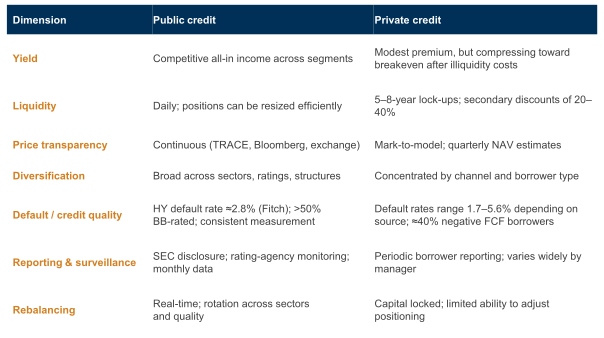
For institutional investors, governance is a practical consideration as much as a return consideration. Public credit is scalable, benchmarkable, and straightforward to explain to boards and investment committees. Pricing is visible. Risk can be monitored continuously. Positions can be resized efficiently if the institution’s cash needs, risk tolerance, or investment views change. These attributes simplify the fiduciary process in ways that matter for plan sponsors, insurers, and endowments with regular reporting and liquidity obligations (see Figure 9).
Figure 9: A practical comparison
Source: MacKay Shields analysis.
Conclusion
The structural advantages of public credit—transparency, liquidity, diversification, and governance simplicity—are always relevant. But they are particularly valuable in the current environment, where higher rates have compressed the illiquidity premium, credit conditions require closer monitoring, and the premium on real-time information and portfolio flexibility has increased.
For allocators, the case is grounded in data: public credit offers competitive income, favorable default experience, higher-quality borrower composition, and the ability to monitor and reposition in real time—all measured with a consistency and transparency that is inherent to public markets. The illiquidity premium that once justified the trade-offs of private credit has narrowed to levels that warrant reassessment. In that context, public credit is not simply the more liquid choice—it may also be the more efficiently compensated one.
In today’s market, adaptability may be the most valuable quality of all. Public credit delivers it—with income, transparency, and governance that serve institutions well across the cycle.
1. ICE Data
2. Morgan Stanley Research.
IMPORTANT DISCLOSURE
Availability of products and services provided by MacKay Shields may be limited by applicable laws and regulations in certain jurisdictions and this document is provided only for persons to whom this document and the products and services of MacKay Shields may otherwise lawfully be issued or made available. None of the products and services provided by MacKay Shields are offered to any person in any jurisdiction where such offering would be contrary to local law or regulation. This document is provided for information purposes only. It does not constitute investment advice and should not be construed as an offer to buy securities. The contents of this document have not been reviewed by any regulatory authority in any jurisdiction. All investments contain risks and may lose value and these materials do not undertake to explain all of the risks associated with any investment strategy referred to herein. Clients and investors should not invest in any strategy referred to herein unless satisfied that they and/or their representatives have requested and received all information that would enable them to evaluate the merits and risks thereof. Any forward-looking statements speak only as of the date they are made, and MacKay Shields assumes no duty and does not undertake to update forward looking statements. Any opinions expressed are the views and opinions of certain investment professionals at MacKay Shields which are subject to change without notice. There may have been, and may in the future be, changes to the investment personnel responsible for the management of the strategy(ies) described herein, as well as changes to the investment process utilized by such investment personnel. Past performance is not indicative of future results.
At the time of writing, MacKay Shields LLC maintains investments in the securities, issuers and/or companies cited herein. References to such securities, issuers and/or companies for educational and informational purposes only, and are intended to convey factual information and current market conditions. Such names are not intended, nor should they be construed as, a recommendation to buy and sell any individual security.
Information included herein should not be considered predictive of future transactions or commitments made by MacKay Shields LLC nor as an indication of current or future profitability. There is no assurance investment objectives will be met.
Past performance is not indicative of future results.
NOTE TO UK AND EUROPEAN UNION AUDIENCE
This document is intended only for the use of professional investors as defined in the Alternative Investment Fund Manager’s Directive and/or the UK Financial Conduct Authority’s Conduct of Business Sourcebook. To the extent this document has been issued in the United Kingdom, it has been issued by NYL Investments UK LLP, 200 Aldersgate Street, London UK EC1A 4HD, which is authorised and regulated by the UK Financial Conduct Authority. To the extent this document has been issued in the EEA, it has been issued by NYL Investments Europe Limited, 77 Sir John Rogerson's Quay, Block C Dublin D02 VK60 Ireland. NYL Investments Europe Limited is authorized and regulated by the Central Bank of Ireland (i) to act as an alternative investment fund manager of alternative investment funds under the Alternative Investment Fund Managers Directive (Directive 2011/61/EU) and (ii) to provide the services of individual portfolio management, investment advice and the receipt and transmission of orders as defined in Regulation 7(4) of the AIFMD Regulations to persons who meet the definition of “professional client” as set out in the MiFID Regulations. It has passported its license in additional countries in the EEA.
This document only describes capabilities of certain affiliates of New York Life Investments and/or MacKay Shields LLC. No such affiliates will accept subscriptions in any funds not admitted to marketing in your country or provide services to potential customers in your country, including discretionary asset management services, except where it is licensed to do so or can rely on an applicable exemption.
MacKay Shields LLC is a wholly owned subsidiary of New York Life Investment Management Holdings LLC, which is wholly owned by New York Life Insurance Company. "New York Life Investment Management" is both a service mark, and the common trade name of certain investment advisers affiliated with New York Life Insurance Company. Investments are not guaranteed by New York Life Insurance Company or New York Life Investment Management.
NOTE TO CANADIAN RECIPIENTS
The information in these materials is not an offer to sell securities or a solicitation of an offer to buy securities in any jurisdiction of Canada. In Canada, any offer or sale of securities or the provision of any advisory or investment fund manager services will be made only in accordance with applicable Canadian securities laws. More specifically, any offer or sale of securities will be made in accordance with applicable exemptions to dealer and investment fund manager registration requirements, as well as under an exemption from the requirement to file a prospectus, and any advice given on securities will be made in reliance on applicable exemptions to adviser registration requirements.
Information included herein should not be considered predictive of future transactions or commitments made by MacKay Shields LLC nor as an indication of current or future profitability. There is no assurance investment objectives will be met. Past performance is not indicative of future results.
NOTE TO JAPANESE RECIPIENTS
In Japan, this is issued by New York Life Investment Management Asia Limited (Financial Instruments Business Operator, Kanto Local Finance Bureau (FIBO) No. 2964, Member of the Investment Management Association of Japan and the Type 2 Financial Instruments Firms Association) for institutional investors only. As costs and/or fees to be borne by investors vary depending on circumstances such as products, services, investment period and market conditions, the total amount nor the calculation methods cannot be disclosed in advance. All investments involve risks, including market fluctuation and investors may lose the principal amount invested. Investors should obtain and read the prospectus and/or information set forth in Article 37-3 of the Financial Instruments and Exchange Act carefully before making investment decisions. MacKay Shields LLC is a wholly owned subsidiary of New York Life Investment Management Holdings LLC, which is wholly owned by New York Life Insurance Company. "New York Life Investment Management" is both a service mark, and the common trade name of certain investment advisers affiliated with New York Life Insurance Company. Investments are not guaranteed by New York Life Insurance Company or New York Life Investment Management.
SOURCE INFORMATION
“Bloomberg®”, “Bloomberg Indices®”, Bloomberg Fixed Income Indices, Bloomberg Equity Indices and all other Bloomberg indices referenced herein are service marks of Bloomberg Finance L.P. and its affiliates, including Bloomberg Index Services Limited (“BISL”), the administrator of the indices (collectively, “Bloomberg”) and have been licensed for use for certain purposes by MacKay Shields LLC (“MacKay Shields”). Bloomberg is not affiliated with MacKay Shields, and Bloomberg does not approve, endorse, review, or recommend MacKay Shields or any products, funds or services described herein. Bloomberg does not guarantee the timeliness, accurateness, or completeness of any data or information relating to MacKay Shields or any products, funds or services described herein.
Subscribe to get MacKay Shields insights delivered to your inbox.