
- Fed Chair nominee Kevin Warsh has floated pairing additional rate cuts with shrinking the Fed’s balance sheet, i.e., a resumption of quantitative tightening.
- In our base case, we see scope for a somewhat smaller balance sheet in conjunction with regulatory reform that reduces bank demand for reserves. The process would take time to implement and would then occur at a gradual pace to ensure a limited impact on long-term interest rates and funding markets.
- A delayed start followed by a gradual reduction in the balance sheet suggests little change to the near-term path of the policy rate.
- The transition to a smaller balance sheet can increase interest rate volatility and the Treasury term premium, and steepen the curve. Treasury and Fed coordination, however, can limit the impact on term premium, for example if the Fed increases its bill holdings while Treasury shifts its issuance to the front end.
Kevin Warsh’s nomination as Chair of the Federal Reserve has introduced significant uncertainty into the outlook for Federal Reserve balance sheet policy. Warsh has long criticized the Fed for maintaining a “bloated” balance sheet, and frames the monetary policy stance as a function of both interest rate policy and the size and composition of the balance sheet.1 More specifically, as the battle to succeed Chair Powell heated up, Warsh argued for significant balance sheet reduction, a form of tightening that could be offset by interest rate cuts.2 As additional balance sheet reduction would increase the supply of duration to the market while also reducing bank liquidity, Warsh’s proposals, if implemented, have the potential to destabilize funding markets and increase term premia across the Treasury curve.
Balance sheet 101
Understanding the practical considerations of Warsh’s proposals for the balance sheet requires a review of the size and composition of the Fed’s balance sheet. As seen in Figure 1 below, the Fed’s substantial holdings of Treasury and agency securities are funded by three main types of liabilities: currency, deposits from the Treasury Department, and reserve balances, i.e., deposits held by banks.
The Fed meets all demand for currency in circulation, and Treasury determines its holdings at the Fed. Thus any reduction in the overall size of the Fed’s balance sheet would see a decline in reserve balances on the liability side. This is where Warsh’s proposal for reducing the balance sheet first runs into difficulties – in 2019, the FOMC formally adopted an “ample reserves” operating framework, seeing the framework as offering substantial benefits to the banking sector and financial markets compared to the “scarce reserves” framework in effect prior to the global financial crisis.5 Policymakers have stressed, for example, that the ample reserves framework offers better control over short-term interest rates, including during periods of financial instability that require a rapid liquidity response from the central bank. For the banking system, reserves have the benefit, in contrast to, say, Treasury securities, of offering intraday liquidity. As such, they are the ultimate liquid asset.
Figure 1: Federal Reserve balance sheet | $Billions

Data through February 4, 2026.
Source: “Federal Reserve Balance Sheet: Factors Affecting Reserve Balances – H.4.1”, Board of Governors of the Federal Reserve System.
Policymakers also see little cost of an ample reserves system; although the Fed pays interest on reserve balances, they can be matched on the asset side of the balance sheet with short-term Treasuries that pay a similar rate of interest. In defense of the ample reserves system and its favorable cost-benefit tradeoff, Governor Waller has used the following metaphor: “If governments could provide clean, safe drinking water for citizens at zero cost, why would they make it scarce?”4
Balance sheet reduction requires a structural shift in reserve demand
Given these considerations, Warsh may face an uphill battle in shifting the Fed away from an ample reserves framework. At the very least, it would take many FOMC meetings worth of analysis and convincing. And even if the Committee were eventually to agree to return to a scarce reserves framework, the switch would need to take place over a long period of time to prevent adverse market effects. Most Committee members would have a strong preference for reducing the size of the balance sheet via passive runoff, rather than asset sales, especially against the backdrop of a US fiscal position that is expected to deteriorate further in the years ahead and has already put upward pressure on the term premium.
If the FOMC were to move toward a less ample reserves framework, it would face operational challenges. As reserves decline through balance sheet runoff, money market rates would eventually rise above the interest rate on reserve balances, risking increased volatility and tighter financial conditions than intended by the policy stance. To contain these pressures, the Fed would need to supply liquidity as needed, and potentially on a daily basis, through repo operations in which it finances Treasury and agency MBS holdings of primary dealers and other counterparties.5 But liquidity provision via repos would limit balance sheet reduction – the Fed’s securities holdings would decline, while repo assets would increase; on the liability side, the reserve drain from run-off would be offset by reserve creation that funds the repos.
Figure 2: Money market and policy rates
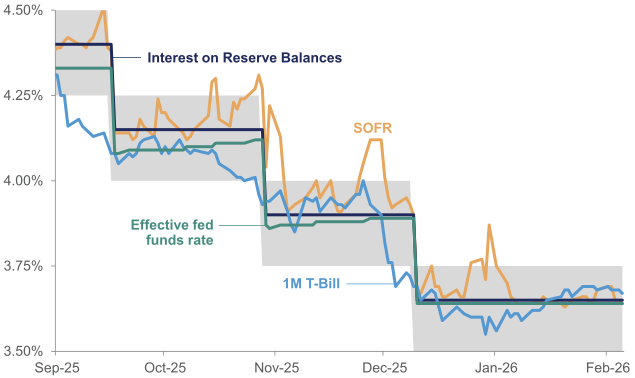
Data through February 6, 2026.
Gray shading indicates the target range for the effective fed funds rate specified by the FOMC after each meeting.
Source: Bloomberg.
Figure 2 above highlights that without steps to reduce structural demand for reserves, further reductions in their supply would yield too-tight money market conditions or repo operations that forestall balance sheet reduction, and likely some combination of the two. Structural reserve demand largely results from two sources. First, as a result of the Global Financial Crisis and the COVID shock, bank treasurers have come to view reserve balances at the Fed as a preferred form of liquidity. The collapse of Silicon Valley Bank in 2023 also highlighted the importance of reserves in liquidity stress events; not only do they provide intraday liquidity, but unlike Treasuries, reserves don’t risk becoming “trapped” on a bank’s balance sheet due to a reluctance to sell and realize losses.
A recent bank survey by the Bank Policy Institute supports the view that reserves are a preferred form of liquidity. As seen in the Figure 3 below, internal liquidity risk management practices, distinct from compliance with regulations or examiners’ judgements, ranked as the most important factor determining demand for reserves.
Second, the current regulatory framework incentivizes banks to hold reserves versus other high-quality liquid assets. As required by the bank regulatory agencies, including the Federal Reserve, banks conduct monthly Internal Liquidity Stress Tests. The stress tests, however, do not fully recognize the Fed’s repo operations and discount window as freely available forms of liquidity. As such, banks are required to turn to other forms of liquidity, and namely reserves, to meet their stress test requirements. Other regulatory requirements, such as the Liquidity Coverage Ratio, also create demand for reserves, especially since other competing liquidity sources must be unencumbered.
Figure 3 suggests that a further reduction in the size of the Fed’s balance sheet would require addressing the sources of elevated structural demand for reserve balances. This too would take time, including coordinating with other bank regulatory agencies to change regulations that incentivize banks to hold reserves.6
Figure 3: Factors that determine the quantity of reserve balances on a scale of 1 (not important) to 5 (very important)

Source: Bill Nelson, Laurence Briston and Brett Waxman, “What Determines Banks’ Demand for Reserve Balances?”, Bank Policy Institute, January 14, 2026. ILST: internal liquidity stress test; LCR: liquidity coverage ratio.
Figure 4: Reserve balances as a percent of nominal GDP
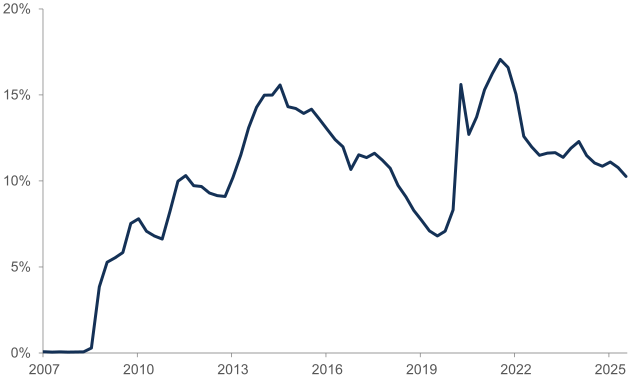
Data as of 3Q 2025
Source: Board of Governors of the Federal Reserve System, Bureau of Economic Analysis.
The asset side of the balance sheet matters too
Beyond complications stemming from structural reserve demand, reducing the balance sheet runs into issues related to monetary policy transmission and the policy stance. Most importantly, after nearly two decades of experience with quantitative easing, there remains a great deal of uncertainty and disagreement over how changes to the size and composition of the balance sheet impact financial conditions and the economy. Studies give a wide range of estimates of the impact of a given quantity of QE on Treasury yields, and there remain doubts about whether estimates of QE effects can be directly applied to balance sheet tightening via a gradual and passive reduction in securities holdings. Given these considerations, the FOMC as currently composed would be quite reluctant to translate additional balance sheet run-off into a specific amount of front-end rate cuts, especially in an environment where inflation remains above trend. At most, a plan to incrementally reduce the balance sheet over time, in conjunction with regulatory changes that reduce bank demand for reserves, could be offset by measured rate cuts if financial conditions are clearly tightening. Overall, though, the process of revisiting the reserve operating framework, changing bank regulations, and gradually and slowly running off the balance sheet, would push off any additional front-end easing well into 2027.
Limiting the impact on long-term rates
While we see some scope for additional balance sheet reduction over time, both the Fed and Treasury will look to limit any adverse impact on long-term Treasury yields. It is against this backdrop that we consider Warsh’s frequent comments about the need for a new Treasury-Fed Accord. In a recent interview, for example, he stated that:
“If we have a new accord, and ... the Fed chair and the Treasury secretary can describe to the markets plainly and with deliberation this is our objective for the size of the Fed's balance sheet, the Treasury can say this is our issuing calendar ... so that markets will know what is coming.”7
While the original 1951 Accord established Fed independence in monetary policy, Warsh seems to be indicating a new type of understanding that defines roles and responsibility over debt management (Treasury) and monetary policy (the Fed). And debt management can be understood expansively, encompassing the impact of both Treasury and Fed actions. When the Fed expands or shrinks its balance sheet, it changes the maturity structure of debt held by the public, which is arguably the remit of fiscal policy. Thus Warsh may be hinting at an arrangement under which Fed actions complement, or at least do not push against, the Treasury’s objectives for the maturity of the debt held by the public.
Assuming balance sheet reduction does not resume immediately, the Fed will continue to gradually expand its balance sheet to ensure that reserves remain sufficient for the conduct and transmission of monetary policy. In December, the FOMC announced that the expansion will occur via bill purchases. Given that many Fed officials see the benefits of increasing bill holdings, a logical next step would be for the Fed to shift its reinvestment of proceeds from maturing Treasury securities away from coupon-bearing instruments and into the bill market. Under Warsh’s proposed accord, Treasury could shift its issuance into the front end, where the new supply would be met with new demand from the Fed.
Figure 5: Par value of maturing Fed holdings of treasury notes and bonds over next decade | $Billions

Data as of February 4, 2026
Excludes floating rate notes and TIPS.
Source: Federal Reserve Bank of New York.
Other considerations
Warsh’s communications on the balance sheet raise several other questions about balance sheet policy. Below we highlight two.
Size of the Treasury General Account (TGA): While we focused above on reducing bank demand for reserves as a precondition of a smaller Fed balance sheet, it is also possible that Treasury could reduce balances in the TGA to match asset run-off.8 Since 2022, the TGA has fluctuated between $500 billion and $1 trillion, with larger drawdowns during debt ceiling impasses. Treasury could target a smaller, though still sizeable balance, perhaps around $500 billion or roughly half of the current balance, to accommodate Fed balance sheet reduction while ensuring ample reserves in the system. Still, Treasury’s willingness to do so may be limited. First, it has targeted a high cash balance to provide an adequate buffer against seasonal cash-flow volatility and stress events or market disruptions that could impact its ability to make payments. A TGA buffer also provides flexibility in managing around debt ceiling episodes during which Treasury must limit issuance. And finally, accommodating Fed balance sheet runoff may be in tension with Treasury’s focus on maintaining or lowering long-term interest rates.
Returning to an all-Treasury portfolio: Warsh has also highlighted a desire to return to an all-Treasury Fed portfolio, and he may prefer a quicker transition than is currently occurring via passive MBS runoff. Still, a stepped-up transition is likely to run into headwinds. MBS sales would crystallize losses for the Fed while putting upward pressure on mortgage rates. There has also been some market discussion of a lift-out of the portfolio by Treasury, or sale to the GSEs, but these ideas run into the requirement that Fed transactions occur in open markets. Hence the most likely avenue for a faster reduction in MBS holdings is a substantial drop in long-term interest rates that increases prepayment speeds on the mortgage portfolio.
What we are watching
There are clearly several moving parts and sources of uncertainty regarding Warsh’s balance sheet plans. Some of his proposals may also be in tension with Treasury’s objectives. Most notably, Warsh’s QT-for-rate-cuts swap risks higher long-term rates if not carefully managed, an outcome in direct opposition to Secretary Bessent’s stated goals. And it also remains to be seen if renewed QT paired with rate cuts is a true priority for Warsh. Finally, the objectives of a new Treasury-Fed Accord remain far from clear. Given these uncertainties, we are focused on a number of venues for clarity:
- Warsh’s confirmation hearing. As Warsh’s communications in the past have been short on details, the hearing will provide him with an opportunity to correct this. In particular, we will be attuned to signals about whether he will prioritize changing the size or composition of the balance sheet, as the two objectives can be in tension. This is because reducing the balance sheet to clear space for rate cuts limits the ability to roll over maturing Treasuries into bills and change the composition and average maturity of the portfolio.
- Treasury Quarterly Refundings. Treasury’s quarterly policy statements can provide insight into future issuance adjustments. Treasury has already given some hints of a likely shift towards greater bill issuance; its most recent policy statement noted that, “Treasury is monitoring [Fed] purchases of Treasury bills and growing demand for Treasury bills from the private sector.”9 It also charged the Treasury Borrowing Advisory Committee with assessing the interplay between Treasury issuance and Fed balance sheet policy.
- Notices of Proposed Rulemaking (NPRM). The Fed, Office of the Comptroller of the Currency, and the Federal Deposit Insurance Corporation recently rescinded their public FAQs on the Liquidity Coverage Ratio rule, while noting that the agencies “anticipate seeking comment on the issues addressed in the FAQs, as well as on proposed regulatory changes, in the future.”10 This may be a precursor to a NPRM, the Fed’s formal document for proposing a new or amended regulation. In this case, the NPRM may provide clarity on whether changes to the LCR aimed at lowering regulatory demand for reserves are being considered.
- Balance sheet guidance. Moving forward, we will be monitoring communications from FOMC participants for potentially evolving views on the balance sheet size and composition. Some FOMC participants, such as Governor Waller and Dallas Fed President Logan, have already staked out clear positions on the balance sheet; we will be looking for speeches on the topic from other policymakers in the months ahead.
Concluding thoughts
While Warsh has long championed a smaller Fed balance sheet, we see only limited scope for reducing the size of the Fed’s securities portfolio. Not only has the FOMC adopted an ample reserves framework, but a significant reduction in the Treasury and MBS portfolios risks upward pressure on interest rates, which would tighten the monetary policy stance and could be in tension with the Treasury’s own objectives. Thus, the most likely path is a resumption of QT at a measured pace but only once regulatory changes lower bank demand for reserves. This would allow the Committee to retain an ample reserves framework, with regulatory reform lowering the definition of what is considered “ample.” However, a delayed resumption of balance sheet reduction, and at a modest pace, implies little appetite across the FOMC for significant rate cuts to balance QT.
Warsh’s proposal for meaningful QT paired with rate cuts also sits uneasily with his call for coordination with Treasury over balance sheet composition. The smaller the balance sheet, the less capacity the Fed has to reinvest maturing principal into Treasury bills and absorb front-end supply. In practice, coordination with Treasury over the composition of debt held by the public may prove the higher priority. Shifting the portfolio toward a greater share of Treasury bills could attract majority support within the FOMC and, if paired with adjustments to Treasury issuance, could reduce duration supply to the market, lowering long-term yields and supporting growth.
1. Kevin Warsh, “The Federal Reserve’s Broken Leadership,” Wall Street Journal, November 16, 2025.
2. As one example, in a July 2025 interview on Fox Business, Warsh said, “My simple version of this is run the printing press a little bit less, let the balance sheet come down, let Secretary Bessent handle the fiscal accounts, and in so doing you can have materially lower interest rates.”
3. In an ample reserves system, reserves are sufficient enough that the central bank need not actively fine-tune the supply of reserves via daily market operations. Instead, interest rate control can be achieved primarily through the setting of administered rates, such as the interest rates on reserve balances, reverse repo operations, and standing repo operations. In contrast, in the pre-GFC scarce reserves framework, the Fed supplied a low level of reserves, forcing banks to borrow and lend in the fed funds market to meet reserve requirements. Banks also economized on reserves given that the Fed did not pay interest on their deposits. The Fed would conduct daily fine-tuning operations via repo transactions with primary dealers when it estimated an imbalance between aggregate reserve supply and demand that might take the fed funds rate away from the FOMC’s target rate.
4. Christopher Waller, “Demystifying the Federal Reserve’s Balance Sheet,” July 10, 2025.
5. In the fall of 2019, the Fed over-drained reserves from the system, leading them to turn temporarily to overnight repo operations to add back liquidity. They would eventually conduct bill purchases to add reserves on a more permanent basis.
6. Regulatory changes would also come with a cost as less stringent liquidity requirements could undermine resilience of the banking sector.
7. “Ex-Fed Governor Warsh says new accord between Treasury, central bank needed,” Reuters, July 17, 2025.
8. During QT, Treasury pays the principal on maturing Fed holdings by drawing down the TGA. It then replenishes the TGA by issuing more bonds to the private sector. Investors pay for those bonds with deposits at commercial banks, and Treasury uses the funds to top up the TGA. The movement of deposits from commercial banks to the Treasury reduces bank reserves in the system. Alternatively, Treasury need not offset Fed balance sheet reduction with new issuance to the market, in which case the TGA balance, rather than reserves, would decline.
9. “Quarterly Refunding Statement of Deputy Assistant Secretary for Federal Finance Brian Smith,” US Department of the Treasury, February 4, 2026 and “Bill Purchases and the Consolidated Balance Sheet, Treasury Borrowing Advisory Committee, February 3, 2026.
10. “Liquidity Coverage Ratio FAQs,” Updated February 10, 2026.
IMPORTANT DISCLOSURE
Availability of products and services provided by MacKay Shields may be limited by applicable laws and regulations in certain jurisdictions and this document is provided only for persons to whom this document and the products and services of MacKay Shields may otherwise lawfully be issued or made available. None of the products and services provided by MacKay Shields are offered to any person in any jurisdiction where such offering would be contrary to local law or regulation. This document is provided for information purposes only. It does not constitute investment advice and should not be construed as an offer to buy securities. The contents of this document have not been reviewed by any regulatory authority in any jurisdiction. All investments contain risks and may lose value and these materials do not undertake to explain all of the risks associated with any investment strategy referred to herein. Clients and investors should not invest in any strategy referred to herein unless satisfied that they and/or their representatives have requested and received all information that would enable them to evaluate the merits and risks thereof. Any forward-looking statements speak only as of the date they are made, and MacKay Shields assumes no duty and does not undertake to update forward looking statements. Any opinions expressed are the views and opinions of certain investment professionals at MacKay Shields which are subject to change without notice. There may have been, and may in the future be, changes to the investment personnel responsible for the management of the strategy(ies) described herein, as well as changes to the investment process utilized by such investment personnel. Past performance is not indicative of future results.
At the time of writing, MacKay Shields LLC maintains investments in the securities, issuers and/or companies cited herein. References to such securities, issuers and/or companies for educational and informational purposes only, and are intended to convey factual information and current market conditions. Such names are not intended, nor should they be construed as, a recommendation to buy and sell any individual security.
Information included herein should not be considered predicative of future transactions or commitments made by MacKay Shields LLC nor as an indication of current or future profitability. There is no assurance investment objectives will be met.
Past performance is not indicative of future results.
NOTE TO UK AND EUROPEAN UNION AUDIENCE
This document is intended only for the use of professional investors as defined in the Alternative Investment Fund Manager’s Directive and/or the UK Financial Conduct Authority’s Conduct of Business Sourcebook. To the extent this document has been issued in the United Kingdom, it has been issued by NYL Investments UK LLP, 200 Aldersgate Street, London UK EC1A 4HD, which is authorised and regulated by the UK Financial Conduct Authority. To the extent this document has been issued in the EEA, it has been issued by NYL Investments Europe Limited, 77 Sir John Rogerson's Quay, Block C Dublin D02 VK60 Ireland. NYL Investments Europe Limited is authorized and regulated by the Central Bank of Ireland (i) to act as an alternative investment fund manager of alternative investment funds under the Alternative Investment Fund Managers Directive (Directive 2011/61/EU) and (ii) to provide the services of individual portfolio management, investment advice and the receipt and transmission of orders as defined in Regulation 7(4) of the AIFMD Regulations to persons who meet the definition of “professional client” as set out in the MiFID Regulations. It has passported its license in additional countries in the EEA.
This document only describes capabilities of certain affiliates of New York Life Investments and/or MacKay Shields LLC. No such affiliates will accept subscriptions in any funds not admitted to marketing in your country or provide services to potential customers in your country, including discretionary asset management services, except where it is licensed to do so or can rely on an applicable exemption.
MacKay Shields LLC is a wholly owned subsidiary of New York Life Investment Management Holdings LLC, which is wholly owned by New York Life Insurance Company. “New York Life Investment Management” is the brand name and service mark used to represent a group of affiliated investment advisors of New York Life Insurance Company, including New York Life Investment Management LLC, a registered investment advisor.
NOTE TO CANADIAN RECIPIENTS
The information in these materials is not an offer to sell securities or a solicitation of an offer to buy securities in any jurisdiction of Canada. In Canada, any offer or sale of securities or the provision of any advisory or investment fund manager services will be made only in accordance with applicable Canadian securities laws. More specifically, any offer or sale of securities will be made in accordance with applicable exemptions to dealer and investment fund manager registration requirements, as well as under an exemption from the requirement to file a prospectus, and any advice given on securities will be made in reliance on applicable exemptions to adviser registration requirements.
Information included herein should not be considered predicative of future transactions or commitments made by MacKay Shields LLC nor as an indication of current or future profitability. There is no assurance investment objectives will be met. Past performance is not indicative of future results.
NOTE TO JAPANESE RECIPIENTS
In Japan, this is issued by New York Life Investment Management Asia Limited (Financial Instruments Business Operator, Kanto Local Finance Bureau (FIBO) No. 2964, Member of Japan Investment Advisers Association and Type 2 Financial Instruments Firms Association) for institutional investors only. As costs and/or fees to be borne by investors vary depending on circumstances such as products, services, investment period and market conditions, the total amount nor the calculation methods cannot be disclosed in advance. All investments involve risks, including market fluctuation and investors may lose the principal amount invested. Investors should obtain and read the prospectus and/or information set forth in Article 37-3 of the Financial Instruments and Exchange Act carefully before making investment decisions.
MacKay Shields LLC is a wholly owned subsidiary of New York Life Investment Management Holdings LLC, which is wholly owned by New York Life Insurance Company. "New York Life Investments" is both a service mark, and the common trade name of certain investment advisers affiliated with New York Life Insurance Company. Investments are not guaranteed by New York Life Insurance Company or New York Life Investments.
SOURCE INFORMATION
“Bloomberg®”, “Bloomberg Indices®”, Bloomberg Fixed Income Indices, Bloomberg Equity Indices and all other Bloomberg indices referenced herein are service marks of Bloomberg Finance L.P. and its affiliates, including Bloomberg Index Services Limited (“BISL”), the administrator of the indices (collectively, “Bloomberg”) and have been licensed for use for certain purposes by MacKay Shields LLC (“MacKay Shields”). Bloomberg is not affiliated with MacKay Shields, and Bloomberg does not approve, endorse, review, or recommend MacKay Shields or any products, funds or services described herein. Bloomberg does not guarantee the timeliness, accurateness, or completeness of any data or information relating to MacKay Shields or any products, funds or services described herein.
MacKay Shields LLC is a wholly owned subsidiary of New York Life Investment Management Holdings LLC, which is wholly owned by New York Life Insurance Company. "New York Life Investments" is both a service mark, and the common trade name of certain investment advisers affiliated with New York Life Insurance Company. Investments are not guaranteed by New York Life Insurance Company or New York Life Investments.
Subscribe to get MacKay Shields insights delivered to your inbox.
Related Thought Leadership