
Executive summary
- Rapid advances in artificial intelligence are driving a reassessment of software credit risk and igniting market volatility. Credit investors are now evaluating broader balance sheet implications in the software space.
- While the software sector represents as much as 13.9% of the leveraged loan market, according to Morningstar LSTA US Leveraged Loan Index, it is a much smaller component of the US investment grade and high yield market at approximately 2.2% and 3.4%, respectively (ICE Data, JPMorgan).
Figure 1: Software exposure in index
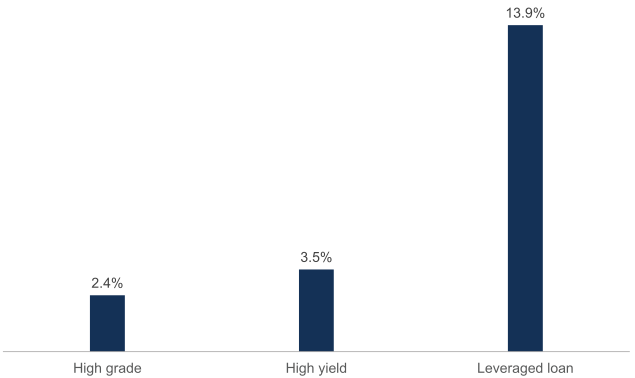
Data as of January 31, 2026
Source: ICE Data, Bloomberg, JPMorgan.
- In our view, displacement scenarios appear unlikely in the near term as we see AI development and innovation as a multi-year cycle. However, margin pressure, IT budget reallocation, and seat-based revenue erosion represent credible medium-to-long term risks for certain issuers.
- While we remain broadly underweight software, we prefer to lean into infrastructure-related software and compliance-critical platforms which appear to be better positioned from a credit perspective due to higher switching costs and mission-critical use cases.
AI as a catalyst for software credit repricing
The proliferation of accessible AI tools has introduced a new structural variable in the software credit landscape. After several years of robust growth driven by a historic investment upcycle, investors are increasingly questioning whether legacy software business models can sustain cash flows as AI expands the range of tasks that can be automated or internally developed.
More recently, market participants have become more discriminating, particularly toward issuers lacking a credible AI narrative. Equity declines have been followed by widening credit spreads, reflecting concerns around medium-term earnings durability, refinancing risk, and leverage trajectories rather than near-term liquidity stress.
In this environment, credit markets are prioritizing downside protection over upside optionality, leading to greater dispersion across the sector.
Key credit risks to consider
The most extreme bear cases assume enterprises increasingly rely on AI tools to build internal software solutions, reducing demand for third-party vendors. While AI coding assistants have meaningfully improved developer productivity, we believe more meaningful near term risks include:
- Pressure on seat-based and usage-based pricing models if AI adoption reduces enterprise headcount
- IT budget reallocation toward AI infrastructure, limiting pricing power and elongating sales cycles
- Margin compression as vendors invest to remain competitive while facing capped pricing
- Reduced deleveraging capacity, particularly for leveraged issuers reliant on EBITDA growth assumptions
Infrastructure vs. application software: credit implications
Software issuers can broadly be categorized as infrastructure or application providers. Infrastructure software underpins core enterprise operations and carries high switching costs, whereas Application software is more modular and discretionary, making it easier to replace, consolidate, or eliminate.
From a credit standpoint, application-layer issuers face greater downside risk, particularly where products are not embedded in mission-critical or regulated workflows. Infrastructure providers are generally more insulated due to revenue stickiness and operational dependency. For this reason, we see both better value and potential downside protection through the Infrastructure subsector.
What to watch: investment implications for credit investors
As we evaluate individual credits in this environment, we’re focused on several key indicators that will signal whether these risks are materializing.
Revenue durability remains paramount. We’re closely monitoring exposure to seat-based pricing models, churn trends, and renewal rates as enterprises reassess software spend. Any deterioration in net revenue retention or elongation in sales cycles would be an early warning sign.
Margin trajectory provides insight into competitive positioning. We’re watching whether issuers can absorb AI related investments without structurally impairing EBITDA, or whether margin compression becomes persistent rather than cyclical.
Figure 2: % of BDC sector exposures by fair value
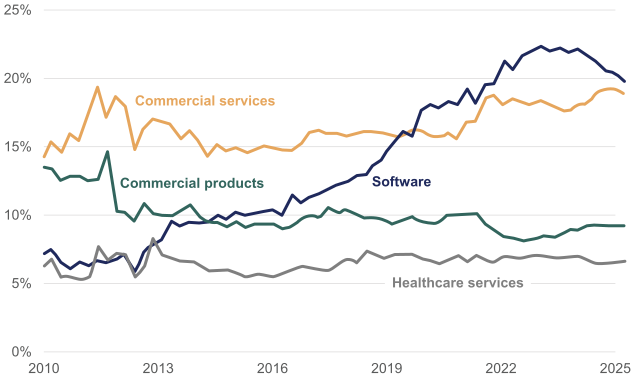
Source: Barclays
Capital intensity is increasing for many software companies. Rising capex and R&D requirements to maintain competitiveness signal potential cash flow pressure, particularly for companies that historically operated asset-light models.
Leverage and covenant headroom deserve heightened attention. Slower growth assumptions embedded in capital structures may prove optimistic, creating refinancing risk for issuers approaching maturities. We’re particularly focused on maintenance covenant cushions for revolving credit facilities.
Finally, business criticality remains the most important qualitative factor. We continue to prefer issuers tied to infrastructure or compliance-sensitive workflows where switching costs are high and the software is genuinely mission-critical to enterprise operations.
Conclusion
We expect continued pressure across software credit as AI adoption reshapes investor perceptions of long-term cash flow stability. Risks are unevenly distributed and infrastructure and mission-critical software providers appear relatively better positioned. Application-layer issuers with discretionary use cases warrant closer scrutiny in portfolios. Market dislocations of this nature also create opportunities and we remain vigilant for issuers that are being mispriced relative to their fundamental resilience.
IMPORTANT DISCLOSURE
Availability of products and services provided by MacKay Shields may be limited by applicable laws and regulations in certain jurisdictions and this document is provided only for persons to whom this document and the products and services of MacKay Shields may otherwise lawfully be issued or made available. None of the products and services provided by MacKay Shields are offered to any person in any jurisdiction where such offering would be contrary to local law or regulation. This document is provided for information purposes only. It does not constitute investment advice and should not be construed as an offer to buy securities. The contents of this document have not been reviewed by any regulatory authority in any jurisdiction. All investments contain risks and may lose value and these materials do not undertake to explain all of the risks associated with any investment strategy referred to herein. Clients and investors should not invest in any strategy referred to herein unless satisfied that they and/or their representatives have requested and received all information that would enable them to evaluate the merits and risks thereof. Any forward looking statements speak only as of the date they are made, and MacKay Shields assumes no duty and does not undertake to update forward looking statements. Any opinions expressed are the views and opinions of certain investment professionals at MacKay Shields which are subject to change without notice. There may have been, and may in the future be, changes to the investment personnel responsible for the management of the strategy(ies) described herein, as well as changes to the investment process utilized by such investment personnel.
No part of this material may be reproduced in any form, or referred to in any other publication, without the express written permission of MacKay Shields. ©2026 MacKay Shields LLC. All rights reserved.
Information included herein should not be considered predicative of future transactions or commitments made by MacKay Shields LLC nor as an indication of current or future profitability. There is no assurance investment objectives will be met. Past performance is not indicative of future results.
NOTE TO UK AND EUROPEAN UNION AUDIENCE
This document is intended only for the use of professional investors as defined in the Alternative Investment Fund Manager’s Directive and/or the UK Financial Conduct Authority’s Conduct of Business Sourcebook. To the extent this document has been issued in the United Kingdom, it has been issued by NYL Investments UK LLP, 200 Aldersgate Street, London UK EC1A 4HD, which is authorised and regulated by the UK Financial Conduct Authority. To the extent this document has been issued in the EEA, it has been issued by NYL Investments Europe Limited, 77 Sir John Rogerson's Quay, Block C Dublin D02 VK60 Ireland. NYL Investments Europe Limited is authorized and regulated by the Central Bank of Ireland (i) to act as an alternative investment fund manager of alternative investment funds under the Alternative Investment Fund Managers Directive (Directive 2011/61/EU) and (ii) to provide the services of individual portfolio management, investment advice and the receipt and transmission of orders as defined in Regulation 7(4) of the AIFMD Regulations to persons who meet the definition of “professional client” as set out in the MiFID Regulations. It has passported its license in additional countries in the EEA.
This document only describes capabilities of certain affiliates of New York Life Investments and/or MacKay Shields LLC. No such affiliates will accept subscriptions in any funds not admitted to marketing in your country or provide services to potential customers in your country, including discretionary asset management services, except where it is licensed to do so or can rely on an applicable exemption.
MacKay Shields LLC is a wholly owned subsidiary of New York Life Investment Management Holdings LLC, which is wholly owned by New York Life Insurance Company. "New York Life Investments" is both a service mark, and the common trade name of certain investment advisers affiliated with New York Life Insurance Company. Investments are not guaranteed by New York Life Insurance Company or New York Life Investments.
NOTE TO CANADIAN RECIPIENTS
The information in these materials is not an offer to sell securities or a solicitation of an offer to buy securities in any jurisdiction of Canada. In Canada, any offer or sale of securities or the provision of any advisory or investment fund manager services will be made only in accordance with applicable Canadian securities laws. More specifically, any offer or sale of securities will be made in accordance with applicable exemptions to dealer and investment fund manager registration requirements, as well as under an exemption from the requirement to file a prospectus, and any advice given on securities will be made in reliance on applicable exemptions to adviser registration requirements.
NOTE TO JAPANESE RECIPIENTS
This is issued by New York Life Investment Management Asia Limited (Financial Instruments Business Operator, Kanto Local Finance Bureau (FIBO) No. 2964, Member of Japan Investment Advisers Association and Type 2 Financial Instruments Firms Association) for institutional investors only. As costs and/or fees to be borne by investors vary depending on circumstances such as products, services, investment period and market conditions, the total amount nor the calculation methods cannot be disclosed in advance. All investments involve risks, including market fluctuation and investors may lose the principal amount invested. Investors should obtain and read the prospectus and/or information set forth in Article 37-3 of the Financial Instruments and Exchange Act carefully before making investment decisions.
MacKay Shields LLC is a wholly owned subsidiary of New York Life Investment Management Holdings LLC, which is wholly owned by New York Life Insurance Company. "New York Life Investments" is both a service mark, and the common trade name of certain investment advisers affiliated with New York Life Insurance Company. Investments are not guaranteed by New York Life Insurance Company or New York Life Investments.
Subscribe to get MacKay Shields insights delivered to your inbox.
Related Thought Leadership