
As many former sovereign crisis credits transition into recovery stories, one question is attracting growing attention among investors: could Senegal emerge as the next significant sovereign debt test case?
For emerging market debt investors, the mood today is very different from just a few years ago. The cluster of sovereign crisis between 2020 and 2023 triggered by the pandemic is largely behind us. Zambia, Ghana and Sri Lanka have all successfully restructured. Across emerging markets, fiscal deficits are narrowing, inflation is moderating and investors are increasingly discussing upgrades and recovery stories rather than defaults.
It is important to acknowledge that sovereign defaults are rare events. Historically, annual sovereign default rates have averaged well below 1%.1 Yet investors are paid to remain vigilant. Today, the more interesting question for investors is no longer where the next wave of defaults will come from. It is where potential exception may arise. And if there is one sovereign credit that increasingly stands out as a potential exception to the broader improving trend, it is Senegal.
Figure 1: EM sovereign net rating actions
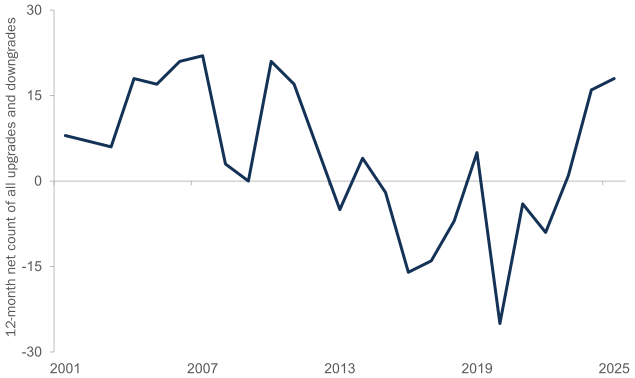
Data as of July 15, 2026
Source: : JP Morgan
A market favorite that lost credibility
Senegal was never supposed to be the next sovereign debt story.
For years, it was one of Africa's market favourites, combining political stability, strong growth and an ambitious development agenda. More recently, the start of offshore oil and gas production appeared to strengthen an already compelling investment case.
In many respects, that story remains intact. Growth prospects remain attractive, export capacity is improving and future hydrocarbon revenues should support the economy for years to come. (see Figure 2)
What changed was not the economy. What changed was the balance sheet.
Following a review by the new administration, public debt estimates were revised sharply higher. Debt previously reported at roughly 75% of GDP at the end of 2023 was subsequently revised above 110%, while broader public-sector debt is now estimated at around 130% of GDP by the IMF.2
The increase in debt was significant. The loss of credibility was even more damaging. Investors can live with high debt. What they struggle with is uncertainty over the numbers. Once confidence in fiscal reporting is undermined, every forecast becomes harder to trust.
That leaves Senegal in an unusual, and arguably more challenging position than many of the sovereigns that underwent debt distress in the post-pandemic period. While its growth outlook is improving, confidence in its public finances has been weakened. The key question for investors is no longer whether Senegal can grow. It is whether that growth can outpace a debt burden that turned out to be far larger than anyone expected.
Figure 2: GTA phase 1 production profile
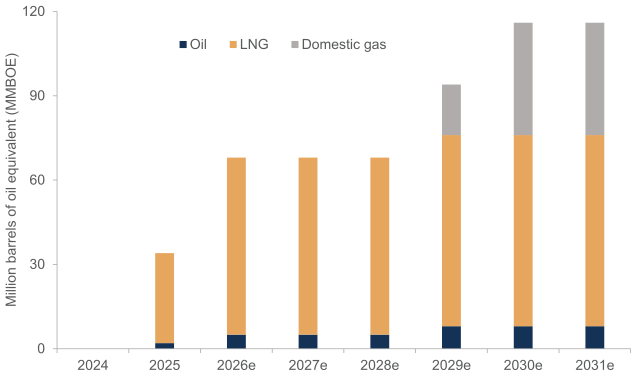
Source: Kosmos Energy, Greater Tortue Ahmeyim (GTA project) straddling the maritime border between Senegal and Mauritania, Pareto Securities, July 2026
Why Senegal could become the next sovereign test case
What makes Senegal particularly important is not simply the possibility of restructuring. It is the possibility that Senegal becomes the first major sovereign test case for a changing IMF framework.
Historically, IMF debt sustainability assessments focused primarily on external obligations. The central question was whether a country could generate enough foreign currency to service its international debts and regain market access.
Today the framework is becoming broader. Increasingly, the IMF is placing greater emphasis on total public debt, domestic debt and gross financing needs, or the amount of debt that must be refinanced each year.
This distinction matters enormously for Senegal. International investors naturally focus on the country's Eurobonds. Yet a substantial portion of Senegal's debt sits within the domestic and regional financial system. Domestic debt is estimated at roughly 50% of GDP, while domestic refinancing requirements account for a large share of annual financing needs.3
Under the older IMF framework, a restructuring could largely focus on external creditors. Under the newer framework, the IMF may place much greater emphasis on the sustainability of the entire sovereign balance sheet, including domestic debt and refinancing risks. Therefore, Senegal may not simply be another restructuring story. It may be the first restructuring designed around a much broader definition of debt sustainability.
Senegal's previous $1.8 billion programme with the IMF was suspended after the discovery of debt discrepancies, and discussions regarding a new programme are now central to investor thinking. Ultimately, the IMF must answer a difficult question: Can a country with debt around 130% of GDP and improving growth prospects gradually stabilise its debt burden through reform, fiscal adjustment and stronger revenues? Or does debt sustainability require some form of creditor contribution? Current market pricing suggests investors increasingly believe some debt treatment may eventually be required.
Conclusion
For the past couple of years, the broader story in emerging market debt has been recovery, resilience and reflows. The sovereign default cycle has receded. Many former crisis credits are becoming recovery stories with net positive ratings action across the universe. Economic fundamentals of the asset class continue to improve.
While emerging markets are moving beyond the sovereign debt crisis era, Senegal may ultimately become the exception that proves the rule. It remains one of the few countries where improving fundamentals and rising restructuring risk are unfolding simultaneously, making it one of the most closely watched sovereign stories in emerging markets today.
1. Source: J.P. Morgan
2. Source: Pareto Securities, July 2026
3. Source: IMF
IMPORTANT DISCLOSURE
Availability of products and services provided by MacKay Shields may be limited by applicable laws and regulations in certain jurisdictions and this document is provided only for persons to whom this document and the products and services of MacKay Shields may otherwise lawfully be issued or made available. None of the products and services provided by MacKay Shields are offered to any person in any jurisdiction where such offering would be contrary to local law or regulation. This document is provided for information purposes only. It does not constitute investment advice and should not be construed as an offer to buy securities. The contents of this document have not been reviewed by any regulatory authority in any jurisdiction. All investments contain risks and may lose value and these materials do not undertake to explain all of the risks associated with any investment strategy referred to herein. Clients and investors should not invest in any strategy referred to herein unless satisfied that they and/or their representatives have requested and received all information that would enable them to evaluate the merits and risks thereof. Any forward-looking statements speak only as of the date they are made, and MacKay Shields assumes no duty and does not undertake to update forward looking statements. Any opinions expressed are the views and opinions of certain investment professionals at MacKay Shields which are subject to change without notice. There may have been, and may in the future be, changes to the investment personnel responsible for the management of the strategy(ies) described herein, as well as changes to the investment process utilized by such investment personnel. Past performance is not indicative of future results.
At the time of writing, MacKay Shields LLC maintains investments in the securities, issuers and/or companies cited herein. References to such securities, issuers and/or companies for educational and informational purposes only, and are intended to convey factual information and current market conditions. Such names are not intended, nor should they be construed as, a recommendation to buy and sell any individual security.
Information included herein should not be considered predicative of future transactions or commitments made by MacKay Shields LLC nor as an indication of current or future profitability. There is no assurance investment objectives will be met.
Past performance is not indicative of future results.
NOTE TO UK AND EUROPEAN AUDIENCE
TThis document is intended only for the use of professional investors as defined in the Alternative Investment Fund Manager’s Directive and/or the UK Financial Conduct Authority’s Conduct of Business Sourcebook. To the extent this document has been issued in the United Kingdom, it has been issued by NYL Investments UK LLP, 200 Aldersgate Street, London UK EC1A 4HD, which is authorised and regulated by the UK Financial Conduct Authority. To the extent this document has been issued in the EEA, it has been issued by NYL Investments Europe Limited, 77 Sir John Rogerson's Quay, Block C Dublin D02 VK60 Ireland. NYL Investments Europe Limited is authorized and regulated by the Central Bank of Ireland (i) to act as an alternative investment fund manager of alternative investment funds under the Alternative Investment Fund Managers Directive (Directive 2011/61/EU) and (ii) to provide the services of individual portfolio management, investment advice and the receipt and transmission of orders as defined in Regulation 7(4) of the AIFMD Regulations to persons who meet the definition of “professional client” as set out in the MiFID Regulations. It has passported its license in additional countries in the EEA.
This document only describes capabilities of certain affiliates of New York Life Investment Management and/or MacKay Shields LLC. No such affiliates will accept subscriptions in any funds not admitted to marketing in your country or provide services to potential customers in your country, including discretionary asset management services, except where it is licensed to do so or can rely on an applicable exemption.
MacKay Shields LLC is a wholly owned subsidiary of New York Life Investment Management Holdings LLC, which is wholly owned by New York Life Insurance Company. "New York Life Investment Management" is both a service mark, and the common trade name of certain investment advisers affiliated with New York Life Insurance Company. Investments are not guaranteed by New York Life Insurance Company or New York Life Investment Management.
NOTE TO CANADIAN RECIPIENTS
The information in these materials is not an offer to sell securities or a solicitation of an offer to buy securities in any jurisdiction of Canada. In Canada, any offer or sale of securities or the provision of any advisory or investment fund manager services will be made only in accordance with applicable Canadian securities laws. More specifically, any offer or sale of securities will be made in accordance with applicable exemptions to dealer and investment fund manager registration requirements, as well as under an exemption from the requirement to file a prospectus, and any advice given on securities will be made in reliance on applicable exemptions to adviser registration requirements.
Information included herein should not be considered predicative of future transactions or commitments made by MacKay Shields LLC nor as an indication of current or future profitability. There is no assurance investment objectives will be met. Past performance is not indicative of future results.
NOTE TO JAPANESE RECIPIENTS
In Japan, this is issued by New York Life Investment Management Asia Limited (Financial Instruments Business Operator, Kanto Local Finance Bureau (FIBO) No. 2964, Member of the Investment Management Association of Japan and the Type 2 Financial Instruments Firms Association) for institutional investors only. As costs and/or fees to be borne by investors vary depending on circumstances such as products, services, investment period and market conditions, the total amount nor the calculation methods cannot be disclosed in advance. All investments involve risks, including market fluctuation and investors may lose the principal amount invested. Investors should obtain and read the prospectus and/or information set forth in Article 37-3 of the Financial Instruments and Exchange Act carefully before making investment decisions. MacKay Shields LLC is a wholly owned subsidiary of New York Life Investment Management Holdings LLC, which is wholly owned by New York Life Insurance Company. "New York Life Investments" is both a service mark, and the common trade name of certain investment advisers affiliated with New York Life Insurance Company. Investments are not guaranteed by New York Life Insurance Company or New York Life Investments.
SOURCE INFORMATION
“Bloomberg®”, “Bloomberg Indices®”, Bloomberg Fixed Income Indices, Bloomberg Equity Indices and all other Bloomberg indices referenced herein are service marks of Bloomberg Finance L.P. and its affiliates, including Bloomberg Index Services Limited (“BISL”), the administrator of the indices (collectively, “Bloomberg”) and have been licensed for use for certain purposes by MacKay Shields LLC (“MacKay Shields”). Bloomberg is not affiliated with MacKay Shields, and Bloomberg does not approve, endorse, review, or recommend MacKay Shields or any products, funds or services described herein. Bloomberg does not guarantee the timeliness, accurateness, or completeness of any data or information relating to MacKay Shields or any products, funds or services described herein.
Subscribe to get MacKay Shields insights delivered to your inbox.
Related Thought Leadership