
The GCC1 has spent much of the past two decades earning a reputation as one of the world's most resilient emerging market regions. Vast sovereign wealth pools, strong public balance sheets, stable currency regimes and prudent fiscal management have created an investment backdrop that compares favourably with many developed markets.
The events of 2026 provided a significant stress test. Regional conflict disrupted trade routes, reduced tourism activity, weakened business confidence and challenged assumptions that had underpinned years of investment and hiring. Yet despite these headwinds, sovereign ratings remained broadly stable, banking systems continued functioning normally, currency pegs held firm and governments retained access to capital markets.
For investors, resilience is no longer the investment thesis. It is the starting point. In a world characterised by rising sovereign indebtedness, fiscal constraints and political fragmentation, balance sheet strength itself has become increasingly valuable.
The more important question is where investors can capture value from the next phase of GCC development. Increasingly, the answer lies beyond sovereign debt and into strategic corporates, infrastructure, real assets and private credit. (see table on next page)
Public credit: more than a sovereign story
The traditional GCC allocation has centred on sovereign and quasi-sovereign debt. That remains justified. The UAE, Qatar, Kuwait and Saudi Arabia continue to rank among the strongest credits in the emerging market universe, supported by exceptional financial resources and stable policy frameworks. However, the opportunity increasingly extends into corporate credit. The most attractive issuers are those positioned at the centre of regional transformation.
Logistics and infrastructure: the DP world example: One company neatly captures both the strengths and challenges of the modern GCC investment story is DP World. Headquartered in Dubai, DP World is one of the world's largest ports and logistics operators, managing a global network of ports, terminals, freight forwarding, warehousing and supply-chain infrastructure across more than 70 countries. While often viewed as a UAE corporate, its business is increasingly global in nature, making it a useful proxy for broader trends in international trade, logistics and economic diversification across the Gulf.
Figure 1: GCC: Large net asset positions underpin credit quality
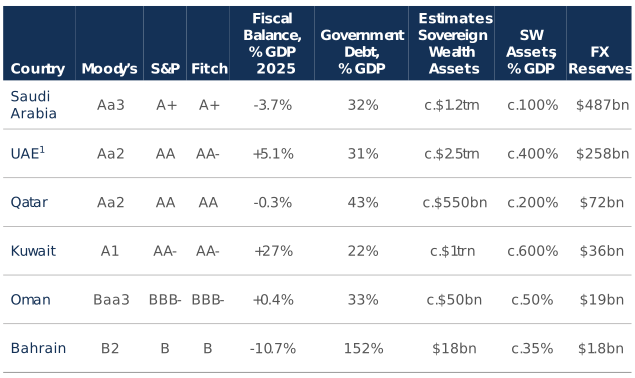
Debt refers to Federal-level debt only. FX reserves are held at the Central Bank of the UAE. Sovereign Wealth assets are primarily held by the Emirate of Abu Dhabi (c.70%), followed by Dubai (25%).
Source: : IMF, September 2026
The GCC enters periods of uncertainty with balance sheets that most developed economies can only aspire to.
On the surface, the company appears highly exposed to geopolitical disruption. Jebel Ali, historically one of its most important assets, has been significantly impacted by shipping disruptions and reduced vessel traffic. Yet the broader group has remained remarkably resilient. According to the company’s latest financial report, revenue continued to grow across logistics and marine services, earnings proved far more robust than expected, liquidity remained strong and the company continued investing in new infrastructure such as Fujairah terminals and alternative trade corridors.2
The broader lesson is important. Many GCC corporates are no longer domestic champions. They are increasingly global businesses with diversified revenue streams, strategic infrastructure assets and substantial operating resilience.
Real estate: when headlines and credit fundamentals diverge
There is no sector that better demonstrates the importance of security selection than Dubai real estate.
By almost any measure, the market has cooled sharply. Off-plan sales have fallen approximately 60-80% from peak levels, rental growth has reversed and transaction activity has slowed considerably3. For equity investors, those trends matter enormously. For fixed income investors, they matter less than cash flows. Today's market differs materially from the 2008 cycle, during which Dubai experienced a severe property and economic crash triggered by the Global Financial Crisis. This time escrow protections are stronger, leverage is lower, regulation is tighter and developers carry substantial contracted sales backlogs already in collection. Leading developers continue to hold significant future receivables capable of supporting project completion and debt service even under weaker market conditions. (see table below)
Figure 2: Key considerations in comparing developers
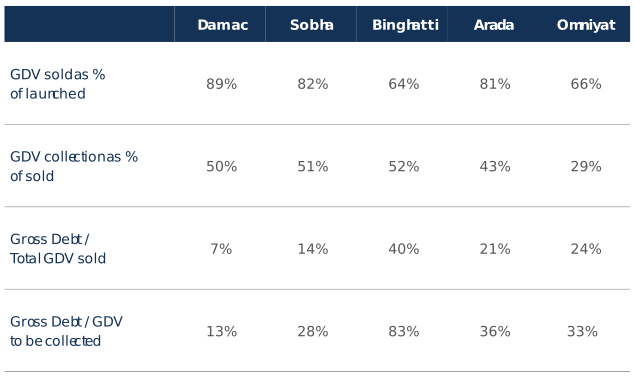
GDV: Gross Development Value.
Source: JP Morgan research, Dubai Real Estate Workshop”, September 18, 2026
The GCC enters periods of uncertainty with balance sheets that most developed economies can only aspire to.
On the surface, the company appears highly exposed to geopolitical disruption. Jebel Ali, historically one of its most important assets, has been significantly impacted by shipping disruptions and reduced vessel traffic. Yet the broader group has remained remarkably resilient. According to the company’s latest financial report, revenue continued to grow across logistics and marine services, earnings proved far more robust than expected, liquidity remained strong and the company continued investing in new infrastructure such as Fujairah terminals and alternative trade corridors.2
The broader lesson is important. Many GCC corporates are no longer domestic champions. They are increasingly global businesses with diversified revenue streams, strategic infrastructure assets and substantial operating resilience.
Real estate: when headlines and credit fundamentals diverge: There is no sector that better demonstrates the importance of security selection than Dubai real estate.
By almost any measure, the market has cooled sharply. Off-plan sales have fallen approximately 60-80% from peak levels, rental growth has reversed and transaction activity has slowed considerably3. For equity investors, those trends matter enormously. For fixed income investors, they matter less than cash flows. Today's market differs materially from the 2008 cycle, during which Dubai experienced a severe property and economic crash triggered by the Global Financial Crisis. This time escrow protections are stronger, leverage is lower, regulation is tighter and developers carry substantial contracted sales backlogs already in collection. Leading developers continue to hold significant future receivables capable of supporting project completion and debt service even under weaker market conditions. (see table below)
Therefore, real estate market weakness does not automatically translate into credit deterioration. In many cases property transactions have deteriorated much faster than developer cash collection profiles. Credit differentiation is paramount, as periods of sector stress often create the most attractive entry points for disciplined credit investors.
Private credit: financing the next growth cycle
If public credit remains the anchor allocation, private credit may represent the region's most compelling opportunity.
Across the Gulf, governments continue to pursue ambitious development strategies spanning logistics, digital infrastructure, transportation, healthcare, education, renewable energy and industrial expansion. Despite geopolitical uncertainty, project pipelines remain extraordinarily large. At the same time, corporate financing needs are beginning to outgrow the capacity and risk appetite of traditional lenders.
This is creating a financing gap. Unlike North America and Europe, where private credit largely emerged alongside leveraged buyouts, GCC private credit is fundamentally linked to economic development. The opportunity lies primarily outside sponsor finance. It is infrastructure finance, logistics finance, asset-backed lending and corporate growth capital.
We believe attractive segments include ports and logistics assets, data centres and digital infrastructure, renewable energy projects, healthcare platforms and education providers. In many cases, these assets sit within ecosystems anchored by sovereign wealth funds and government-led development plans, such as “Saudi Vision 2030”4
Risks and limitations: Despite our overall constructive outlook, we are mindful of several risks.
The first remains geopolitics. We believe a sustained recovery in growth ultimately requires greater stability across regional trade routes, improved investor confidence and reduced disruption to travel and logistics.
The second is valuation. While there are pockets of value in selective corporates, GCC sovereign and quasi-sovereign spreads increasingly reflect their strong fundamentals, limiting the scope for future rerating.
Third, private markets remain relatively immature. Legal frameworks continue to improve, particularly within DIFC (Dubai International Financial Centre) and ADGM (Abu Dhabi Global Market), which are independent financial free zones and common-law jurisdictions inside the UAE. However, creditor protections and restructuring processes remain less established than in major developed-market jurisdictions.
Finally, not all sectors will benefit equally. Real estate, hospitality and consumer-exposed businesses may continue to face pressure if economic growth remains below pre-conflict expectations.
Conclusion
The common perception is that the GCC remains an oil story. The investment reality is increasingly different. The region's greatest strength today is not hydrocarbons themselves, but the balance sheet capacity those hydrocarbons have created. That capacity is now being redeployed into logistics networks, financial centres, data infrastructure, healthcare systems, industrial development and private enterprise.
The events of 2026 have already answered the question of resilience. The more important question for investors is how to participate in what comes next.
We believe our answer is increasingly clear: remain anchored in sovereign quality, selectively add exposure to strategic corporates, and position early for the emergence of a much larger GCC private-credit ecosystem.
That is where the next decade of Gulf investing is likely to be found.
1. GCC stands for the Gulf Cooperation Council. The council includes six nations: Bahrain, Kuwait, Oman, Qatar, Saudi Arabia, and United Arab Emirates (UAE)
2. https://www.dpworld.com/en/investors/financials-presentations
3. Source: JP Morgan research, Dubai Real Estate Workshop”, September 18, 2026
4. https://www.vision2030.gov.sa/en
IMPORTANT DISCLOSURE
Availability of products and services provided by MacKay Shields may be limited by applicable laws and regulations in certain jurisdictions and this document is provided only for persons to whom this document and the products and services of MacKay Shields may otherwise lawfully be issued or made available. None of the products and services provided by MacKay Shields are offered to any person in any jurisdiction where such offering would be contrary to local law or regulation. This document is provided for information purposes only. It does not constitute investment advice and should not be construed as an offer to buy securities. The contents of this document have not been reviewed by any regulatory authority in any jurisdiction. All investments contain risks and may lose value and these materials do not undertake to explain all of the risks associated with any investment strategy referred to herein. Clients and investors should not invest in any strategy referred to herein unless satisfied that they and/or their representatives have requested and received all information that would enable them to evaluate the merits and risks thereof. Any forward-looking statements speak only as of the date they are made, and MacKay Shields assumes no duty and does not undertake to update forward looking statements. Any opinions expressed are the views and opinions of certain investment professionals at MacKay Shields which are subject to change without notice. There may have been, and may in the future be, changes to the investment personnel responsible for the management of the strategy(ies) described herein, as well as changes to the investment process utilized by such investment personnel. Past performance is not indicative of future results.
At the time of writing, MacKay Shields LLC maintains investments in the securities, issuers and/or companies cited herein. References to such securities, issuers and/or companies for educational and informational purposes only, and are intended to convey factual informationand current market conditions. Such names are not intended, nor should they be construed as, a recommendation to buy and sell any individual security.
Information included herein should not be considered predicative of future transactions or commitments made by MacKay Shields LLC nor as an indication of current or future profitability. There is no assurance investment objectives will be met.
Past performance is not indicative of future results.
NOTE TO UK AND EUROPEAN UNION AUDIENCE
This document is intended only for the use of professional investors as defined in the Alternative Investment Fund Manager’s Directive and/or the UK Financial Conduct Authority’s Conduct of Business Sourcebook. To the extent this document has been issued in the United Kingdom, it has been issued by NYL Investments UK LLP, 200 Aldersgate Street, London UK EC1A 4HD, which is authorised and regulated by the UK Financial Conduct Authority. To the extent this document has been issued in the EEA, it has been issued by NYL Investments Europe Limited, 77 Sir John Rogerson's Quay, Block C Dublin D02 VK60 Ireland. NYL Investments Europe Limited is authorized and regulated by the Central Bank of Ireland (i) to act as an alternative investment fund manager of alternative investment funds under the Alternative Investment Fund Managers Directive (Directive 2011/61/EU) and (ii) to provide the services of individual portfolio management, investment advice and the receipt and transmission of orders as defined in Regulation 7(4) of the AIFMD Regulations to persons who meet the definition of “professional client” as set out in the MiFID Regulations. It has passported its license in additional countries in the EEA.
This document only describes capabilities of certain affiliates of New York Life Investment Management and/or MacKay Shields LLC. No such affiliates will accept subscriptions in any funds not admitted to marketing in your country or provide services to potential customers in your country, including discretionary asset management services, except where it is licensed to do so or can rely on an applicable exemption.
MacKay Shields LLC is a wholly owned subsidiary of New York Life Investment Management Holdings LLC, which is wholly owned by New York Life Insurance Company. "New York Life Investment Management" is both a service mark, and the common trade name of certain investment advisers affiliated with New York Life Insurance Company. Investments are not guaranteed by New York Life Insurance Company or New York Life Investment Management.
NOTE TO CANADIAN RECIPIENTS
The information in these materials is not an offer to sell securities or a solicitation of an offer to buy securities in any jurisdiction of Canada. In Canada, any offer or sale of securities or the provision of any advisory or investment fund manager services will be made only in accordance with applicable Canadian securities laws. More specifically, any offer or sale of securities will be made in accordance with applicable exemptions to dealer and investment fund manager registration requirements, as well as under an exemption from the requirement to file a prospectus, and any advice given on securities will be made in reliance on applicable exemptions to adviser registration requirements.
Information included herein should not be considered predicative of future transactions or commitments made by MacKay Shields LLC nor as an indication of current or future profitability. There is no assurance investment objectives will be met. Past performance is not indicative of future results.
NOTE TO JAPANESE RECIPIENTS
In Japan, this is issued by New York Life Investment Management Asia Limited (Financial Instruments Business Operator, Kanto Local Finance Bureau (FIBO) No. 2964, Member of the Investment Management Association of Japan and the Type 2 Financial Instruments Firms Association) for institutional investors only. As costs and/or fees to be borne by investors vary depending on circumstances such as products, services, investment period and market conditions, the total amount nor the calculation methods cannot be disclosed in advance. All investments involve risks, including market fluctuation and investors may lose the principal amount invested. Investors should obtain and read the prospectus and/or information set forth in Article 37-3 of the Financial Instruments and Exchange Act carefully before making investment decisions.
MacKay Shields LLC is a wholly owned subsidiary of New York Life Investment Management Holdings LLC, which is wholly owned by New York Life Insurance Company. "New York Life Investments" is both a service mark, and the common trade name of certain investment advisers affiliated with New York Life Insurance Company. Investments are not guaranteed by New York Life Insurance Company or New York Life Investments.
SOURCE INFORMATION
“Bloomberg®”, “Bloomberg Indices®”, Bloomberg Fixed Income Indices, Bloomberg Equity Indices and all other Bloomberg indices referenced herein are service marks of Bloomberg Finance L.P. and its affiliates, including Bloomberg Index Services Limited (“BISL”), the administrator of the indices (collectively, “Bloomberg”) and have been licensed for use for certain purposes by MacKay Shields LLC (“MacKay Shields”). Bloomberg is not affiliated with MacKay Shields, and Bloomberg does not approve, endorse, review, or recommend MacKay Shields or any products, funds or services described herein. Bloomberg does not guarantee the timeliness, accurateness, or completeness of any data or information relating to MacKay Shields or any products, funds or services described herein.
All ICE Data indices referenced herein (each such index, the “Index”), are products of ICE data indices, LLC (“ICE Data”), and are used with permission. ICE® is a registered trademark of ICE Data or its affiliates, and BofA® is a registered trademark of Bank of America Corporation licensed by Bank of America Corporation and its affiliates (“BofA”) and may not be used without BofA’s prior written approval. ICE Data, its affiliates and their respective third party suppliers disclaim any and all warranties and representations, express and/or implied, including any warranties of merchantability or fitness for a particular purpose or use, including the indices, index data and any data included in, related to, or derived therefrom. Neither ICE Data, its affiliates nor their respective third party suppliers shall be subject to any damages or liability with respect to the adequacy, accuracy, timeliness or completeness of the indices or the index data or any component thereof, and the indices and index data and all components thereof are provided on an “as is” basis and your use is at your own risk. Inclusion of a security within an index is not a recommendation by ICE Data to buy, sell, or hold such security, nor is it considered to be investment advice. ICE Data, its affiliates and their respective third party suppliers do not sponsor, endorse, or recommend MacKay Shields LLC, or any of its products or services.
Subscribe to get MacKay Shields insights delivered to your inbox.
Related Thought Leadership