
Key takeaways
- The market is repricing CoreWeave's financing, not AI demand. Its unsecured notes yield about 15%, while loans secured on specific customer contracts still trade near par.1
- The model depends on capital markets staying open. That is true of every high-yield issuer to some degree, but few need as much new money, as early in their life, as CoreWeave. It burns cash through 2030 even in a constructive case, and the next unsecured dollar now costs about what its projects earn.2
- History says the edge can drag down the core. By the "edge" we mean the leveraged borrowers, such as neoclouds3, that build and rent out capacity on borrowed money. The "core" is the hyperscalers, which largely fund themselves. In past booms, funding breaks at the edge forced capex cuts, which hit suppliers as a demand shock, along with forced asset sales that eventually reached the core.
- For credit, own the contracts and be careful with the residual. Debt secured on specific customer contracts is repaid from those customers' payments. The "residual" is the unsecured debt at the parent company, which is paid only from what is left over, so it depends on continued access to financing. The signal to watch is whether stress reaches the secured debt and GPU pricing.
CoreWeave's unsecured bonds now yield about 15%. Its GPU-backed loans still trade near par. Together, those prices say the market hasn't lost faith in AI compute. It has lost patience with the balance sheets that rent it out on borrowed money.
That is a narrower claim than "the AI bubble is bursting." Demand, pricing, and end-user revenue all still point up. What has changed is the price of the marginal dollar at the leveraged edge of the buildout, the layer of neoclouds and fringe borrowers that lets hyperscalers and model labs keep capacity off their own books.
History is why it still matters. In most of the great infrastructure booms (railroads in the 1870s, fiber in 2000, shale in 2015), demand didn't roll over first. Financing did. The weakest borrowers lost market access, capex stopped at the margin, and only then did the slowdown reach the core. CoreWeave hasn't lost access, and we don't think the full sequence is under way. But early signs of the first step are appearing, cushioned so far by private credit and equity, and they are worth monitoring closely.
What the market actually did
Between September 22 and October 15, CoreWeave's unsecured notes lost 7 to 7.5 points and widened by between 210bp and 275bp. Five-year CDS went from 860bp to 1,130bp. The stock fell about 20% in two sessions, 15% of it on October 14 alone.4
Several pressures hit credit at once, some fundamental and some technical.
- Rates. September core CPI came in hot, and the 10-year Treasury closed at 5.31% on October 5, its highest since 2002. By October 30 it had eased to 4.93%.
- Pricing pressure on AI output. Cheaper open-weight models, starting with Moonshot's Kimi K3 in July5, have pushed token prices down, and each new frontier model this year has launched at 20% to as much as 90% below the price of the model it replaces. That raised doubts about how durable the labs' revenue is. The labs are the largest marginal buyers of compute and neoclouds are the largest marginal sellers, so those doubts land on the neoclouds first.
- Supply. Project finance issuance across IG and high yield has already passed $100bn this year, nearly three times last year's total, and $250–350bn of compute-related financing is expected in 2027.6
- Technicals and headlines. Hedge funds, which hold much of CoreWeave's unsecured debt, were de-risking across AI names. A run of headlines added to the pressure: a widely shared post calling it a private-credit bubble7, a Gartner forecast of neocloud consolidation8, reports that the founders have sold $3.3bn of stock since the IPO, and the company's own FT interview about tapping "unlimited" insurance capital.
Compute pricing has gone the other way. A broad index of token prices has fallen about 57% from its late-May peak, while H1009 rental rates are up about 32% this year (Figure 1). Cheaper tokens are driving much heavier use. On OpenRouter10, open-weight models now carry about 72% of tokens but only about 27% of spend, and weekly token volume there has grown roughly 250-fold in 20 months. Spending has not kept pace: Ramp's data show enterprise AI spend flat in August and September11, even as token volumes rose about fivefold in six months, and roughly 80% of frontier-lab spending comes from 1% of firms. At the same time, power scarcity, permitting delays and shortages of long-lead equipment and skilled labor limit how fast new capacity can come online. The squeeze falls on the labs, which rent compute to sell tokens, more than on the neoclouds selling it, so the bigger risk for neocloud lenders is their customers' ability to pay. To illustrate the squeeze, a 27.5% rise in B200 rents combined with a 50% fall in token prices requires roughly 2.5 times more output per GPU just to hold the labs' gross margins flat.
Figure 1: Token prices fell after may while H100 rents kept rising | Weekly closes, indexed to 100 at December 31, 2025; through October 30, 2026
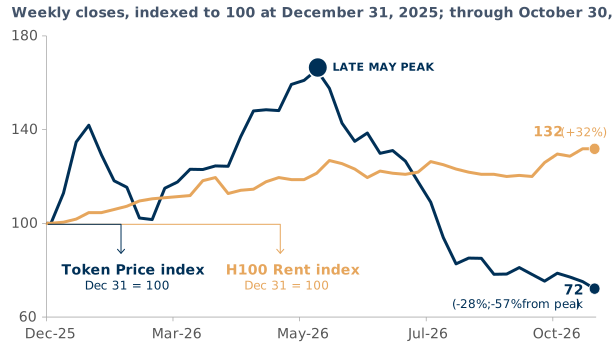
Weekly closes, Dec 31, 2025 to Oct 30, 2026, both indexed to 100 at Dec 31. The Silicon Data LLM Token Expenditure Index (SDLLMTK) is a weighted index of the effective price per million tokens across the actively traded LLM market; The H100 Rental Index (SDH100RT) is a weighted index of effective H100 rental prices from LLM providers.
Source: Bloomberg; Silicon Data LLM Token Expenditure Index (SDLLMTK) and H100 Rental Index (SDH100RT)
Figure 2: Secured loans still sit near par | Unsecured notes yield 14 to 15.5 (yield to worst by instrument)
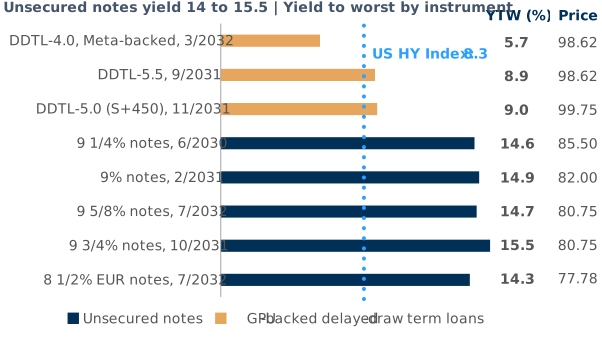
Data as of October 30, 2026.
Source: Bloomberg
Rates explain very little of CoreWeave's own move. Its 2032 notes fell from 100 in July to 75 on October 14, and higher Treasury yields account for only about 3 of those 25 points.12 A brief rebound after mid-October did not last. By October 30, three of CoreWeave's four USD notes were lower in price than on October 15, even as the 10-year Treasury yield fell about 40bp from its early-October high. The stress has persisted rather than faded, which is a reason to focus less on any one week's levels and more on where it is, and isn't, spreading.
Underneath the noise, the secured market told a different story. Over the same stretch, CoreWeave's GPU-backed delayed-draw term loans (DDTLs)13 moved 5 to 50bp. They still trade at or near par, though marks aren't uniform: one fund apparently carries a tranche of CoreWeave's GPU loans at 76.7% of face. By October 30 they had edged another 45 to 50bp wider, but were still priced between 98.6 and 99.75.14
The divergence between the secured loans and the unsecured notes is the central point. (See Figure 2) Lenders who hold claims on specific contracts with Meta, OpenAI and Microsoft are calm. Lenders who hold claims on the parent's ability to keep raising money are not. The selling spilled over to Nebius, Oracle, IREN, Cipher Mining and TeraWulf, which each dropped 9 to 13% on October 14.15 It did not spill into the contract-backed paper.
None of this means CoreWeave has lost access to credit. It raised $3.7bn of convertible notes in September, it can still borrow against specific customer contracts, and it has no bond maturities until 2030. What has changed is the price of its marginal unsecured funding.
A model that only works if the window stays open
Every high-yield issuer depends on access to credit to some degree. What sets CoreWeave apart, as a relatively new entrant in a young sector, is how much new money it needs and how soon. It has to raise capital every year to fund growth, not just to refinance maturities. Consensus projections for its cash flow show the scale of that dependence.
Figure 3: Consensus has CoreWeave burning cash every year through 2030 | Free cash flow ($BN)
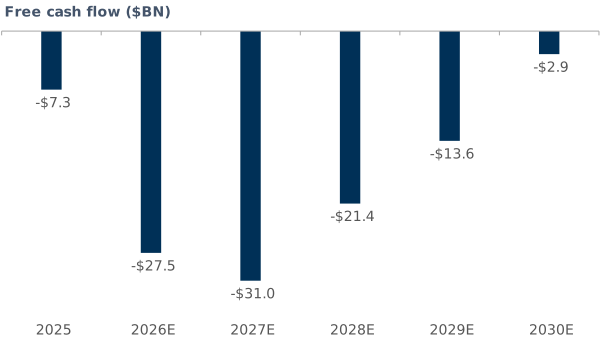
Consensus estimates (BEst) as of Oct 30, 2026; 2025 actual. Out-year estimates rest on fewer analysts (14 for 2030).
Source: Bloomberg
Consensus estimates have CoreWeave burning cash every year through 2030. In one widely followed street projection16, net debt rises from $49bn this year to $130bn. Leverage falls from 8.1x to 2.5x, but only because EBITDA grows into the debt. Nothing gets repaid. The plan needs about $95.6bn of new financing from 2027 to 2030, roughly $30bn of it next year, and ends 2030 with $2.9bn of liquidity against $132bn of debt.(See Figure 3)
Cash interest tells the same story. It runs $2.7bn this year and $8.4bn by 2030. Interest roughly triples over that stretch, and every dollar of it depends on the next financing getting done.
In our view, the only path to positive free cash flow is the minimum-growth case, where CoreWeave stops building and leasing new capacity after the 4.2GW it already has. Then FCF turns to about $45bn across 2029–30 and net debt roughly halves. In other words, deleveraging requires a capex cut, and that is how a funding problem becomes a demand problem for suppliers upstream.
When the cost of capital meets the return on the asset
CoreWeave's pitch to investors rests on contract math. In its illustrative four-year take-or-pay deal, upfront capex runs about 57% of contract value, about 85% of that is debt-funded, and the GPUs earn roughly a 15% unlevered IRR. Payback is about two and a half years. That math works well when the debt costs 6 to 9%, which is what the DDTLs still cost. It stops working on the slice that has to come from somewhere else. On street estimates, that slice is about 20% of funding needs, around $6bn next year. The unsecured market that used to fill it now charges about 15%, the same as the asset earns. There's no spread left to lever. (See Figure 4)
The same squeeze is sharper one layer down. Data center leases yield roughly 12% on cost, while high-yield financing for the developers that build them now costs more than 10%.
Our constructive view runs like this. Project returns still clear a blended cost of capital comfortably. Customer prepayments reduce how much has to be borrowed in the first place. And while compute stays scarce, higher funding costs can potentially be priced into new contracts.
That's plausible, with two caveats. Pass-through works only while capacity stays scarce, and it has to cover rising build costs, from component inflation and pricier next-generation chips, as well as possible rising rates. The cushion is also thinner than the headline return suggests. In CoreWeave's own illustration, only about a sixth of contract value is left for the parent once the project debt is repaid, and that residual is what services the unsecured notes.
Fifteen percent, roughly where its unsecured notes now trade, is the marginal cost, not the average. CoreWeave pays about 8.4% across its debt today, and its notes don't mature until 2030–32.17 The problem is the next dollar, and every obvious source of it costs more than it did a few weeks ago. About $6.6bn of convertible notes have conversion prices far above the current share price (approximately $119.60 for the 2032 notes)18, so at $54.94 they behave more like debt that may need to be refinanced in cash. Refinancing them and the bonds at today's levels would add roughly $1.45bn of annual interest.
Figure 4: The cheap money still earns a spread; the marginal dollar doesn't | Funding cost vs. project unlevered IRR, approximate, October 30, 2026. Spread vs. ~15% IRR midpoint
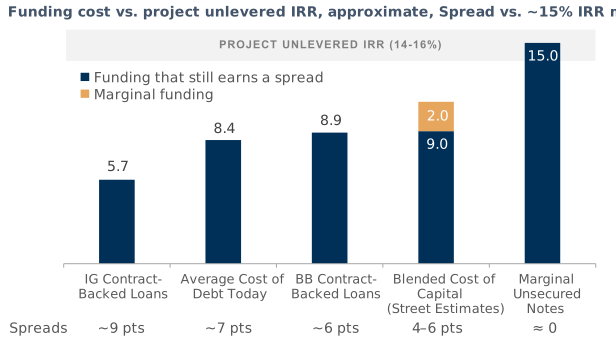
Source: Bloomberg (loan and bond yields, Oct 30, 2026); Data Gravity (average cost of debt); NYLIM/MacKay Shields estimates (blended cost of capital); CoreWeave's illustrative take-or-pay contract (project unlevered IRR).
Figure 5: Two weeks on, the market has pulled default risk forward
CoreWeave CDS, running-equivalent spread by tenor (500bp coupon)
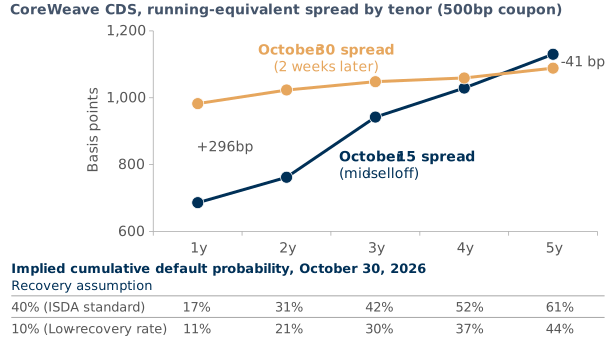
Lower recovery means lower implied odds of default but a larger loss if it happens
Source: Bloomberg CDSW
The 35mn-share at-the-market offering (ATM), unused as of October 30, is worth about $1.9bn, less than a third of next year's non-DDTL gap, and dilutive at these prices. That makes strategic equity from NVIDIA, Jane Street or a customer the most likely source of the balance.
The CDS curve shows how the market's view has shifted. In mid-October the curve was steep: near-term default risk looked modest, and the stress sat in years three to five, where the refinancing needs pile up. Two weeks later the curve is nearly flat, with one-year protection costing about as much as five-year.19 Dealer desks point to two reasons. Banks that lend to CoreWeave have been buying one- to three-year protection, the cheapest way to hedge the risk of a sudden default. And CoreWeave's secured debt amortizes, so billions of dollars of principal fall due over the next two years, well before the 2030 bond maturities.so principal comes due well before the 2030 bond maturities: as of June 30, about $4.4bn was due in the rest of 2026 and $6.2bn in 2027, together close to 30% of its $35.6bn of total debt. Either way, the window the market is worried about has moved closer.
The recovery assumption matters as much as the spread. At the standard 40% recovery, five-year CDS implies about a 61% chance of default. But the unsecured notes sit behind a large secured stack, S&P puts expected recovery on them at 10 to 30%, and some market participants put it as low as 0 to 10%. Market participants also note that CoreWeave's convertible notes may be deliverable into CDS, which could weigh on the auction settlement price.20 At 10% recovery, the implied default probability falls to about 44%, because each default is expected to cost more. The market price pins down expected loss; the recovery assumption only splits it between how likely a default is and how severe it would be. Either way, these are market-implied odds that include a risk premium, not forecasts.
Part of that reflects the shape of the outcomes rather than expected losses alone. CoreWeave is unusual among distressed credits: its five-year CDS trades about 18 points upfront while its equity is still worth roughly $25bn to $31bn, depending on the share count used.about $30bn.21 That combination says the market sees two very different paths rather than a slow decline, and it ties the bonds to the stock. With neocloud debt now near single-B levels relative to enterprise value, further equity declines would push spreads wider at an accelerating rate, while successful equity raises ease the pressure on the bonds.
That also explains the company's push for an investment-grade rating and its talk of "unlimited" insurance capital. Management appears to recognize that the high-yield version of this model isn't sustainable, and is moving the funding stack into contract-backed, IG-rated SPVs while it can. That's rational for the company and costly for its unsecured lenders, because every IG SPV carves the best contracts out of the pool. At June 30, $18.9bn of GPU loans and equipment financing already ranked ahead of $16.6bn of notes22, and S&P expects bondholders would recover only 10 to 30% in a default.23
Why this isn't a demand story, yet
If the AI trade were genuinely rolling over, we would expect pricing to crack first. It's doing the opposite.
- Pricing is rising. Contracts CoreWeave signed in 2Q and early 3Q carry contribution margins 5 to 10 points above recent quarters. July renewals repriced 25% higher, CoreWeave's list prices are up about 37.5% since July, and AWS is raising capacity-block rates about 15%. An A100 contract now runs through 2029, when those chips will be about nine years old.24
- Spot capacity is scarce. Nebius says short-term capacity goes for $40–50mn per MW, against $10–15mn for bare metal. SpaceX cites less than a one-year payback on new compute.25
- End-user revenue is real. Anthropic reportedly did $16.8bn of revenue in 3Q, up 45% on the quarter, with positive free cash flow. Year-to-date that's about $33bn, against $4.6bn for all of 2025. OpenAI reportedly told investors its run-rate grew 77% in 3Q.26
- The buyers are still short. Amazon says it won't have enough capacity in 2026 or 2027. Alphabet calls itself supply-constrained. Meta expects tightness "for the foreseeable future."
CoreWeave's backlog reached about $129bn after $25bn of new signings early in 3Q, and management says 2027 capacity is nearly sold out.
Revenue per MW is expected to keep rising as next-generation capacity comes online. The customer mix is also broadening. Microsoft fell from 66% of backlog at end-2024 to under a third a year later. Meta (27%) and OpenAI (17%) now lead a longer list that includes Jane Street, Google, Mistral and Cohere.27
That isn't what an unraveling looks like. The core of the buildout also doesn't need the market much. Strategist estimates suggest the four strongest hyperscalers generate $5.5tn of operating cash flow through 2030 against $5.2tn of capex. The catch is that the core is increasingly lending its credit to the edge. Big Tech has written up to $300bn of residual value guarantees in the past year, mostly off-balance sheet, and Morgan Stanley counts $3.1tn of off-balance-sheet commitments across seven hyperscalers and chipmakers. That is how a problem at the edge could travel back to the core. Even Amazon, which had largely funded its buildout from cash flow and bonds, disclosed on October 30 an $80bn facility to borrow against the hardware it buys, as its total spending commitments rose to $883bn.28
Demand is fine for now. The open question is who pays for the capacity that the strongest balance sheets have chosen not to own.
How funding breaks become demand breaks
Infrastructure booms rarely end because people stop wanting what is being built. They end because the people building it on borrowed money can't borrow anymore, and their sudden stop ripples back through suppliers and prices. (See Figure 6)
Figure 6: Three booms where the edge broke first (figures approximate, from historical accounts)
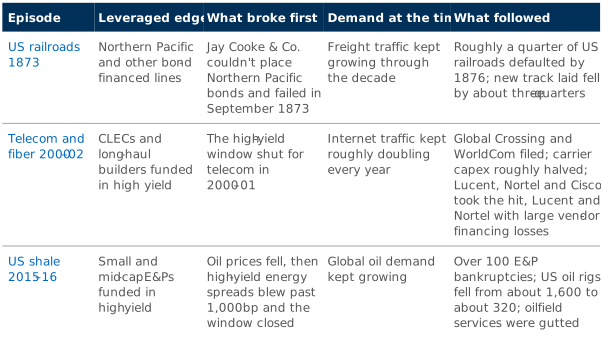
The pattern is consistent. Demand held up every time. What failed was the economics of capacity built on borrowed money, and the transmission ran through three steps.
- The edge loses market access. The weakest borrower can't roll or raise, so it stops ordering. That's a capex cut even though no end customer asked for one.
- Suppliers feel it as a demand shock. The vendors who booked those orders, and often financed them, see revenue fall. Lucent and Nortel learned that vendor financing turns a customer's credit problem into your own.
- Distressed capacity resets prices. Assets bought out of bankruptcy compete at a fraction of their original cost. Pricing falls for everyone, including the healthy players who never borrowed too much.
The third step is the one that converts a financing story into a true demand-and-pricing bust. In fiber, buyers picked up bankrupt networks for cents on the dollar and undercut everyone. Pricing can break without any fall in demand; forced sellers are enough.
There is one big difference. In 2001, only a few percent of installed fiber was lit, meaning actually in use; the rest sat dark in the ground. Today compute is genuinely short, with buyers already reserving 2028 capacity. That's the best argument against history repeating, but it holds only as long as capacity stays scarce. GPU forward curves point the same way for now: H100 rents for delivery in two years trade only about 15% below spot29, which prices modest easing rather than a collapse.
A second difference cuts the same way. Today's core suppliers, NVIDIA above all, have far stronger balance sheets than Lucent or Nortel did, and order cuts at the neoclouds are unlikely to push them into distress. We believe step two would probably play out differently this time: as slower growth and margin pressure at the suppliers rather than defaults, with the credit risk sitting in their contingent exposures, such as equity stakes, capacity backstops and residual-value support, rather than on their balance sheets. That puts more weight on step three. For bond investors, the likelier path from the edge to wider credit stress runs through forced-seller GPU pricing and the leveraged lessors and developers, not through the chipmakers.
How the chain would run this time
Neoclouds exist so that hyperscalers and model labs can rent capacity instead of owning it. That makes them the shock absorber of the buildout, and the place where a funding problem would first turn into an ordering problem.
The exposure is concentrated on both sides. Five neoclouds (CoreWeave, Nscale, Nebius, Lambda and IREN) hold about $302bn of signed contracts, most of it owed by four buyers: Meta, Microsoft, OpenAI and Anthropic. One tally of $364bn of asset-level AI debt finds 62% resting on six end customers.30 On the funding side, strategist estimates put about $0.7tn of the $1.2tn of external capital the buildout needs through 2030 on weaker issuers.31 Those are the borrowers whose cost of capital just jumped.
Today's players line up closely with those three steps.
- The edge. CoreWeave, Nebius, Nscale, Lambda and the ex-crypto-miner developers that lease them shells. If CoreWeave slows from 7GW of planned active power to the 4.2GW it already has, street estimates suggest that would free up roughly $45bn of cash. It also means about 2.8GW of capacity that doesn't get ordered.
- The vendor financier. NVIDIA owns about 10% of CoreWeave, invested $2bn in January, backstops $6.3bn of unsold capacity through 2032, and is building a $500bn financing platform that may offer residual-value support on up to 25% of a project.32 That support helps today. NVIDIA can absorb far more than Lucent could, but the structure is the same one that turned Lucent's customers' problems into Lucent's, and the exposure is growing.
- The landlords. CoreWeave signs 12–15-year data center leases against 4–5-year customer contracts. The developers that financed those shells in high yield (Applied Digital, Core Scientific, Galaxy and others) have effectively written a put on CoreWeave's r econtracting. They collect fixed rent for up to 15 years against revenue CoreWeave has contracted for five. If CoreWeave can't recontract, something has broken in the market, and that is exactly when re-tenanting is hardest and rents are lowest. Default risk and recovery risk arrive together. Two things soften this. Powered shells hold value far better than GPUs, because power is the scarce input and a hyperscaler could step in directly. And some leases have moved into IG-rated SPVs backed by hyperscaler contracts, although these revert to CoreWeave once the contracts end. Prices show the link: at the end of October, bonds on CoreWeave-tenanted data centers traded at spreads of approximately 610bp, against roughly 385bp, on average, for the other 15 high-yield data center bonds33, even though they still trade well inside CoreWeave's own notes because powered shells hold value.
- The forced sellers. The DDTLs are secured by GPUs. If a neocloud fails, those fleets come to market at liquidation prices. That's the 2002 fiber mechanism, and it would hit the recontracting assumptions behind everyone's IRR, CoreWeave's 15% included. Lender step-in rights, discussed below, are the main defense: they let lenders keep the GPUs running under a substitute operator rather than sell them.
The bull case's own answer to overcapacity describes the transmission mechanism. More than two-thirds of a typical data center's capex goes to technology and other short-lived assets, so if demand softens, CoreWeave can throttle back spending quickly. That's true, and it protects bondholders. It's also why a funding squeeze would reach suppliers so fast. The capex that can be cut quickly is GPU, networking and server orders, not concrete.
There's a second, subtler pressure. CoreWeave has said it wants more short-duration contracts, which pay better per MW but are harder to finance. A shift toward less financeable revenue, just as financing tightens, could prove costly if conditions keep tightening.
The first step may already be starting. Public issuance from AI-related borrowers has barely grown since August, and a high-yield index of high-performance-compute bonds widened about 240bp in the month to late October. Financing has not stopped: more than $100bn of GPU funding has moved into large private deals, and new structures are carrying more equity than this year's average loan-to-cost of about 90% implies34. But for lower-rated borrowers, the amount of capacity that gets financed is now adjusting along with the price.35 That is step one of the historical sequence, cushioned so far by private credit and equity.
The contagion is already visible in prices, and it isn't confined to neoclouds. Oracle, cut to BBB- by S&P and the counterparty behind much of the OpenAI build, has five-year CDS near record levels, about 295bp at the end of October. It also sent a force majeure notice on Project Jupiter, where dealers quoted the $18bn construction loan at 87 to 89 cents on the dollar in late October36. Meta's Hyperion bonds, now at 91.5, have mostly moved with rates; their spread is only about 30bp wider than at issue. Broader high-yield markets remain orderly: one-month implied volatility on high-yield CDS has nearly doubled since mid-August but sits around its post-2020 median and well below its spring peak. So far, the stress seems to be contained.
What this means for credit selection
None of this argues for avoiding AI infrastructure credit. AI-related credit has grown from about 1% of high-yield market value in January to about 4.5% now37, which makes it too big to ignore, and the market is already sorting structures by one variable above all: how far the borrower sits from a big-tech balance sheet. (See Figure 7 on next page)
Figure 7: The further from a big-tech balance sheet, the wider the spread | Spread over treasuries, percentage points
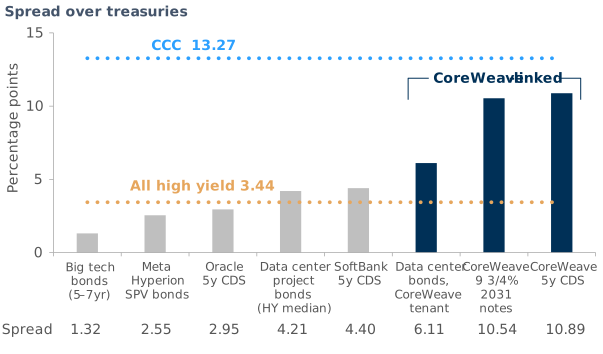
As of October 30, 2026
Source: Bloomberg, ICE BofA US High Yield and US Corporate indices; Big tech: Amazon, Alphabet, Meta and Oracle bonds maturing in 5 to 7 years. Chart concept adapted from Data Gravity (Chris Zeoli), Cheap Money Is the New Moat in AI Infrastructure, October 18, 2026. Project bonds: median of 20 high-yield data center and compute project bonds; CoreWeave tenant: average of five.
The cleanest test sits inside a single CoreWeave facility from May 2024. With the same borrower, collateral, date and maturity, draws against investment-grade customers priced at SOFR38 plus 6 to 6.5%. Everyone else paid 13%.39 The tenant, not the chips, sets the price.
The question for any deal is which side of the funding-versus-demand line it sits on. If our thesis is right, credits that depend only on demand should hold up. Credits that depend on the next financing are where the losses would show up first.
Step-in rights deserve a closer look. They let lenders take over operations or the site, so the GPUs keep running and the customer keeps paying, if the operator fails. In the recent GPU financings we have reviewed, lender step-in is moving from a soft ask toward a standard feature, with newer structures adding substitute-operator mechanics and direct agreements with data center landlords. Customer step-in rights remain rare. Earlier structures leaned more on efforts-based landlord letters backed by a parent guarantee. That matters for bondholders: where the backstop on secured debt is the operator's own parent, the secured layer is more tied to the residual than the "contract-backed" label suggests.
The framework points to owning the contracts and being careful with the residual. Yield on the residual layer is only compensation if the issuer can keep refinancing. With CDS implying high expected losses, driven as much by low likely recovery as by the odds of default, the burden of proof sits with the residual, not the contract.
Figure 8: Sorting AI infrastructure credit by what it actually depends on
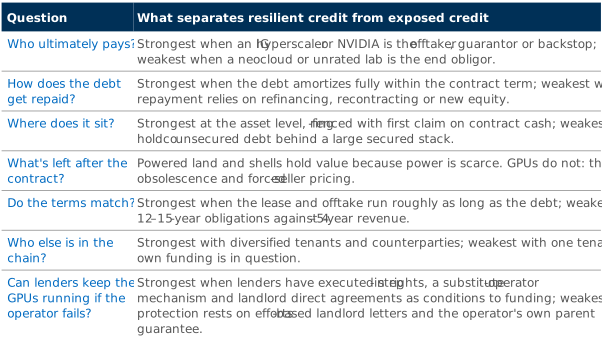
Figure 9: Signposts, from contained to spreading
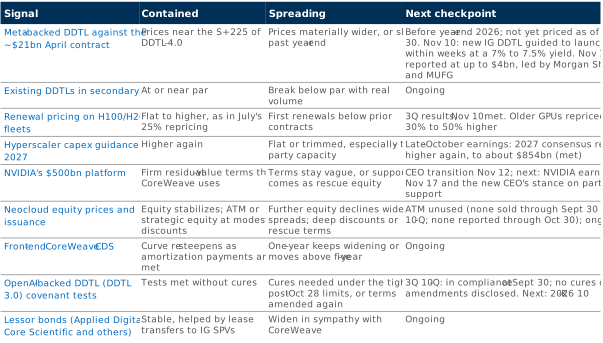
Checkpoints are scheduled or guided events, not forecasts of when stress spreads. Status is as of October 30, updated for CoreWeave’s November 10 results and 10-Q where noted. A December 2025 amendment to the OpenAI-backed facility allowed unlimited equity cures through October 28; cures for its debt-service coverage and contract-realization tests are now limited.
What would tell us the crack is spreading
The key question is whether stress moves from the holdco unsecureds into contract-backed paper and GPU pricing. So far it hasn't. We believe these are the places to watch.
Two signals matter most. The Meta DDTL tells us whether the cheap, contract-backed channel still works at size. Renewal pricing tells us whether step three of the historical sequence, forced sellers resetting prices, has started.
Postscript: third-quarter results (November 10)
CoreWeave's results reinforced both halves of our argument. Demand remains strong: revenue grew 168% year on year, pricing rose again, older GPUs were recontracted at rates 30% to 50% higher, and management described demand as roughly ten times available capacity. But the funding model is changing at the edge. Management said it does not intend to issue more parent-level unsecured debt through 2027. It also expects 2027 capital spending to stay roughly in line with 2026, at about $37bn to $39bn.40 It plans instead to rely on contract-matched secured loans, the next guided at an investment-grade yield of 7% to 7.5%, along with roughly $9bn of customer prepayments due over the next three months. For unsecured bondholders, that removes new supply but adds more secured debt ahead of them, which is the trade-off this piece describes.41 The 10-Q also disclosed that $1.9bn of customer contracts became cancellable during the quarter, without identifying the customer or the reason. Whether any of these contracts support secured debt is not disclosed, and it is worth monitoring.42 Separately, NVIDIA's chief executive, Jensen Huang, resigned on November 12. He was the executive most associated with NVIDIA's support for CoreWeave, including its equity investments and its $6.3bn capacity backstop. NVIDIA's board said customer commitments will continue without interruption, but the change adds uncertainty to the vendor support the edge has relied on.43 The situation remains fluid: Huang has reportedly discussed a return with allies, and some large shareholders have urged the board to keep that option open, while others, including the Treasury Secretary, have called for an outside successor. NVIDIA's existing commitments to CoreWeave, including the capacity backstop, are contractual; the open question is its appetite for new support.44
Bottom line
The market is no longer willing to finance growth at any price for the leveraged tier of the AI buildout. Access remains open, but at a higher cost, and early signs of the first step are appearing as lower-rated borrowers finance less, cushioned so far by private credit and equity. In past booms, a shift like this was the first step in a longer sequence. Whether it becomes one here depends on the signposts above.
On current estimates, we believe CoreWeave needs open capital markets through at least 2028. Still, this isn't yet an unraveling of AI demand. Pricing is up, buyers are short of capacity, and the contract-backed debt is holding near par. The core hyperscalers can fund themselves.
The risk lies in the sequence, not the snapshot. If the edge slows its ordering, suppliers feel it. If an edge borrower fails, its GPUs come to market cheap, and that's how a funding problem becomes a pricing problem for everyone. Until the Meta DDTL prices and the first big renewals print, the right posture is to separate the layers: own the contracts, be careful with the residual, and watch the forced-seller channel more closely than the headlines.
1. Bloomberg, prices as of October 30, 2026 (see Figure 2).
2. Free cash flow: Bloomberg consensus estimates (BEst) as of October 30, 2026 (see Figure 3).
3. "Neocloud" refers to a newer class of cloud providers, such as CoreWeave, Nebius, Nscale and Lambda, that specialize in renting GPU computing capacity for AI workloads. Unlike the large hyperscalers, they typically fund their buildouts with debt secured on customer contracts and GPUs.
4. Bloomberg.
5. Moonshot AI released the open-weight Kimi K3 model on July 16, 2026.
6. JunkBondInvestor, The Cost of Capital Finally Bites, October 18, 2026.
7. Social media post on X by Chamath Palihapitiya, October 13, 2026.
8. Gartner, Inc., Gartner Says Over $3.5 Trillion of AI Infrastructure Spending Could Be Exposed to Impairment by the End of 2030, press release, October 14, 2026.
9. The H100 is NVIDIA's Hopper-generation data center GPU, introduced in 2022 and widely used to train and run large AI models. Rental rates are typically quoted per GPU per hour and are a common benchmark for the price of AI compute.
10. OpenRouter is an AI marketplace and API gateway that lets developers access hundreds of large language models from many providers through a single API key and billing account. Its public usage data is a widely cited gauge of token volumes and pricing across models. Data cited: OpenRouter, The Token State of Play, September 22, 2026.
11. Ramp AI Index (Ramp), monthly enterprise spending data through September 2026.
12. Prices: Bloomberg. Rate attribution: NYLIM/MacKay Shields estimates.
13. DDTL (Delayed Draw Term Loan) is a loan facility that allows a borrower to draw funds over a specified period rather than receiving the full amount upfront. It provides committed financing for future needs, such as acquisitions or capital expenditures, with interest generally accruing only on amounts drawn and commitment fees charged on undrawn amounts.
14. Moves through October 15: Barclays US High Yield Research, CoreWeave (CRWV): In the Eye of the AI Storm, October 15, 2026. October 30 prices: Bloomberg. Fund mark: No Diligence, Who Actually Pays If the AI Data Centre Bet Goes Wrong, based on fund holdings disclosures.
15. Bloomberg.
16. Barclays US High Yield Research, CoreWeave (CRWV): In the Eye of the AI Storm, October 15, 2026.
17. Average cost of debt: Data Gravity (Chris Zeoli), Cheap Money Is the New Moat in AI Infrastructure, October 18, 2026. Note maturities: CoreWeave public filings.
18. CoreWeave, Inc., Form 10-Q for the quarter ended September 30, 2026 (convertible senior notes); NYLIM/MacKay Shields estimates.
19. Bloomberg. October 15: mid-market spreads. October 30: spreads converted from upfront quotes with Bloomberg CDSW.
20. When a CDS credit event occurs, contracts are usually settled through an auction that sets a single final price. Protection buyers may deliver any bond that meets the contract's deliverable-obligation criteria, generally debt ranking equally with the reference obligation (here, senior unsecured). Senior unsecured convertible notes can qualify, and the lowest-priced eligible bond tends to anchor the auction price.
21. Bloomberg, October 30, 2026. Share count: CoreWeave Form 10-Q for the quarter ended September 30, 2026.
22. CoreWeave, Inc., Form 10-Q for the quarter ended June 30, 2026.
23. S&P Global Ratings.
24. Contract margins, renewals and the A100 contract: CoreWeave second-quarter 2026 earnings call, August 2026. List-price and AWS capacity-block changes: No Diligence, Who Actually Pays If the AI Data Centre Bet Goes Wrong.
25. Public remarks by Nebius's chief executive (September 9, 2026) and SpaceX's chief financial officer (September 10, 2026).
26. Anthropic: Bloomberg News, October 14, 2026. OpenAI: Reuters, October 2026.
27. BofA Global Research, Coreweave: Digging into higher capacity adds, price increases and a risk mitigation strategy, October 15, 2026, based on company reports.
28. Bloomberg News, Amazon Taps $80 Billion Supplier Loan Facility to Help Fund AI, October 30, 2026, reporting on Amazon's quarterly filing.
29. Silicon Data H100 rental rate forward curve, via Bloomberg, October 2026.
30. $364bn tally: No Diligence, Who Actually Pays If the AI Data Centre Bet Goes Wrong. Neocloud contract total: company filings and announced deals, as compiled by Rod Dubitsky, CoreWeave Crashes: Chronicle of a Death Foretold?, October 15, 2026.
31. BofA Global Research, High Yield & Loan Strategy, Funding the Future #4, September 11, 2026.
32. CoreWeave and NVIDIA public filings and announcements. Financing platform terms as reported by the Financial Times, October 14, 2026.
33. NYLIM/MacKay Shields estimates based on ICE BofA US High Yield Index option-adjusted spreads, October 30, 2026; averages of five CoreWeave-tenanted and 15 other high-yield data center and compute project bonds.
34. J.P. Morgan North America Credit Research, AI Capex Funding: Data Center Hyperscaler Bond Matrix 3.0, October 29, 2026.
35. Morgan Stanley, Data Center Financing: A Path Forward Through Volatility, October 2026.
36. Oracle CDS: Bloomberg. Force majeure notice: Bloomberg News, September 24, 2026. Loan levels: indicative dealer quotes, October 29, 2026.
37. NYLIM/MacKay Shields estimates based on ICE BofA US High Yield Index constituent data.
38. SOFR, the Secured Overnight Financing Rate, is a benchmark interest rate published by the Federal Reserve Bank of New York. It is based on overnight borrowing against U.S. Treasury securities and has replaced USD LIBOR as the reference rate for most floating-rate loans.
39. NYLIM/MacKay Shields estimates, based on CoreWeave's Form S-1 description of the facility.
40. CoreWeave third-quarter 2026 earnings call, November 10, 2026.
41. CoreWeave third-quarter 2026 results and earnings call, November 10, 2026.
42. CoreWeave, Inc., Form 10-Q for the quarter ended September 30, 2026 (Note 2, Contract Balances).
43. NVIDIA Corporation, Form 8-K, November 12, 2026; PitchBook Credit News, CoreWeave Bonds Bobble as New DDTL Plans, Nvidia Drama Overshadow Earnings, November 12, 2026.
44. Financial Times, November 15, 2026; CNBC, November 14, 2026; Reuters, November 15, 2026.
SOURCES
NYLIM/MacKay Shields credit research and estimates.
Market data (as of October 30, 2026 unless noted): Bloomberg; ICE Data Indices: ICE BofA US High Yield Index (H0A0) and ICE BofA US Corporate Index (C0A0).
Dealer quotes for CoreWeave loans and CDS and for the Project Jupiter construction loan, October 15 to 30, 2026.
OpenRouter, The Token State of Play, September 22, 2026; OpenAI and Anthropic API pricing pages, accessed October 23, 2026; Ramp AI Index.
Barclays US High Yield Research, CoreWeave (CRWV): In the Eye of the AI Storm, October 15, 2026.
BofA Global Research: Coreweave: Digging into higher capacity adds, price increases and a risk mitigation strategy, October 15, 2026; High Yield & Loan Strategy, Funding the Future #4, September 11, 2026; Situation Room, November 4, 2026.
J.P. Morgan North America Credit Research, AI Capex Funding: Data Center Hyperscaler Bond Matrix 3.0, October 29, 2026; J.P. Morgan North America Equity Research, CoreWeave: Debt Concerns Reflect Sentiment Around Timing of Cash Flows, October 16, 2026.
Citi Research, Speculative Grade Beat: Distressed AI CDS, October 2026; Deutsche Bank Credit Strategy, Neocloudy, October 2026; Morgan Stanley, Data Center Financing: A Path Forward Through Volatility, October 2026; Citadel Securities Macro Strategy, Tokenomics 2.0, October 27, 2026.
Data Gravity (Chris Zeoli), Cheap Money Is the New Moat in AI Infrastructure, October 18, 2026; JunkBondInvestor, The Cost of Capital Finally Bites, October 18, 2026; No Diligence, Who Actually Pays If the AI Data Centre Bet Goes Wrong.
Bloomberg News, Oracle Cites Force Majeure to Shield Itself on Controversial Data Center, September 24, 2026; Financial Times, Big Tech Uses Guarantees to Keep $300bn of AI Exposure Off Balance Sheets, September 20, 2026.
Rod Dubitsky, CoreWeave Crashes: Chronicle of a Death Foretold?, October 15, 2026; Gartner, Inc., Gartner Says Over $3.5 Trillion of AI Infrastructure Spending Could Be Exposed to Impairment by the End of 2030, press release, October 14, 2026.
S&P Global Ratings, recovery assessment for CoreWeave senior unsecured notes.
CoreWeave, Inc., Forms 10-Q for the quarters ended June 30 and September 30, 2026; CoreWeave, DDTL 4.0: $8.5 Billion First-of-a-Kind Facility, investor presentation, March 2026.
CoreWeave third-quarter 2026 results and earnings call, November 10, 2026, as summarized in research from Morgan Stanley, J.P. Morgan, BofA Global Research, Barclays, Citi and Goldman Sachs, November 10 to 11, 2026; BofA Global Research High Yield Credit, CoreWeave: Fighting the Tape, November 5, 2026.
Bloomberg News, Amazon Taps $80 Billion Supplier Loan Facility to Help Fund AI, October 30, 2026.
NVIDIA Corporation, Form 8-K, November 12, 2026; PitchBook Credit News, CoreWeave Bonds Bobble as New DDTL Plans, Nvidia Drama Overshadow Earnings, November 12, 2026; Financial Times, CNBC and Reuters reporting on NVIDIA’s CEO search, November 14 to 15, 2026.
IMPORTANT DISCLOSURE
Availability of products and services provided by MacKay Shields may be limited by applicable laws and regulations in certain jurisdictions and this document is provided only for persons to whom this document and the products and services of MacKay Shields may otherwise lawfully be issued or made available. None of the products and services provided by MacKay Shields are offered to any person in any jurisdiction where such offering would be contrary to local law or regulation. This document is provided for information purposes only. It does not constitute investment advice and should not be construed as an offer to buy securities. The contents of this document have not been reviewed by any regulatory authority in any jurisdiction. All investments contain risks and may lose value and these materials do not undertake to explain all of the risks associated with any investment strategy referred to herein. Clients and investors should not invest in any strategy referred to herein unless satisfied that they and/or their representatives have requested and received all information that would enable them to evaluate the merits and risks thereof. Any forward-looking statements speak only as of the date they are made, and MacKay Shields assumes no duty and does not undertake to update forward looking statements. Any opinions expressed are the views and opinions of certain investment professionals at MacKay Shields which are subject to change without notice. There may have been, and may in the future be, changes to the investment personnel responsible for the management of the strategy(ies) described herein, as well as changes to the investment process utilized by such investment personnel. Past performance is not indicative of future results.
Information included herein should not be considered predicative of future transactions or commitments made by MacKay Shields LLC nor as an indication of current or future profitability. There is no assurance investment objectives will be met.
At the time of writing, MacKay Shields LLC maintains investments in the securities, issuers and/or companies cited herein. References to such securities, issuers and/or companies are for educational and informational purposes only, and are intended to convey factual information and current market conditions. Such names are not intended, nor should they be construed as, a recommendation to buy and sell any individual security.
Information included herein should not be considered predicative of future transactions or commitments made by MacKay Shields LLC nor as an indication of current or future profitability. There is no assurance investment objectives will be met.
Past performance is not indicative of future results.
NOTE TO UK AND EUROPEAN UNION AUDIENCE
This document is intended only for the use of professional investors as defined in the Alternative Investment Fund Manager’s Directive and/or the UK Financial Conduct Authority’s Conduct of Business Sourcebook. To the extent this document has been issued in the United Kingdom, it has been issued by NYL Investments UK LLP, 200 Aldersgate Street, London UK EC1A 4HD, which is authorised and regulated by the UK Financial Conduct Authority. To the extent this document has been issued in the EEA, it has been issued by NYL Investments Europe Limited, 77 Sir John Rogerson's Quay, Block C Dublin D02 VK60 Ireland. NYL Investments Europe Limited is authorized and regulated by the Central Bank of Ireland (i) to act as an alternative investment fund manager of alternative investment funds under the Alternative Investment Fund Managers Directive (Directive 2011/61/EU) and (ii) to provide the services of individual portfolio management, investment advice and the receipt and transmission of orders as defined in Regulation 7(4) of the AIFMD Regulations to persons who meet the definition of “professional client” as set out in the MiFID Regulations. It has passported its license in additional countries in the EEA.
This document only describes capabilities of certain affiliates of New York Life Investment Management LLC and/or MacKay Shields LLC. No such affiliates will accept subscriptions in any funds not admitted to marketing in your country or provide services to potential customers in your country, including discretionary asset management services, except where it is licensed to do so or can rely on an applicable exemption.
MacKay Shields LLC is a wholly owned subsidiary of New York Life Investment Management Holdings LLC, which is wholly owned by New York Life Insurance Company. “New York Life Investment Management” is the brand name and service mark used to represent a group of affiliated investment advisors of New York Life Insurance Company, including New York Life Investment Management LLC, a registered investment advisor.
NOTE TO CANADIAN RECIPIENTS
The information in these materials is not an offer to sell securities or a solicitation of an offer to buy securities in any jurisdiction of Canada. In Canada, any offer or sale of securities or the provision of any advisory or investment fund manager services will be made only in accordance with applicable Canadian securities laws. More specifically, any offer or sale of securities will be made in accordance with applicable exemptions to dealer and investment fund manager registration requirements, as well as under an exemption from the requirement to file a prospectus, and any advice given on securities will be made in reliance on applicable exemptions to adviser registration requirements.
Information included herein should not be considered predicative of future transactions or commitments made by MacKay Shields LLC nor as an indication of current or future profitability. There is no assurance investment objectives will be met. Past performance is not indicative of future results.
NOTE TO JAPANESE RECIPIENTS
In Japan, this is issued by New York Life Investment Management Asia Limited (Financial Instruments Business Operator, Kanto Local Finance Bureau (FIBO) No. 2964, Member of the Investment Management Association of Japan and the Type 2 Financial Instruments Firms Association) for institutional investors only. As costs and/or fees to be borne by investors vary depending on circumstances such as products, services, investment period and market conditions, the total amount nor the calculation methods cannot be disclosed in advance. All investments involve risks, including market fluctuation and investors may lose the principal amount invested. Investors should obtain and read the prospectus and/or information set forth in Article 37-3 of the Financial Instruments and Exchange Act carefully before making investment decisions.
SOURCE INFORMATION
“Bloomberg®”, “Bloomberg Indices®”, Bloomberg Fixed Income Indices, Bloomberg Equity Indices and all other Bloomberg indices referenced herein are service marks of Bloomberg Finance L.P. and its affiliates, including Bloomberg Index Services Limited (“BISL”), the administrator of the indices (collectively, “Bloomberg”) and have been licensed for use for certain purposes by MacKay Shields LLC (“MacKay Shields”). Bloomberg is not affiliated with MacKay Shields, and Bloomberg does not approve, endorse, review, or recommend MacKay Shields or any products, funds or services described herein. Bloomberg does not guarantee the timeliness, accurateness, or completeness of any data or information relating to MacKay Shields or any products, funds or services described herein.
Subscribe to get MacKay Shields insights delivered to your inbox.
Related Thought Leadership