
Following a significant sell-off in the US Treasury market, all-in yields sit near their highest levels since 2007, while credit spreads have widened only modestly and remain near historical tights. This has been a rates repricing, not a credit event. Growth and earnings remain firm enough to keep credit risk contained while carry continues to be one of the clearest opportunities in the bond market today.
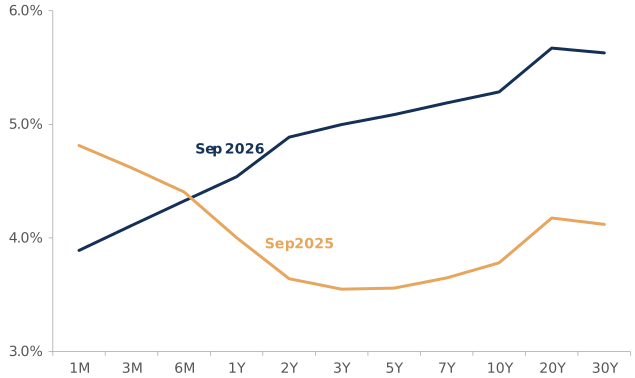
Figure 1: Yield Curve
Higher rates, strong economy
The bond market has re-priced but in our view it is not broken. While there continues to be an ongoing “wall of worry” regarding inflation, monetary policy, the Middle East conflict, AI and midterm elections, nominal bond yields (and real yields) have climbed on a firmer growth impulse, a labor market still adding jobs, inflation that has proven stubbornly sticky, with the BEA reporting core PCE above 3%, and oil above $100 (source: Bloomberg). The Fed responded with its first hike of this cycle in September, and 30-day Fed Fund futures markets pricing additional hikes through 2027 (source: CME Group), and tightening is global, with the Bank of Japan, European Central Bank and several other central banks also hiking.
Importantly, rising yields driven by strong economic activity and firm earnings represent a different signal than rising yields driven by credit stress or a funding crisis. Corporate balance sheets remain in good shape (Barclay’s reports investment-grade EBITDA grew 19.5% year-over-year in 2Q, with record margins and lower leverage), leveraged loan defaults are near 2% according to BofA Securities, and heavy issuance has been readily absorbed by healthy demand.
Get paid even more to wait
Carry is simply the income an investor earns from yield and price roll-down, independent of whether rates move at all. All-in yields across both investment-grade corporate credit and structured credit now sit well above their longer-term historical averages; the Bloomberg U.S. Corporate index yields roughly 6%, more than 100bp higher than a year ago. The repricing has been broad enough that higher rated issuers now offer yields that, in prior cycles, were typically only available further down the credit spectrum— a materially better risk-reward trade-off than reaching for yield in weaker credits.
Elevated starting yields also provide a cushion: at a roughly 6% yield and 6.5-year duration, we estimate that the Bloomberg U.S. Corporate index could absorb a rise of about 90bp in yields over the next year before its total return turns negative — a margin of safety that simply did not exist when yields were much lower.
It’s not just about fixed rate income
- Floating rate obligations, including bank loans, CLOs and certain securitized assets, carry minimal duration risk and reset higher as policy tightens — ballast against renewed rate volatility or an inflation surprise.
- Fixed rate investments such as investment-grade corporates, Treasuries, and agency MBS take advantage of the income opportunities available at today’s yield levels. and stand to appreciate when policy eventually reverses.
The right mix allows an investor to realize today's income while staying prepared for two possible outcomes: 1) a longer and deeper tightening cycle, or 2) an eventual pivot as inflation cools.
Where we see value
At the margin, we favor high-quality securitized credit over investment-grade corporates. Agency MBS spreads have repriced wider with the rate sell-off while corporate spreads have not: the investment-grade index now yields only 16bp more than the Bloomberg MBS index, versus a 10-year average of 50bp. In corporates, fundamentals are strong, but tight spreads and heavy AI-related issuance argue for issuer selectivity over broad exposure.
Stay in the belly of the curve
We believe the sweet spot is still in the short-to-intermediate part of the yield curve (the “belly”), which offers attractive yield while limiting the reinvestment risk of the front end and the term-premium and volatility exposure of the long end. With markets already pricing roughly 90bp of further hikes, more than most economists expect, intermediate yields offer a cushion should the Fed deliver less than priced. And with 5-year Treasuries yielding over 5% versus roughly 4% on 1-month bills, investors are paid to move out of cash.
Investing is not without risk
Importantly, we see four key risks to our thesis that need to be monitored closely: 1) inflation re-acceleration, particularly if Middle East disruptions keep oil elevated, could force the Fed to tighten more than markets expect, pushing yields higher; 2) fiscal and supply pressure at the long end can further widen the term premium; 3) a sudden growth slowdown would widen credit spreads from tight starting levels; and 4) the scale of AI-related borrowing could pressure spreads in concentrated sectors.
Summary of views
- Favor short-to-intermediate duration for the best trade-off between carry and interest rate risk.
- Blend floating- and fixed-rate exposure rather than making a single bet on the trajectory of policy.
- Stay up in quality—earn compelling carry without extending risk.
- Favor high-quality securitized credit over investment-grade corporates at the margin; be selective in corporates.
- Deploy cash and stay invested.
IMPORTANT DISCLOSURE
Availability of products and services provided by MacKay Shields may be limited by applicable laws and regulations in certain jurisdictions and this document is provided only for persons to whom this document and the products and services of MacKay Shields may otherwise lawfully be issued or made available. None of the products and services provided by MacKay Shields are offered to any person in any jurisdiction where such offering would be contrary to local law or regulation. This document is provided for information purposes only. It does not constitute investment advice and should not be construed as an offer to buy securities. The contents of this document have not been reviewed by any regulatory authority in any jurisdiction. All investments contain risks and may lose value and these materials do not undertake to explain all of the risks associated with any investment strategy referred to herein. Clients and investors should not invest in any strategy referred to herein unless satisfied that they and/or their representatives have requested and received all information that would enable them to evaluate the merits and risks thereof. Any forward-looking statements speak only as of the date they are made, and MacKay Shields assumes no duty and does not undertake to update forward looking statements. Any opinions expressed are the views and opinions of certain investment professionals at MacKay Shields which are subject to change without notice. There may have been, and may in the future be, changes to the investment personnel responsible for the management of the strategy(ies) described herein, as well as changes to the investment process utilized by such investment personnel. Past performance is not indicative of future results.
Information included herein should not be considered predicative of future transactions or commitments made by MacKay Shields LLC nor as an indication of current or future profitability. There is no assurance investment objectives will be met.
Past performance is not indicative of future results.
NOTE TO UK AND EUROPEAN UNION AUDIENCE
This document is intended only for the use of professional investors as defined in the Alternative Investment Fund Manager’s Directive and/or the UK Financial Conduct Authority’s Conduct of Business Sourcebook. To the extent this document has been issued in the United Kingdom, it has been issued by NYL Investments UK LLP, 200 Aldersgate Street, London UK EC1A 4HD, which is authorised and regulated by the UK Financial Conduct Authority. To the extent this document has been issued in the EEA, it has been issued by NYL Investments Europe Limited, 77 Sir John Rogerson's Quay, Block C Dublin D02 VK60 Ireland. NYL Investments Europe Limited is authorized and regulated by the Central Bank of Ireland (i) to act as an alternative investment fund manager of alternative investment funds under the Alternative Investment Fund Managers Directive (Directive 2011/61/EU) and (ii) to provide the services of individual portfolio management, investment advice and the receipt and transmission of orders as defined in Regulation 7(4) of the AIFMD Regulations to persons who meet the definition of “professional client” as set out in the MiFID Regulations. It has passported its license in additional countries in the EEA.
This document only describes capabilities of certain affiliates of New York Life Investments and/or MacKay Shields LLC. No such affiliates will accept subscriptions in any funds not admitted to marketing in your country or provide services to potential customers in your country, including discretionary asset management services, except where it is licensed to do so or can rely on an applicable exemption.
MacKay Shields LLC is a wholly owned subsidiary of New York Life Investment Management Holdings LLC, which is wholly owned by New York Life Insurance Company. “New York Life Investment Management” is the brand name and service mark used to represent a group of affiliated investment advisors of New York Life Insurance Company, including New York Life Investment Management LLC, a registered investment advisor.
NOTE TO CANADIAN RECIPIENTS
The information in these materials is not an offer to sell securities or a solicitation of an offer to buy securities in any jurisdiction of Canada. In Canada, any offer or sale of securities or the provision of any advisory or investment fund manager services will be made only in accordance with applicable Canadian securities laws. More specifically, any offer or sale of securities will be made in accordance with applicable exemptions to dealer and investment fund manager registration requirements, as well as under an exemption from the requirement to file a prospectus, and any advice given on securities will be made in reliance on applicable exemptions to adviser registration requirements.
Information included herein should not be considered predicative of future transactions or commitments made by MacKay Shields LLC nor as an indication of current or future profitability. There is no assurance investment objectives will be met. Past performance is not indicative of future results.
NOTE TO JAPANESE RECIPIENTS
In Japan, this is issued by New York Life Investment Management Asia Limited (Financial Instruments Business Operator, Kanto Local Finance Bureau (FIBO) No. 2964, Member of the Investment Management Association of Japan and the Type 2 Financial Instruments Firms Association) for institutional investors only. As costs and/or fees to be borne by investors vary depending on circumstances such as products, services, investment period and market conditions, the total amount nor the calculation methods cannot be disclosed in advance. All investments involve risks, including market fluctuation and investors may lose the principal amount invested. Investors should obtain and read the prospectus and/or information set forth in Article 37-3 of the Financial Instruments and Exchange Act carefully before making investment decisions.
SOURCE INFORMATION
“Bloomberg®”, “Bloomberg Indices®”, Bloomberg Fixed Income Indices, Bloomberg Equity Indices and all other Bloomberg indices referenced herein are service marks of Bloomberg Finance L.P. and its affiliates, including Bloomberg Index Services Limited (“BISL”), the administrator of the indices (collectively, “Bloomberg”) and have been licensed for use for certain purposes by MacKay Shields LLC (“MacKay Shields”). Bloomberg is not affiliated with MacKay Shields, and Bloomberg does not approve, endorse, review, or recommend MacKay Shields or any products, funds or services described herein. Bloomberg does not guarantee the timeliness, accurateness, or completeness of any data or information relating to MacKay Shields or any products, funds or services described herein.
Subscribe to get MacKay Shields insights delivered to your inbox.
Related Thought Leadership