
Executive summary
- The war in Iran represents a broad-based supply shock that is likely to slow global growth and push inflation higher, though the direct impact on the U.S. economy should remain manageable.
- Against a backdrop of elevated inflation and moderating growth, the Federal Reserve is likely to remain on hold, as policymakers balance upside risks to inflation against a gradual softening in activity.
- For fixed income markets, higher yields, increased volatility, and modest spread widening have improved forward return potential, with income remaining the primary driver of returns.
- We maintain a neutral to modestly long duration stance, favor intermediate maturities, and emphasize higher-quality credit and securitized assets, as dispersion across sectors reinforces the importance of selectivity and disciplined portfolio construction.
Macroeconomic outlook
The war in Iran poses meaningful downside risks to the global economy, particularly for oil-importing economies in Asia and Europe that are most vulnerable to disruptions in flows through the Strait of Hormuz. Beyond energy markets, the conflict represents a broader supply shock with potential spillovers into key industrial inputs, including fertilizer, plastics, aluminum and segments of the semiconductor supply chain. While the scale of disruption is unlikely to approach that seen during the pandemic, the war nonetheless introduces a stagflationary impulse, constraining output while placing upward pressure on global prices.
For the U.S. economy, the macroeconomic impact should remain manageable provided the conflict does not escalate further and shipping through the Strait begins to normalize in the coming weeks. Recent developments on this front have been mixed, however, and pricing in prediction markets reflects expectations that a return to more typical vessel traffic may not occur until early summer. Against this backdrop, we have lowered our US growth forecast for this year by 50 basis points, to two percent. The revision reflects both higher energy prices and the drag from tighter global supply conditions. The state of the U.S. consumer also factors into this adjustment. Compared with the 2022 energy price spike, household resilience appears more limited, with a softer labor market, higher debt servicing burdens, and reduced savings all suggesting less capacity to absorb an external shock.
Figure 1: Global manufacturing PMIs are already reflecting increased supply chain stresses
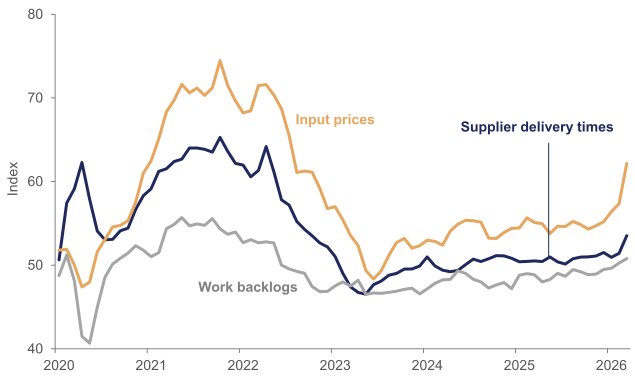
Source: S&P Global. Readings above 50 indicate that a greater share of responding firms report rising input prices, longer supplier delivery times, or increasing backlogs of work
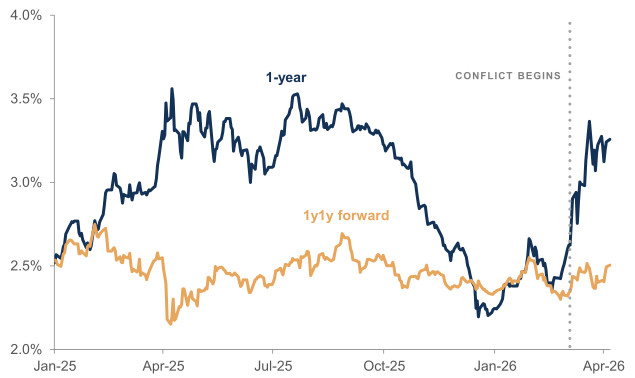
While the impact on headline inflation is likely to be meaningful, the effect on core inflation should be more limited and mainly reflecting higher transportation costs, increased input prices for goods such as plastics, and broader supply chain frictions. Assuming inflation expectations remain anchored, we expect core PCE inflation to end the year roughly where it began, at around three percent, for a second consecutive year. (see Figure 2)
We continue to expect monetary policy to remain on hold this year. While markets have at times priced in the possibility of a rate hike by year-end, we remain skeptical of such an outcome. As long as inflation expectations remain contained, policymakers are likely to look through a temporary energy-driven increase in inflation, particularly given the associated drag on growth and labor demand. We expect incoming Fed Chair Kevin Warsh to take a similar approach, remaining focused on underlying inflation dynamics and requiring clearer evidence of second-round effects before considering any tightening of policy.
Figure 2: Beyond the next year, inflation expectations remain anchored
Source: Barclays
Market and portfolio implications
A macroeconomic backdrop characterized by slowing growth, persistent inflation near three percent, and a Federal Reserve on hold creates an environment in which fixed income returns are increasingly driven by income, selectivity, and careful sector allocation than in recent years. The stagflationary nature of the current shock, combined with elevated uncertainty, has contributed to higher volatility and a more uneven performance across sectors. At the same time, higher starting yields and recent spread widening have improved forward return potential, reinforcing the role of fixed income as both an income-generating and diversifying asset class. In this environment, carry may continue to be a significant driver of returns, while episodic volatility may create opportunities for selective positioning.
Rates outlook: rangebound with a mild steepening bias
We expect the 10-year Treasury to remain in a relatively broad range of roughly 4.0% to 4.5% in the near term. Slower growth and the potential for eventual policy easing once inflation stabilizes may limit upward pressure on yields, while elevated fiscal deficits and Treasury supply concerns argue for continued caution around the long end of the curve. In this environment, duration is unlikely to be the primary source of return, and we favor intermediate maturities and curve positioning over aggressive long-end exposure.
Return profile: income still dominates
The first quarter reinforced a simple but important point: in a higher-rate world, fixed income does not need a large rally to generate attractive returns. Income remains the foundation of the asset class. At the same time, the market weakness late in the quarter improved the entry point in several sectors, increasing the potential for capital appreciation.
This is also an environment in which dispersion is increasing. Broad market exposure is less attractive than it was when spreads were tighter and volatility was lower. In our view, returns from here are more likely to come from careful sector selection, structural advantages, and security-specific opportunities than from broad beta exposure alone.
Credit outlook
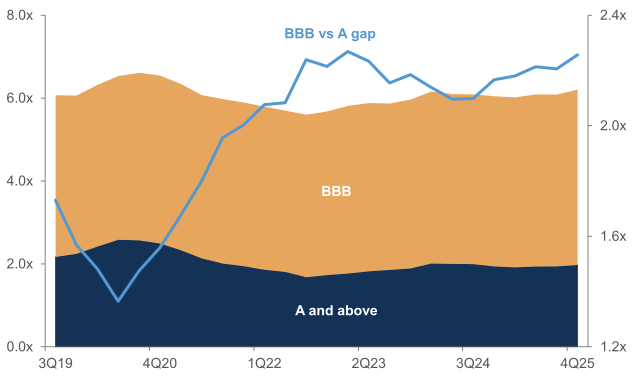
Corporate credit fundamentals remain broadly stable, but the picture is becoming more uneven. In investment grade, balance sheets are still generally healthy, and all-in yields remain attractive. However, margins are no longer improving across the board, and weaker credits are beginning to show more strain than stronger issuers. That argues for maintaining a quality bias, particularly within BBB-rated credit and more cyclical industries.
In high yield, higher-quality segments continue to offer a more attractive risk-reward tradeoff than lower-quality credit. Wider spreads have improved compensation, but not all parts of the market have repriced equally. We continue to favor the upper tier of high yield, where carry remains compelling and refinancing risk is more manageable.
We remain more cautious on leveraged loans. Their floating-rate structure provided relative support in the quarter, but that same feature continues to pressure weaker borrowers. In our view, loans remain more vulnerable in a slowing growth environment, especially where issuers face margin pressure, elevated leverage, or business-model uncertainty. That caution extends to parts of the market adjacent to private credit, where transparency, valuation discipline, and refinancing flexibility may prove increasingly important as the year progresses.
While a sharp deterioration in credit is not our base case, spread widening risk has increased, particularly in lower-quality segments and in sectors where refinancing needs are rising into a still-restrictive funding backdrop.
Figure 3: Rising leverage gap between AAA-a and BBB issuers | gross leverage
Source: JP Morgan
Conclusion
The first quarter of 2026 did not undermine the case for fixed income. It refined it. The environment remains favorable for income generation, but the path forward is likely to be less forgiving for lower-quality credits and broad beta exposure. In our view, public fixed income has regained its role as a meaningful source of income and portfolio diversification, but the market is increasingly rewarding selectivity, liquidity, and balance-sheet strength. Accordingly, we believe that maintaining a focus on income, quality, and liquidity remains critical as markets navigate a more uncertain macroeconomic and policy landscape.
IMPORTANT DISCLOSURE
Availability of products and services provided by MacKay Shields may be limited by applicable laws and regulations in certain jurisdictions and this document is provided only for persons to whom this document and the products and services of MacKay Shields may otherwise lawfully be issued or made available. None of the products and services provided by MacKay Shields are offered to any person in any jurisdiction where such offering would be contrary to local law or regulation. This document is provided for information purposes only. It does not constitute investment advice and should not be construed as an offer to buy securities. The contents of this document have not been reviewed by any regulatory authority in any jurisdiction. All investments contain risks and may lose value and these materials do not undertake to explain all of the risks associated with any investment strategy referred to herein. Clients and investors should not invest in any strategy referred to herein unless satisfied that they and/or their representatives have requested and received all information that would enable them to evaluate the merits and risks thereof. Any forward-looking statements speak only as of the date they are made, and MacKay Shields assumes no duty and does not undertake to update forward looking statements. Any opinions expressed are the views and opinions of certain investment professionals at MacKay Shields which are subject to change without notice. There may have been, and may in the future be, changes to the investment personnel responsible for the management of the strategy(ies) described herein, as well as changes to the investment process utilized by such investment personnel. Past performance is not indicative of future results.
At the time of writing, MacKay Shields LLC maintains investments in the securities, issuers and/or companies cited herein. References to such securities, issuers and/or companies for educational and informational purposes only, and are intended to convey factual information and current market conditions. Such names are not intended, nor should they be construed as, a recommendation to buy and sell any individual security.
Information included herein should not be considered predicative of future transactions or commitments made by MacKay Shields LLC nor as an indication of current or future profitability. There is no assurance investment objectives will be met.
Past performance is not indicative of future results.
NOTE TO UK AND EUROPEAN UNION AUDIENCE
This document is intended only for the use of professional investors as defined in the Alternative Investment Fund Manager’s Directive and/or the UK Financial Conduct Authority’s Conduct of Business Sourcebook. To the extent this document has been issued in the United Kingdom, it has been issued by NYL Investments UK LLP, 200 Aldersgate Street, London UK EC1A 4HD, which is authorised and regulated by the UK Financial Conduct Authority. To the extent this document has been issued in the EEA, it has been issued by NYL Investments Europe Limited, 77 Sir John Rogerson's Quay, Block C Dublin D02 VK60 Ireland. NYL Investments Europe Limited is authorized and regulated by the Central Bank of Ireland (i) to act as an alternative investment fund manager of alternative investment funds under the Alternative Investment Fund Managers Directive (Directive 2011/61/EU) and (ii) to provide the services of individual portfolio management, investment advice and the receipt and transmission of orders as defined in Regulation 7(4) of the AIFMD Regulations to persons who meet the definition of “professional client” as set out in the MiFID Regulations. It has passported its license in additional countries in the EEA.
This document only describes capabilities of certain affiliates of New York Life Investments and/or MacKay Shields LLC. No such affiliates will accept subscriptions in any funds not admitted to marketing in your country or provide services to potential customers in your country, including discretionary asset management services, except where it is licensed to do so or can rely on an applicable exemption.
MacKay Shields LLC is a wholly owned subsidiary of New York Life Investment Management Holdings LLC, which is wholly owned by New York Life Insurance Company. “New York Life Investment Management” is the brand name and service mark used to represent a group of affiliated investment advisors of New York Life Insurance Company, including New York Life Investment Management LLC, a registered investment advisor.
NOTE TO CANADIAN RECIPIENTS
The information in these materials is not an offer to sell securities or a solicitation of an offer to buy securities in any jurisdiction of Canada. In Canada, any offer or sale of securities or the provision of any advisory or investment fund manager services will be made only in accordance with applicable Canadian securities laws. More specifically, any offer or sale of securities will be made in accordance with applicable exemptions to dealer and investment fund manager registration requirements, as well as under an exemption from the requirement to file a prospectus, and any advice given on securities will be made in reliance on applicable exemptions to adviser registration requirements.
Information included herein should not be considered predicative of future transactions or commitments made by MacKay Shields LLC nor as an indication of current or future profitability. There is no assurance investment objectives will be met. Past performance is not indicative of future results.
NOTE TO JAPANESE RECIPIENTS
In Japan, this is issued by New York Life Investment Management Asia Limited (Financial Instruments Business Operator, Kanto Local Finance Bureau (FIBO) No. 2964, Member of the Investment Management Association of Japan and the Type 2 Financial Instruments Firms Association) for institutional investors only. As costs and/or fees to be borne by investors vary depending on circumstances such as products, services, investment period and market conditions, the total amount nor the calculation methods cannot be disclosed in advance. All investments involve risks, including market fluctuation and investors may lose the principal amount invested. Investors should obtain and read the prospectus and/or information set forth in Article 37-3 of the Financial Instruments and Exchange Act carefully before making investment decisions.
MacKay Shields LLC is a wholly owned subsidiary of New York Life Investment Management Holdings LLC, which is wholly owned by New York Life Insurance Company. “New York Life Investment Management” is the brand name and service mark used to represent a group of affiliated investment advisors of New York Life Insurance Company, including New York Life Investment Management LLC, a registered investment advisor.
SOURCE INFORMATION
“Bloomberg®”, “Bloomberg Indices®”, Bloomberg Fixed Income Indices, Bloomberg Equity Indices and all other Bloomberg indices referenced herein are service marks of Bloomberg Finance L.P. and its affiliates, including Bloomberg Index Services Limited (“BISL”), the administrator of the indices (collectively, “Bloomberg”) and have been licensed for use for certain purposes by MacKay Shields LLC (“MacKay Shields”). Bloomberg is not affiliated with MacKay Shields, and Bloomberg does not approve, endorse, review, or recommend MacKay Shields or any products, funds or services described herein. Bloomberg does not guarantee the timeliness, accurateness, or completeness of any data or information relating to MacKay Shields or any products, funds or services described herein.
Subscribe to get MacKay Shields insights delivered to your inbox.