
The U.S. economy has once again demonstrated remarkable resilience, weathering this year’s conflict in the Middle East and the resulting energy price shock. As geopolitical tensions have eased and energy markets have begun to normalize, a significant source of macroeconomic uncertainty has begun to recede, supporting our expectation of a continued expansion.
While higher energy prices have weighed on real household incomes and contributed to a renewed pickup in inflation, the economy has benefited from several important offsets, including fading trade policy headwinds, fiscal support from the administration’s 2025 tax legislation, and the ongoing AI investment boom.
Inflation remains the principal macroeconomic challenge. We expect only modest moderation in core inflation over the remainder of the year and now anticipate that the Federal Reserve will reverse last year’s insurance rate cuts beginning in December, and possibly earlier.
Over the past several years, the U.S. economy has weathered an unusual succession of supply shocks, including COVID-era supply chain strains, an oil price shock early in the Russia-Ukraine war, immigration restrictions that continue to dent labor supply, and an escalation in trade barriers. Most recently, the conflict in the Middle East introduced another significant challenge, pushing energy prices sharply higher and raising concerns about weaker growth, higher inflation, and disruptions to global supply chains. Yet despite these repeated headwinds, the expansion has endured. The resilience of the U.S. economy has again been tested, but not broken.
The U.S.-Iran ceasefire and the subsequent pickup in energy flows through the Strait of Hormuz suggest that a significant source of macroeconomic uncertainty is beginning to fade. Crude oil prices have declined meaningfully from their peak as markets assign a lower probability to a prolonged disruption in global energy supplies. U.S. gasoline prices have also moved lower, providing welcome relief to households after several months in which higher fuel costs squeezed purchasing power. While risks remain—not least because the ceasefire may yet prove fragile and energy inventories remain unusually low heading into the summer driving season—the probability of a sustained energy-driven downturn appears considerably lower than it did only a few months ago.
Figure 1: Weekly inventories of motor gasoline by year
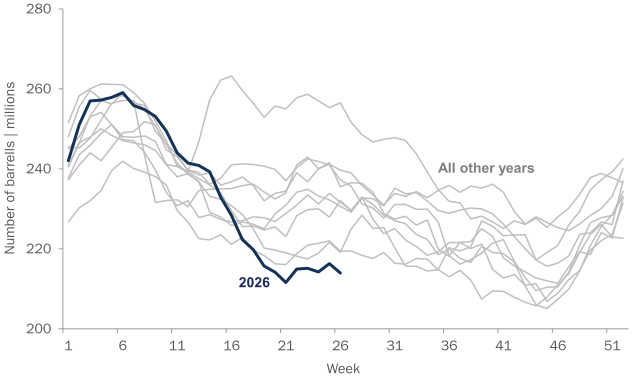
2026 data through week of June 26
Source: Energy Information Administration
The economy’s resilience during the energy shock reflected more than simply the absence of a worst-case geopolitical outcome. Several important tailwinds offset the drag from higher fuel prices. First, the fading of the trade policy shock following the Supreme Court’s overturning of the administration’s use of the International Emergency Economic Powers Act (IEEPA) lowered the effective tariff rate and reduced policy uncertainty. Second, the administration’s fiscal package boosted disposable income through stronger tax refunds and lower tax payments, helping households absorb the increase in energy costs. Finally, the ongoing artificial intelligence investment boom has continued to support both business capital expenditures and household spending through wealth effects associated with strong equity markets. Collectively, these forces have allowed aggregate demand to remain remarkably resilient despite a significant deterioration in real purchasing power.
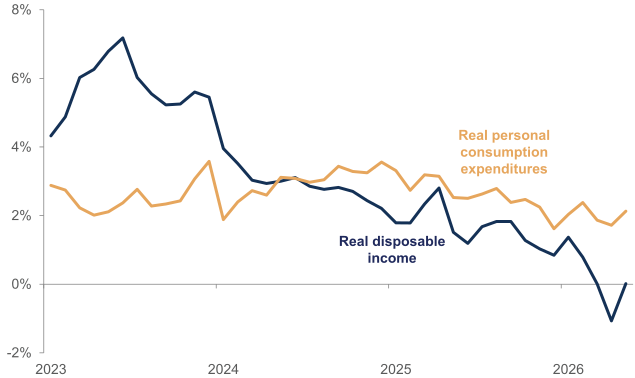
Nonetheless, the recent resilience of consumer spending masks growing strains beneath the surface. The sharp rise in gasoline prices reduced real disposable income growth, and many households increasingly relied on savings and credit to maintain spending. Rising delinquency rates on credit card and auto loans suggest that many households remain under pressure despite the broader strength in the household sector’s aggregate balance sheet. Looking ahead, the boost to disposable income from this year’s tax refund season will now begin to fade. Encouragingly, however, lower energy prices should allow real incomes to recover somewhat over coming months, while the labor market has regained some footing as uncertainty surrounding trade policy has diminished. We therefore continue to expect GDP growth of roughly 2 percent this year—around half a percentage point below our forecast at the beginning of the year.
Figure 2: Year-over-year change in real household income and spending
Source: Bureau of Economic Analysis
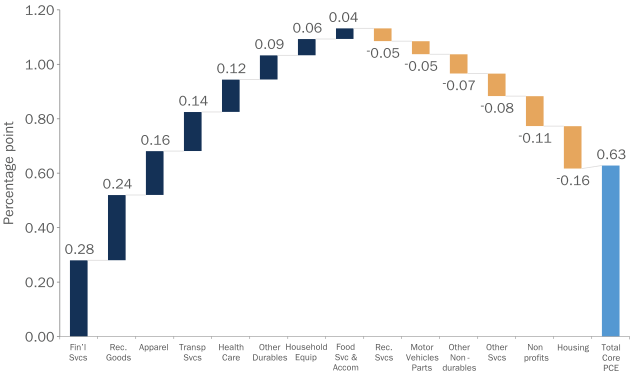
The outlook is somewhat less encouraging on inflation. Core inflation has moved higher over recent months, and while we continue to expect some moderation over the remainder of the year, progress toward the Federal Reserve’s two percent objective is likely to remain frustratingly slow. Importantly, the composition of the recent increase in inflation provides some grounds for cautious optimism. Much of the increase in inflation reflects categories that are poor proxies for broad-based cyclical inflation, as seen in the chart below. These include:
- higher asset management fees (within the financial services category in the chart below);
- sharp price increases for software and computer equipment, accounting for most of the contribution to the rise in core inflation from recreational goods;
- tariff-related increases in apparel and household durables and equipment; and
- higher airfares within the transportation services category, resulting from the impact of the war in the Middle East on jet fuel prices.
While these developments have pushed core inflation in the wrong direction, they do not yet suggest that inflationary pressures are becoming more generalized throughout the economy (see Figure 3).
Perhaps more importantly, there remains little evidence that higher inflation has generated meaningful second-round effects through the labor market. Wage growth has remained relatively subdued despite recent improvement in hiring, suggesting that services inflation should moderate gradually as temporary price pressures dissipate. Even so, inflation has now remained above target for more than five years, and recent data have reinforced concerns among policymakers that progress has stalled. With the labor market stabilizing and downside employment risks fading, the Federal Reserve’s focus has increasingly shifted back toward price stability. Whereas we entered the year expecting policy rates to remain on hold, we now anticipate that the FOMC will reverse the insurance cuts implemented last year, with the first increase likely coming in December after policymakers have had additional time to assess any lingering second-round effects from the energy shock. Risks to this outlook remain skewed toward an earlier start to tightening given the increasingly hawkish tone of several Committee participants and Chair Warsh’s emphasis on restoring price stability.
Our base case remains constructive, although not without important risks. Inflation remains uncomfortably high, geopolitical risks have by no means disappeared, and household finances have become increasingly uneven across income groups. In addition, the AI investment boom represents both a core strength and an important vulnerability. AI-related infrastructure spending remains a major source of business investment and is increasingly being financed with leverage, while recent earnings reports suggest that many firms are increasingly sensitive to the costs of incorporating AI tools into business processes. More broadly, optimism surrounding AI has become an important support for equity valuations at a time when modest real income growth has left household spending increasingly reliant on wealth effects or borrowing. Consequently, any meaningful reassessment of the expected returns to AI investment could trigger a broader tightening in financial conditions, weighing simultaneously on capital expenditures, hiring, equity prices and consumer spending.
The U.S. economy has again demonstrated an impressive ability to absorb a major external shock. The fading of geopolitical tensions, reduced trade policy uncertainty, continued AI investment and a healthy aggregate household sector balance sheet should provide a solid foundation for continued expansion over the coming year. Still, the composition of growth has become less balanced. Temporary support from tax relief is fading, household finances have become increasingly uneven, and the economy is relying more heavily on a relatively narrow set of investment and financial-market drivers. As a result, the durability of the expansion over the longer termmay depend on whether private demand can broaden beyond the sectors that have carried the economy through the past few years.
Figure 3: Contribution to change in core PCE inflation rate over the past year
Source: Bureau of Economic Analysis
IMPORTANT DISCLOSURE
Availability of products and services provided by MacKay Shields may be limited by applicable laws and regulations in certain jurisdictions and this document is provided only for persons to whom this document and the products and services of MacKay Shields may otherwise lawfully be issued or made available. None of the products and services provided by MacKay Shields are offered to any person in any jurisdiction where such offering would be contrary to local law or regulation. This document is provided for information purposes only. It does not constitute investment advice and should not be construed as an offer to buy securities. The contents of this document have not been reviewed by any regulatory authority in any jurisdiction. All investments contain risks and may lose value and these materials do not undertake to explain all of the risks associated with any investment strategy referred to herein. Clients and investors should not invest in any strategy referred to herein unless satisfied that they and/or their representatives have requested and received all information that would enable them to evaluate the merits and risks thereof. Any forward-looking statements speak only as of the date they are made, and MacKay Shields assumes no duty and does not undertake to update forward looking statements. Any opinions expressed are the views and opinions of certain investment professionals at MacKay Shields which are subject to change without notice. There may have been, and may in the future be, changes to the investment personnel responsible for the management of the strategy(ies) described herein, as well as changes to the investment process utilized by such investment personnel. Past performance is not indicative of future results.
Information included herein should not be considered predicative of future transactions or commitments made by MacKay Shields LLC nor as an indication of current or future profitability. There is no assurance investment objectives will be met.
Past performance is not indicative of future results.
NOTE TO UK AND EUROPEAN UNION AUDIENCE
This document is intended only for the use of professional investors as defined in the Alternative Investment Fund Manager’s Directive and/or the UK Financial Conduct Authority’s Conduct of Business Sourcebook. To the extent this document has been issued in the United Kingdom, it has been issued by NYL Investments UK LLP, 200 Aldersgate Street, London UK EC1A 4HD, which is authorised and regulated by the UK Financial Conduct Authority. To the extent this document has been issued in the EEA, it has been issued by NYL Investments Europe Limited, 77 Sir John Rogerson's Quay, Block C Dublin D02 VK60 Ireland. NYL Investments Europe Limited is authorized and regulated by the Central Bank of Ireland (i) to act as an alternative investment fund manager of alternative investment funds under the Alternative Investment Fund Managers Directive (Directive 2011/61/EU) and (ii) to provide the services of individual portfolio management, investment advice and the receipt and transmission of orders as defined in Regulation 7(4) of the AIFMD Regulations to persons who meet the definition of “professional client” as set out in the MiFID Regulations. It has passported its license in additional countries in the EEA.
This document only describes capabilities of certain affiliates of New York Life Investment Managements and/or MacKay Shields LLC. No such affiliates will accept subscriptions in any funds not admitted to marketing in your country or provide services to potential customers in your country, including discretionary asset management services, except where it is licensed to do so or can rely on an applicable exemption.
MacKay Shields LLC is a wholly owned subsidiary of New York Life Investment Management Holdings LLC, which is wholly owned by New York Life Insurance Company. “New York Life Investment Management” is the brand name and service mark used to represent a group of affiliated investment advisors of New York Life Insurance Company, including New York Life Investment Management LLC, a registered investment advisor.
NOTE TO CANADIAN RECIPIENTS
The information in these materials is not an offer to sell securities or a solicitation of an offer to buy securities in any jurisdiction of Canada. In Canada, any offer or sale of securities or the provision of any advisory or investment fund manager services will be made only in accordance with applicable Canadian securities laws. More specifically, any offer or sale of securities will be made in accordance with applicable exemptions to dealer and investment fund manager registration requirements, as well as under an exemption from the requirement to file a prospectus, and any advice given on securities will be made in reliance on applicable exemptions to adviser registration requirements.
Information included herein should not be considered predicative of future transactions or commitments made by MacKay Shields LLC nor as an indication of current or future profitability. There is no assurance investment objectives will be met. Past performance is not indicative of future results.
NOTE TO JAPANESE RECIPIENTS
In Japan, this is issued by New York Life Investment Management Asia Limited (Financial Instruments Business Operator, Kanto Local Finance Bureau (FIBO) No. 2964, Member of the Investment Management Association of Japan and the Type 2 Financial Instruments Firms Association) for institutional investors only. As costs and/or fees to be borne by investors vary depending on circumstances such as products, services, investment period and market conditions, the total amount nor the calculation methods cannot be disclosed in advance. All investments involve risks, including market fluctuation and investors may lose the principal amount invested. Investors should obtain and read the prospectus and/or information set forth in Article 37-3 of the Financial Instruments and Exchange Act carefully before making investment decisions.
MacKay Shields LLC is a wholly owned subsidiary of New York Life Investment Management Holdings LLC, which is wholly owned by New York Life Insurance Company. “New York Life Investment Management” is the brand name and service mark used to represent a group of affiliated investment advisors of New York Life Insurance Company, including New York Life Investment Management LLC, a registered investment advisor.
Subscribe to get MacKay Shields insights delivered to your inbox.