
As one of the largest and most active issuers in the municipal bond market, NYC spreads remain contained, fundamentals are holding, and in our view, in the current backdrop it is not surprising. Further, a broader drift away from tax-backed credits towards essential service/revenue credits was a cornerstone in our 2026 Top 5 Insights. Still, though, in a retail driven market, it is important to peel apart the layers of nuance that separate headlines from actual fiscal reality.
Headlines vs. Fiscal Reality
As Mayor Zohran Mamdani advances his policy agenda, the city’s FY 2027 budget has become a focal point. The preliminary plan includes a $5.4 billion deficit—down meaningfully from the $12.6 billion projection last November, supported by stronger personal income tax collections and incremental state support.1
Looking ahead, projected outyear gaps of approximately $6–7 billion are elevated but broadly consistent with prior financial plans.1 More importantly, New York City operates within a disciplined fiscal framework: budgets must be balanced annually and supported by a rolling four-year financial plan. That structure, combined with historically conservative forecasting. has been a reliable constraint on fiscal drift. The rating agencies’ move to a negative outlook reflects the evolving policy backdrop, but it does not, in our view, represent a fundamental shift in credit quality.
FIGURE 1: ACTUAL REVENUES CONSISTENTLY EXCEED ADOPTED BUDGET AMOUNTS
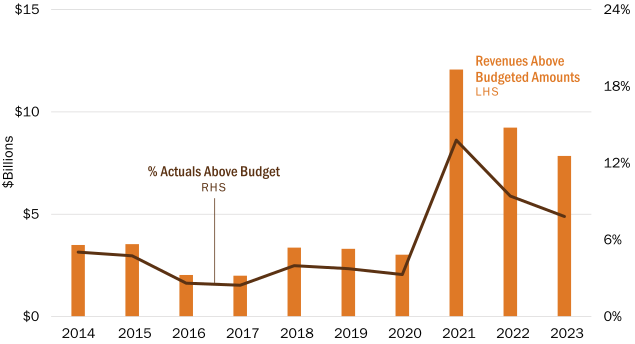
Source: New York City Annual Comprehensive Financial Report FY 2014 through FY 2023
Closing the Gap: Policy in Focus
The path to closing the remaining gap is coming into clearer focus. The administration is weighing a mix of revenue options, including higher taxes on high earners and corporations (subject to state approval) and a potential property tax increase as a fallback.
The latter faces resistance from the City Council, while at the state level, Governor Hochul has thus far pushed back on broader tax increases—making Albany a key swing factor, particularly with the April 1 budget deadline approaching.
Importantly, the policy process itself is a stabilizing feature. Multiple layers of oversight—City Hall, the Council, and Albany—create a system of checks and balances that has historically moderated more aggressive fiscal outcomes.
Reserves and Structural Strength
Even under a scenario where reserves are utilized, the city’s financial position remains strong. Current plans contemplate drawing on the Rainy Day Fund and Retiree Health Benefits Trust, but reserve levels would remain in the $6+ billion range2, consistent with solid historical coverage.
More broadly, New York City’s fiscal foundation continues to provide meaningful support. Reserves have reached record levels in recent years, and when including additional available resources, total savings represent a significant share of revenues.3 Just as importantly, the city has a long track record of revenue outperformance relative to budget assumptions, reflecting conservative forecasting practices.
FIGURE 2: FISCAL CONTROLS

Market Perspective: Positioning vs. Fundamentals
If headlines were translating into sustained credit concern, spreads would be much wider.
Instead, 10-year NYC GO spreads are ~34 bps , not too far from longer term averages and a far cry from the wides we saw in 2020. Notably, spreads have remained somewhat range bound following Moody’s outlook revision, suggesting the market is not pricing in meaningful deterioration.
That said, sentiment was more cautious earlier in the cycle. Periods of volatility were amplified by participation from more tactical, headline-driven investors, creating technical pressure at times.
FIGURE 3: NEW YORK CITY CREDIT SPREADS
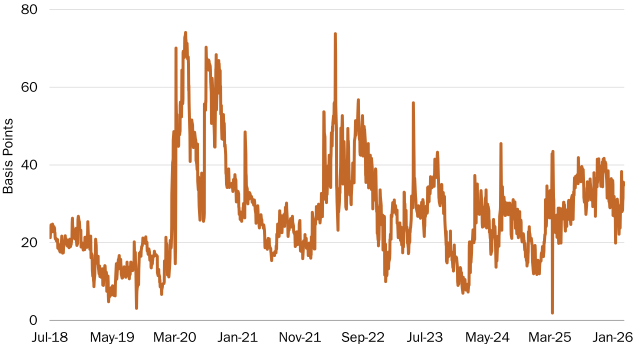
Data as of March 24, 2026
Source: Bloomberg
Interestingly, this week, the city is coming to market with a multi-billion dollar issuance. This supply arrives at a more challenging moment for the broader market, with rates under pressure, geopolitical uncertainty elevated, and a heavy municipal calendar weighing on demand. Against that backdrop, it would not be surprising to see some concession or weaker pricing on the deal.
Even so, we would view any near-term weakness through the lens of market technicals rather than a fundamental shift in credit quality.
Economic and Revenue Backdrop
The fundamental story for New York City remains intact. Revenues are at record levels, with personal income tax collections up 10% and corporate tax revenues up 5%. The labor market continues to show resilience, with private-sector employment approximately 144,000 jobs above pre-pandemic levels.4
Demographic trends have also stabilized, with population growth returning over the past two years, supported by international migration. At the same time, office utilization has surpassed 2019 levels—an important signal for the city’s commercial base and broader economic normalization.
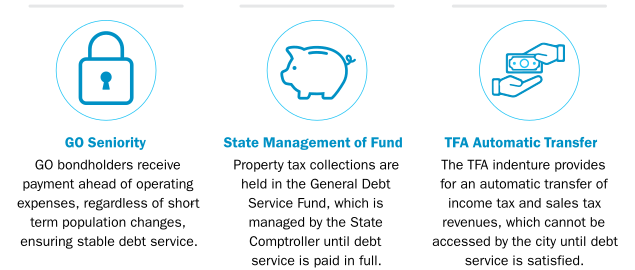
New York City also benefits from strong bondholder protections embedded across both GO and Transitional Finance Authority (TFA) structures, providing an additional layer of credit stability through cycles.
Bottom Line
We expect there will be no shortage of headlines as the FY 2027 budget process unfolds, and the potential for rating pressure remains if fiscal or policy outcomes weaken over time.
FIGURE 4: NEW YORK CITY POPULATION | 2000-2024
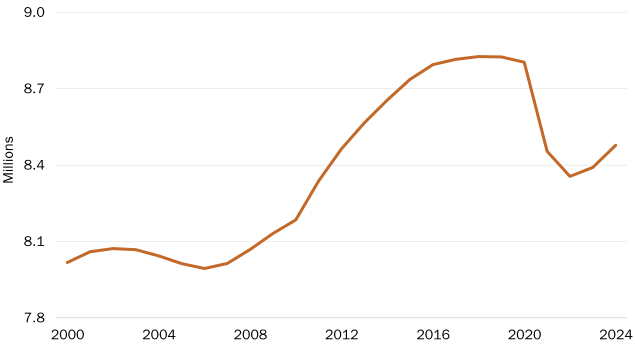
Data as of July 2024
Source: United States Census Bureau Intercensal Estimates
Rating agencies also tend to take a more active posture with larger, high-profile issuers, where maintaining fiscal discipline is viewed as particularly important. That dynamic can at times contribute to a more cautious tone in outlooks and ratings actions.
That said, while we cannot predict whether the city will ultimately be downgraded…however, the core credit story remains intact.
New York City continues to benefit from a large and diversified economic base, structurally conservative budgeting, multiple layers of fiscal oversight, and substantial reserves. While market technicals—including the upcoming issuance—may drive near-term price action, we remain focused on these underlying fundamentals.
FIGURE 5: BONDHOLDER PROTECTIONS PROVIDE ADDITIONAL LAYER OF CREDIT STABILITY THROUGH CYCLES
Source: Bloomberg
1. NYC Mayor's Office of Management and Budget - The City of New York Preliminary Budget Fiscal Year 2027
2. NYC Mayor's Office of Management and Budget - The City of New York Preliminary Budget Fiscal Year 2027
3. New York City Annual Comprehensive Financial Reports FY25
4. NYCEDC State of the New York City Economy 2025
DISCLOSURES
Availability of this document and products and services provided by MacKay Shields LLC may be limited by applicable laws and regulations in certain jurisdictions and this document is provided only for persons to whom this document and the products and services of MacKay Shields LLC may otherwise lawfully be issued or made available. None of the products and services provided by MacKay Shields LLC are offered to any person in any jurisdiction where such offering would be contrary to local law or regulation. It does not constitute investment advice and should not be construed as an offer to buy securities. The contents of this document have not been reviewed by any regulatory authority in any jurisdiction. This material contains the opinions of the MacKay Municipal Managers™ team of MacKay Shields LLC but not necessarily those of MacKay Shields LLC. The opinions expressed herein are subject to change without notice. This material is distributed for informational purposes only. Forecasts, estimates, and opinions contained herein should not be considered as investment advice or a recommendation of any particular security, strategy or investment product. Information contained herein has been obtained from sources believed to be reliable, but not guaranteed. Any forward-looking statements speak only as of the date they are made and MacKay Shields assumes no duty and does not undertake to update forward-looking statements. No part of this document may be reproduced in any form, or referred to in any other publication, without express written permission of MacKay Shields LLC. ©2026, MacKay Shields LLC. All Rights Reserved.
MacKay Shields LLC does not offer or sponsor any funds registered under the Investment Company Act of 1940, as amended (“Registered Funds”). MacKay Shields LLC serves in the capacity as investment manager of certain Registered Funds through sub-advisory arrangements.
MacKay Municipal Managers is a trademark of MacKay Shields LLC.
MacKay Shields LLC is a wholly owned subsidiary of New York Life Investment Management Holdings LLC, which is wholly owned by New York Life Insurance Company. "New York Life Investment Management" is both a service mark, and the common trade name of certain investment advisers affiliated with New York Life Insurance Company. Investments are not guaranteed by New York Life Insurance Company or New York Life Investment Management.
At the time of writing, MacKay Shields LLC maintains investments in the securities, issuers and/or companies cited herein. References to such securities, issuers and/or companies for educational and informational purposes only, and are intended to convey factual information and current market conditions. Such names are not intended, nor should they be construed as, a recommendation to buy and sell any individual security.
It is not possible to invest directly in an index. Past performance is not indicative of future results.
COMPARISONS TO AN INDEX
Comparisons to a financial index are provided for illustrative purposes only. Comparisons to an index are subject to limitations because portfolio holdings, volatility and other portfolio characteristics may differ materially from the index. Unlike an index, portfolios within the composite are actively managed and may also include derivatives. There is no guarantee that any of the securities in an index are contained in any managed portfolio. The performance of an index may assume reinvestment of dividends and income, or follow other index-specific methodologies and criteria, but does not reflect the impact of fees, applicable taxes or trading costs which, unlike an index, may reduce the returns of a managed portfolio. Investors cannot invest in an index. Because of these differences, the performance of an index should not be relied upon as an accurate measure of comparison.
SOURCE INFORMATION
“Bloomberg®”, “Bloomberg Indices®”, Bloomberg Fixed Income Indices, Bloomberg Equity Indices and all other Bloomberg indices referenced herein are service marks of Bloomberg Finance L.P. and its affiliates, including Bloomberg Index Services Limited (“BISL”), the administrator of the indices (collectively, “Bloomberg”) and have been licensed for use for certain purposes by MacKay Shields LLC (“MacKay Shields”). Bloomberg is not affiliated with MacKay Shields, and Bloomberg does not approve, endorse, review, or recommend MacKay Shields or any products, funds or services described herein. Bloomberg does not guarantee the timeliness, accurateness, or completeness of any data or information relating to MacKay Shields or any products, funds or services described herein.
All ICE Data indices referenced herein (each such index, the “Index”), are products of ICE data indices, LLC (“ICE Data”), and are used with permission. ICE® is a registered trademark of ICE Data or its affiliates, and BofA® is a registered trademark of Bank of America Corporation licensed by Bank of America Corporation and its affiliates (“BofA”) and may not be used without BofA’s prior written approval. ICE Data, its affiliates and their respective third party suppliers disclaim any and all warranties and representations, express and/or implied, including any warranties of merchantability or fitness for a particular purpose or use, including the indices, index data and any data included in, related to, or derived therefrom. Neither ICE Data, its affiliates nor their respective third party suppliers shall be subject to any damages or liability with respect to the adequacy, accuracy, timeliness or completeness of the indices or the index data or any component thereof, and the indices and index data and all components thereof are provided on an “as is” basis and your use is at your own risk. Inclusion of a security within an index is not a recommendation by ICE Data to buy, sell, or hold such security, nor is it considered to be investment advice. ICE Data, its affiliates and their respective third party suppliers do not sponsor, endorse, or recommend MacKay Shields LLC, or any of its products or services.
Subscribe to get MacKay Shields insights delivered to your inbox.
Related Thought Leadership