
Warsh had a mixed track record as a Fed Governor. He has been widely lauded for the market acumen he brought to the Fed during the Global Financial Crisis. But he frequently focused on inflation risks that never materialized, even as joblessness remained elevated.
Warsh has argued for a “strategic reset” at the Fed, but change is likely to come slowly. Nevertheless, Warsh may argue for additional rate cuts based on evidence of higher potential growth. He may also push the Committee to revisit the calibration of balance sheet and interest rate policy.
The key market question is whether Warsh’s appointment reinforces credibility and lowers inflation compensation/term premium, or whether his recent calls for rate cuts and perceived political pressure raises the risk premium embedded in long rates.
President Trump’s nomination of Kevin Warsh to succeed Jerome Powell as Federal Reserve Chair heralds the return of a central banker with well-established hawkish credentials as well as relevant financial market expertise. In addition to his five years as Fed Governor centered around the global financial crisis, Warsh’s background includes a career as an investment banker and a stint on President George W. Bush’s National Economic Council. In more recent years, he has had a close association with Stanford University’s Hoover Institution, where he has been a Distinguished Visiting Fellow. He has also been a partner at Stanley Druckenmiller’s family office, Duquesne.
Given President Trump’s insistence that the Fed lower short-term rates, the choice of a policy hawk may seem curious. One explanation may lie in the administration’s focus on the need to lower long-term rates to support the housing market and overall economic growth. President Trump’s inner circle, and Treasury Secretary Bessent in particular, may have advised that a Fed Chair with hawkish credentials can strengthen the Fed’s inflation-fighting credibility and, at the margin, reduce the term premium and inflation compensation embedded in long-term Treasury yields, which have risen since the Fed began to cut rates in the fall of 2024. While the Fed does not directly set long-term yields, leadership credibility can influence market expectations over time.
Figure 1: Decomposition of ten-year treasury yield increase during the current easing cycle
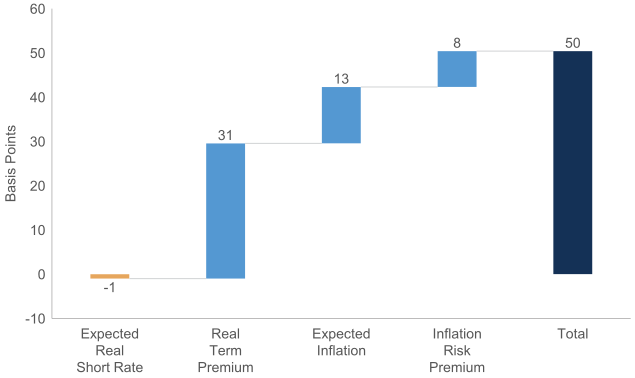
Source: D'Amico, Kim & Wei (DKW) No-Arbitrage Term Structure Model, Board of Governors of the Federal Reserve System, change from September 2024 through December 2025
As US markets were closed when news of the Warsh nomination broke on Thursday evening, it is challenging to do a clean event study of the immediate market reaction. Nevertheless, in early Asian hours the DXY dollar index rose modestly, as did short-dated Treasury yields, and the price of gold fell almost six percent. These moves are directionally consistent with the perception that Warsh has more hawkish instincts and is better positioned to carry forward Fed independence than some of the other leading candidates for the nomination.
Warsh believes that the Fed has drifted from its core mandate of full employment and price stability, straying into areas best left to elected officials. 1 His approach to central banking and his track record as a Governor also align with the broader push of the administration to narrow the scope of independent agencies. Indeed, many of Warsh’s criticisms of the Federal Reserve focus on what he sees as overreach that undermines pursuit of the dual mandate, and by extension, central bank legitimacy and independence. These criticisms include:
- Overreliance on quantitative easing (QE), especially outside of crisis conditions
- Blurring fiscal and monetary boundaries and lowering Treasury’s cost of funding through zero-interest rate policy, forward guidance and QE - thereby enabling larger deficits.
- Excessive use of forward guidance on the likely path of policy.
- Mission creep, especially by engaging in work on climate change and allowing considerations of inclusive growth to impact the 2019-2020 strategy review and the ill-fated shift to Flexible Average Inflation Targeting.
- Abandonment of monetary analysis in understanding inflation dynamics and setting monetary policy.
Warsh’s strategic reset
In light of these criticisms, Warsh has called for a strategic reset at the Fed. No single speech or interview clearly lays out his priorities for reform, but a number of themes emerge from his work. First, Warsh stresses the need for the Fed to refocus its energies on its core responsibilities of full employment and price stability in order to reestablish its credibility and safeguard its independence. This would largely consist of anchoring around the notion of “institutional neutrality, …avoid[ing] taking positions on social and political issues unless such measures plainly threaten the core missions”2. Second, forays into QE must be carefully circumscribed to minimize inflation risks and incentives for elected officials to expand deficits. In Warsh’s view, QE is best used to address market disfunction that threatens credit creation and monetary policy transmission, and should not be used in the normal course of policy. Third, the Fed should revisit its assumptions about inflation drivers, especially the reliance of models on Keynesian assumptions that put little emphasis on the money supply. Finally, central bankers should reduce their imprint on market expectations for policy, dialing back their use of formal forward guidance and the frequency of communications on the economic and policy outlook.
Track record at the Fed
In his autobiography, former Chair Ben Bernanke praised Warsh for the market insights he brought to the Committee based on his practical experience in finance as well as his many financial market contacts. He reportedly played a lead role in helping to arrange JP Morgan’s takeover of Bear Stearns and in the rescue of American International Group. Chair Bernanke would eventually task then-Governor Warsh with leading an internal effort to formulate key principles for financial reform, with a goal of honing the Fed’s position ahead of anticipated discussions with Congress and the Obama administration.
There are other aspects of Warsh’s Fed legacy that deserve highlighting, as they may have some bearing on his policy preferences as Fed Chair. First, consistent with his recent criticisms of the Fed, Governor Warsh was a hesitant supporter of quantitative easing. For example, in March 2009, when the Committee first agreed to extend QE to Treasury securities, Warsh indicated discomfort with the program and raised the concern that Treasury purchases might lead to higher yields:
“if the Fed is perceived to be monetizing debt and serving as a buyer of last resort in the name of lowering risk-free rates, we could end up with higher rates and less credibility as a central bank.”3
Caution over committing the Fed to balance sheet expansion is not in itself problematic, and arguably reveals laudable humility for a central banker on the eve of a major new policy foray with uncertain effects. Still, the passage above demonstrates his hesitancy to take forceful policy measures, even as a deep recession was unfolding and the central bank had already used up its conventional policy ammunition.4 This hesitancy would later extend into the launch of QE2, which he voted for to support Chair Bernanke but implicitly encouraged other FOMC members to vote against.5 In addition, the quote above reveals Warsh’s early focus on the interaction between fiscal and monetary policy, and his concern that any blurring of the lines between the two, even during a crisis, would lead investors to demand a higher term premium to hold Treasuries.
Finally, the FOMC meeting transcripts from the financial crisis and its immediate aftermath reveal that Warsh frequently highlighted upside inflation risks that never materialized.6 This suggests a misdiagnosis of the issues facing the economy at the time, and the channels through which quantitative easing affects the economy. One example of misdiagnosis can be found in the November 2010 FOMC meeting transcripts, the meeting at which the Committee agreed to implement QE2. At the meeting, Warsh identified “growth-defeating” government policies as the culprit for the anemic recovery:
“The U.S. economy continues to be mired in a sluggish recovery. The adjectives that many of you used are adjectives that I would use, but I would suggest that the ability of us around the table to have a material effect on that contour is overstated. Changes in fiscal, regulatory, and trade policies, which are long in the making and which have been unfriendly to economic growth for several years, are, I think, the most responsible party. And I do not expect the economy to turn durably in a more constructive direction until these other macroeconomic policies stop being so growth-defeating.”7
This interpretation of events is remarkable in its setting aside of the lingering damage done by the crisis, especially the deleveraging across households, businesses and financial institutions that even in late 2010 was stifling credit growth and aggregate demand. Here and elsewhere, Warsh argued that the Fed had only a limited ability to impact the economy, and preferred to let elected officials take the policy lead.
A Warsh-run Fed
Kevin Warsh’s speeches and interviews going back to his first stint at the Fed demonstrate a strong appreciation of the importance of central bank independence, and there is every reason to expect that as Chair he would act to reinforce the Fed’s independence. Importantly, Warsh has argued that independence of central bank activities extends only to monetary policy and not to other areas such as regulatory policy and bank supervision.8 He also views monetary policy independence as fragile, and best safeguarded by ensuring the central bank steers clear of policy areas best left to elected officials. The central bank can also protect its independence by succeeding in its monetary policy remit, and price stability in particular.
Regulatory and supervisory policy could be an underappreciated channel of change. If Warsh views independence as applying primarily to monetary policy, he may be more open to coordination with elected officials on supervision, stress testing, and regulatory calibration. For credit markets, even incremental shifts in the stance of supervision could influence bank risk appetite, loan growth, and the availability of liquidity in periods of stress.
It is also worth emphasizing that meaningful shifts in monetary policy still require majority support on the FOMC, and the practical impact of a new Chair will depend in part on the broader composition of the Board of Governors and the degree of consensus that can be built. Still, under Warsh the following areas may see a renewed and perhaps different focus.
Supply Side Emphasis. Warsh has argued that the US is on the cusp of a supply side renaissance as a result of the current administration’s deregulatory policies and a likely productivity boom.9 Recent FOMC minutes indicate that the Committee is also beginning to consider whether potential growth is rising, although the Summary of Economic Projections (SEP) indicates that very few policy-makers have revised their estimate higher over the past year. Warsh is likely to give this topic greater focus, and borrowing a page from Greenspan he may argue that higher potential growth allows for stronger economic activity without inflationary pressure. Ultimately a supply side focus could open the door to more rate cuts than reflected in the most recent SEP, though support from the broader FOMC will likely require clear evidence of inflation falling sustainably towards the two percent objective.
Recalibrating Balance Sheet and Interest Rate Policy. Warsh has criticized the Fed for maintaining a large balance sheet, which he has described as a “proxy for the Fed’s growing imprimatur on the economy.”10 Most notably, he sees the need to correct an imbalanced policy mix, with too large a balance sheet and too-high policy rates. In a July 2025 interview, Warsh argued that the Fed should significantly reduce the size of its balance sheet but offset that monetary tightening by lowering interest rates.11 Any such recalibration would likely face significant opposition on the FOMC, as policy-makers have endorsed the current ample reserves regime, would be concerned about interest rate volatility associated with both the regime switch and the added supply of duration to the market, and would not view the two policy levers as substitutes for each other, in either magnitude or timing. It is also possible that to secure the nomination, Warsh has agreed to set aside any downsizing of the balance sheet. Nevertheless, this is a topic where Warsh will need to clarify his current stance, and it will likely be a focus of his confirmation hearing.
Communications Policy. Warsh has criticized policymakers for their too-frequent communications on the outlook and the use of forward guidance outside of economic crises. As such, Warsh may commission a new internal review of communications policy focused on potential changes to the SEP. One possibility would be to replace the economic projections of individual FOMC participants with a staff forecast, including alternative scenarios that give a better sense of risks around a baseline outlook.
Warsh may also argue for less guidance of market expectations for policy in FOMC statements. However, any such change would likely run into significant opposition from FOMC participants given the substantial body of research showing that clarity on the economic and policy outlook can lead to better economic outcomes.
Personnel Changes. Warsh is very likely to focus on staff changes at the Board of Governors to refocus research on the supply side of the economy and monetary analysis.12 These changes are likely to extend to changes in the leadership of key departments such as Monetary Affairs and Research & Statistics.
Bottom line for investors: Warsh’s appointment will likely tilt the Fed’s framework toward a tighter definition of the policy mandate and a greater emphasis on supply-side considerations, but near-term policy outcomes will still be driven by the data and FOMC consensus. The key market question is whether the appointment reinforces credibility and lowers inflation compensation and the real term premium, or whether perceived political pressure raises the risk premium embedded in long rates. If Warsh’s “inflation-first” instincts remain evident in both word and deed, Fed credibility and perceived political independence should be reinforced. By contrast, invoking productivity gains to justify substantial rate cuts while inflation remains elevated could erode confidence and reprice term premia upward.
Finally, while Warsh has been an outspoken critic of the use of QE outside of periods of intense market stress, his views are unlikely to shape policy in the coming years. This is because policy-makers also view QE as an unconventional measure, relegated to use when the policy rate is at the zero lower bound. Absent a return to such an environment, any difference in view that Warsh has regarding the cost-benefit tradeoffs of renewed QE are unlikely to matter for policy.
1. Warsh’s criticisms of the Fed and his call for a “strategic reset” are synthesized in his April 2025 speech, “Commanding Heights: Central Banks at a Crossroads.”
2. Ibid.
3. Transcript from the Meeting of the Federal Open Market Committee on March 17–18, 2009, Board of Governors of the Federal Reserve System.
4. As another example of his more cautious approach to unconventional policy, at the June 2008 FOMC meeting Warsh suggested raising the price at which dealers could borrow funds from the emergency Primary Dealer Credit Facility, despite ongoing strains in funding markets. Raising the rate on PDCF borrowing would likely have undermined the facility’s utility, by increasing the stigma associated with borrowing from the Fed and raising questions over the Fed’s commitment to financial stability. Transcript from the Meeting of the Federal Open Market Committee on June 24-25, 2008, Board of Governors of the Federal Reserve System.
5. In the policy round at the November 2010 meeting, Warsh remarked, “If I were in your chair, I would not be leading the Committee in this direction, and frankly, if I were in the chair of most people around this room, I would dissent.” Despite voting in favor of QE2 at the meeting, the following week he would give a speech that many investors viewed as a soft dissent against QE2, stating, “when non-traditional tools are needed to loosen policy and markets are functioning more or less normally--even with output and employment below trend--the risk-reward ratio for policy action is decidedly less favorable…As a result, we cannot and should not be as aggressive as conventional policy rules--cultivated in more benign environments--might judge appropriate.” Transcript from the Meeting of the Federal Open Market Committee on November 2-3, 2010, Board of Governors of the Federal Reserve System.
6. Noteworthy examples include the June 2008 and January 2010 FOMC meetings. At the June 2008 meeting, despite the unemployment rate having risen a full percentage point over the prior twelve months, Warsh commented that, “Inflation risks, in my view, continue to predominate as the greater risk to the economy.” It should be noted, however, that in the relative lull between the bankruptcies of Bear Stearns and Lehman Brothers, Warsh’s views on growth and inflation risks were broadly held by many others on the Committee, and the June 2008 post-meeting policy statement indicated that, “downside risks to growth…appear to have diminished somewhat, and the upside risks to inflation and inflation expectations have increased.”
At the January 2010 meeting Warsh commented that, “If policy rates were to stay as accommodative as the Greenbook suggests, given these policy uncertainties, I would be surprised if inflation and inflation expectations stayed at levels consistent with price stability in the forecast period.” At that meeting, Board Staff had projected in the Greenbook that the policy rate would remain at the zero lower bound until the third quarter of 2011, whereas markets expected lift-off from the lower bound before the end of 2010. In the end, the policy rate remained at the lower bound until December 2015, with core inflation averaging only 1.5 percent over the six years following the January 2010 meeting.
7. Transcript from the Meeting of the Federal Open Market Committee on November 2–3, 2010, Board of Governors of the Federal Reserve System.
8. Kevin Warsh, “An Ode to Independence,” March 2010 and “Commanding Heights: Central Banks at a Crossroads,” April 2025.
9. “Inflation is a Choice: Kevin Warsh on Fixing the Federal Reserve”, Uncommon Knowledge podcast, Hoover Institute, July 2025.
10. Kevin Warsh “Commanding Heights: Central Banks at a Crossroads,” April 2025.
11. Kevin Warsh, interview on Fox Business, July 2025.
12. In the Uncommon Knowledge interview, Warsh stated, “There is also plenty of dead wood. There are also people who need to adjust their thinking to a modern economy...inflation is caused by the growth of money.”
IMPORTANT DISCLOSURE
Availability of products and services provided by MacKay Shields may be limited by applicable laws and regulations in certain jurisdictions and this document is provided only for persons to whom this document and the products and services of MacKay Shields may otherwise lawfully be issued or made available. None of the products and services provided by MacKay Shields are offered to any person in any jurisdiction where such offering would be contrary to local law or regulation. This document is provided for information purposes only. It does not constitute investment advice and should not be construed as an offer to buy securities. The contents of this document have not been reviewed by any regulatory authority in any jurisdiction. All investments contain risks and may lose value and these materials do not undertake to explain all of the risks associated with any investment strategy referred to herein. Clients and investors should not invest in any strategy referred to herein unless satisfied that they and/or their representatives have requested and received all information that would enable them to evaluate the merits and risks thereof. Any forward-looking statements speak only as of the date they are made, and MacKay Shields assumes no duty and does not undertake to update forward looking statements. Any opinions expressed are the views and opinions of certain investment professionals at MacKay Shields which are subject to change without notice. There may have been, and may in the future be, changes to the investment personnel responsible for the management of the strategy(ies) described herein, as well as changes to the investment process utilized by such investment personnel. Past performance is not indicative of future results.
At the time of writing, MacKay Shields LLC maintains investments in the securities, issuers and/or companies cited herein. References to such securities, issuers and/or companies for educational and informational purposes only, and are intended to convey factual information and current market conditions. Such names are not intended, nor should they be construed as, a recommendation to buy and sell any individual security.
Information included herein should not be considered predicative of future transactions or commitments made by MacKay Shields LLC nor as an indication of current or future profitability. There is no assurance investment objectives will be met.
Past performance is not indicative of future results.
NOTE TO UK AND EUROPEAN UNION AUDIENCE
This document is intended only for the use of professional investors as defined in the Alternative Investment Fund Manager’s Directive and/or the UK Financial Conduct Authority’s Conduct of Business Sourcebook. To the extent this document has been issued in the United Kingdom, it has been issued by NYL Investments UK LLP, 200 Aldersgate Street, London UK EC1A 4HD, which is authorised and regulated by the UK Financial Conduct Authority. To the extent this document has been issued in the EEA, it has been issued by NYL Investments Europe Limited, 77 Sir John Rogerson's Quay, Block C Dublin D02 VK60 Ireland. NYL Investments Europe Limited is authorized and regulated by the Central Bank of Ireland (i) to act as an alternative investment fund manager of alternative investment funds under the Alternative Investment Fund Managers Directive (Directive 2011/61/EU) and (ii) to provide the services of individual portfolio management, investment advice and the receipt and transmission of orders as defined in Regulation 7(4) of the AIFMD Regulations to persons who meet the definition of “professional client” as set out in the MiFID Regulations. It has passported its license in additional countries in the EEA.
This document only describes capabilities of certain affiliates of New York Life Investments and/or MacKay Shields LLC. No such affiliates will accept subscriptions in any funds not admitted to marketing in your country or provide services to potential customers in your country, including discretionary asset management services, except where it is licensed to do so or can rely on an applicable exemption.
MacKay Shields LLC is a wholly owned subsidiary of New York Life Investment Management Holdings LLC, which is wholly owned by New York Life Insurance Company. "New York Life Investments" is both a service mark, and the common trade name of certain investment advisers affiliated with New York Life Insurance Company. Investments are not guaranteed by New York Life Insurance Company or New York Life Investments.
NOTE TO CANADIAN RECIPIENTS
The information in these materials is not an offer to sell securities or a solicitation of an offer to buy securities in any jurisdiction of Canada. In Canada, any offer or sale of securities or the provision of any advisory or investment fund manager services will be made only in accordance with applicable Canadian securities laws. More specifically, any offer or sale of securities will be made in accordance with applicable exemptions to dealer and investment fund manager registration requirements, as well as under an exemption from the requirement to file a prospectus, and any advice given on securities will be made in reliance on applicable exemptions to adviser registration requirements.
Information included herein should not be considered predicative of future transactions or commitments made by MacKay Shields LLC nor as an indication of current or future profitability. There is no assurance investment objectives will be met. Past performance is not indicative of future results.
NOTE TO JAPANESE RECIPIENTS
In Japan, this is issued by New York Life Investment Management Asia Limited (Financial Instruments Business Operator, Kanto Local Finance Bureau (FIBO) No. 2964, Member of Japan Investment Advisers Association and Type 2 Financial Instruments Firms Association) for institutional investors only. As costs and/or fees to be borne by investors vary depending on circumstances such as products, services, investment period and market conditions, the total amount nor the calculation methods cannot be disclosed in advance. All investments involve risks, including market fluctuation and investors may lose the principal amount invested. Investors should obtain and read the prospectus and/or information set forth in Article 37-3 of the Financial Instruments and Exchange Act carefully before making investment decisions.
MacKay Shields LLC is a wholly owned subsidiary of New York Life Investment Management Holdings LLC, which is wholly owned by New York Life Insurance Company. "New York Life Investments" is both a service mark, and the common trade name of certain investment advisers affiliated with New York Life Insurance Company. Investments are not guaranteed by New York Life Insurance Company or New York Life Investments.
SOURCE INFORMATION
“Bloomberg®”, “Bloomberg Indices®”, Bloomberg Fixed Income Indices, Bloomberg Equity Indices and all other Bloomberg indices referenced herein are service marks of Bloomberg Finance L.P. and its affiliates, including Bloomberg Index Services Limited (“BISL”), the administrator of the indices (collectively, “Bloomberg”) and have been licensed for use for certain purposes by MacKay Shields LLC (“MacKay Shields”). Bloomberg is not affiliated with MacKay Shields, and Bloomberg does not approve, endorse, review, or recommend MacKay Shields or any products, funds or services described herein. Bloomberg does not guarantee the timeliness, accurateness, or completeness of any data or information relating to MacKay Shields or any products, funds or services described herein.
Subscribe to get MacKay Shields insights delivered to your inbox.
Related Thought Leadership