
Reimagining the institutional municipal toolkit
The municipal market entered 2026 from a position of relative stability, yet the drivers of return have become more differentiated. Credit dispersion is widening, technical forces favor selectivity, and investor demand has concentrated in passive vehicles that prioritize liquidity and predictability. Within this environment, we believe institutional allocators should reconsider the architecture of their municipal exposure.
Passively managed buy and hold municipal portfolios continue to serve essential roles, but their structural design leaves attractively priced segments (i.e., AMT bonds, prepaid energy, housing) of the market inaccessible. The reason is structural. Municipal fixed income strategies require navigating differences in yields, credit quality, security structure and available supply, complexity that, in our view, is precisely where active management adds value. Flexible municipal strategies, with their broader mandate and captive liquidity, may potentially complement that buy-and-hold exposure by reaching segments where active management has historically been rewarded. As investors increasingly combine passive, model-delivered exposures with actively traded sleeves within a single portfolio, we believe the case for complementing, not replacing core municipal allocations with more flexible, actively managed strategies has never been more compelling.
Key characteristics of flexible municipal strategies
- Actively managed portfolios driven by deep fundamental credit research and relative value trading.
- Income potential through short-term carry for certain investment vehicles.
- Designed to seek attractive after-tax total returns for certain investment vehicles.
A complementary allocation for a differentiated market
Following several years in which broad-based factors drove most of the municipal market in the same direction, 2026 presents a more nuanced opportunity set. The fading of extraordinary federal aid, the widening gap between essential-service revenue credits and tax-backed obligations, and the renewed importance of disciplined credit selection have together reintroduced dispersion across return outcomes. We believe credit differentiation, structural differentiation, and active flexibility are once again being rewarded. Allocators whose municipal exposure consists exclusively of passive or rules-based portfolios may find that those vehicles, by design, do not engage with the part of the market where the most compelling relative value currently resides.
Flexible municipal strategies offer a differentiated complement in this context, combining a broader investment mandate with the structural features that active, research-driven managers rely on to generate alpha. We believe actively managed strategies may have certain advantages, supported by intentional curve positioning, access to structurally underrepresented segments, and disciplined security selection. Composite performance illustrates the cumulative effect of these advantages may have over time relative to peer vehicles.
Figure 1: MacKay Shields Municipal Investment Grade composites performance vs. peer vehicles
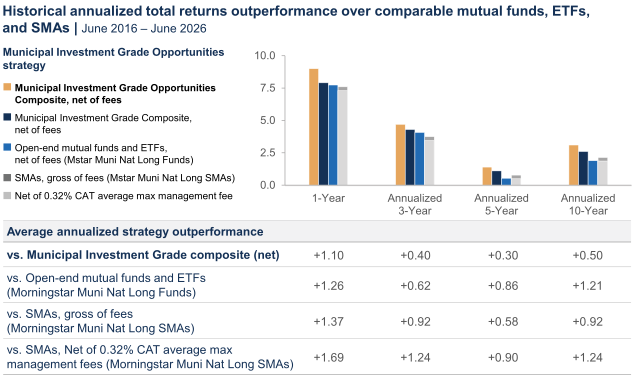
Data as of June 30, 2026. Based on annualized total returns. Average max mgmt. fee for SMAs in the Morningstar Muni National Long Separate Account category is 0.32%.
Municipal Investment Grade Composite and Municipal High Yield Composite are included for comparison purposes to MacKay Shields Municipal Investment Grade Opportunities Composite and MacKay Shields Municipal Credit Opportunities Composite as they are invested in the municipal investment grade and municipal high yield markets, respectively.
Open-end mutual funds and ETFs labels on the charts represent the Morningstar Muni National Long Funds category and Morningstar High Yield Muni Funds category for the comparison to MacKay Shields Municipal Investment Grade Opportunities Composite and MacKay Shields Municipal Credit Opportunities Composite, respectively.
SMAs represent the Morningstar Muni National Long Separate Account category, while mutual funds represent the Morningstar Muni National Long Funds category. Both categories consist of nationally diversified municipal portfolios with long-duration characteristics and have the same definition as the Morningstar Muni National Long category.
We reviewed the turnover of the top ten SMA peers (i.e. the Morningstar Muni National Long Separate Account category) based on assets under management, excluding the MacKay Shields Municipal Investment Grade Opportunities Composite. The analysis indicates that the top ten SMA peers tend to exhibit lower turnover (average weighted turnover ratio of 22% as of 12/31/25) relative to MacKay Shields Municipal Investment Grade Opportunities Composite that has a turnover of 84% as of 12/31/25, exhibiting a more active approach to portfolio management.
SMAs are excluded from the Municipal Credit Opportunities composite analysis because the Morningstar peer group is limited. Furthermore, we believe investor preference is generally for SMAs in the investment-grade municipal space and for commingled products in the high-yield municipal space.
Material differences between Mutual Funds (MF), and Separately Managed Accounts (SMA): Security selection: MF investors cannot dictate which securities will be in the fund. SMA investors can request the manager sell an individual security or restrict exposure to certain securities. Liquidity: MFs offer daily liquidity, although there may be transaction fees involved. With SMAs, it may take a few days to get your money fully invested and managers may only allow the liquidation of managed accounts at certain times. Capital gains: MFs must pay out income and capital gains to investors, which is a taxable event. With SMAs, an investor can ask a manager to be as tax-efficient as possible and to try to offset gains and losses. Account minimums and costs: MFs typically have lower minimum accounts sizes than SMAs. MFs may also carry sales charges. SMAs typically charge higher fees than MFs due to their customizable nature. Holdings: SMA investors may request access to account holdings at any time. MFs report holdings periodically on a set schedule.
Please see composites disclosures at the end of this material.
The net performance of a composite is not directly comparable to the net performance experienced by investors in a fund. Composite net returns are typically calculated by deducting a model or representative management fee, whereas fund-level returns reflect the impact of additional fees and expenses, such as fund operating expenses, and other costs borne by investors. As a result, net returns realized by funds are generally lower than composite net returns. Because fees and expenses can vary across investment vehicles and strategies, performance comparisons to benchmarks or peer groups may appear less favorable when based on fund returns rather than composite results.
Past performance is not indicative of future results. See further disclosures at the end of this document.
Sources: Morningstar, MacKay Shields, Callan LLC, based on monthly returns.
Figure 2: MacKay Shields Municipal High Yield composites performance vs. peer vehicles
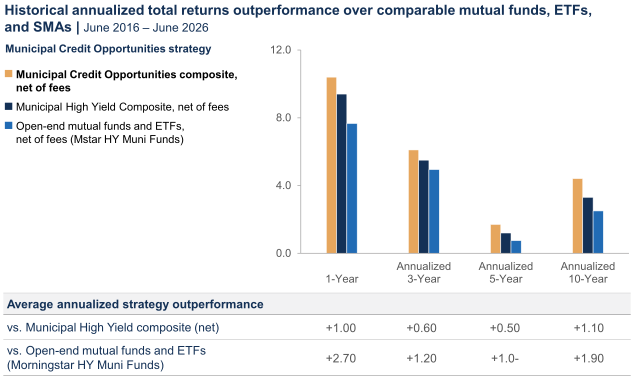
Data as of June 30, 2026. Based on annualized total returns. All performance is net of fees. Average max mgmt. fee for SMAs in the Morningstar Muni National Long Separate Account category is 0.32%.
Municipal Investment Grade Composite and Municipal High Yield Composite are included for comparison purposes to MacKay Shields Municipal Investment Grade Opportunities Composite and MacKay Shields Municipal Credit Opportunities Composite as they are invested in the municipal investment grade and municipal high yield markets, respectively.
Open-end mutual funds and ETFs labels on the charts represent the Morningstar Muni National Long Funds category and Morningstar High Yield Muni Funds category for the comparison to MacKay Shields Municipal Investment Grade Opportunities Composite and MacKay Shields Municipal Credit Opportunities Composite, respectively.
We reviewed the turnover of the top ten SMA peers (i.e. the Morningstar Muni National Long Separate Account category) based on assets under management, excluding the MacKay Shields Municipal Investment Grade Opportunities Composite. The analysis indicates that the top ten SMA peers tend to exhibit lower turnover (average weighted turnover ratio of 22% as of 12/31/25) relative to MacKay Shields Municipal Investment Grade Opportunities Composite that has a turnover of 84% as of 12/31/25, exhibiting a more active approach to portfolio management.
SMAs are excluded from the Municipal Credit Opportunities composite analysis because the Morningstar peer group is limited. Furthermore, we believe investor preference is generally for SMAs in the investment-grade municipal space and for commingled products in the high-yield municipal space.
Material differences between Mutual Funds (MF), and Separately Managed Accounts (SMA): Security selection: MF investors cannot dictate which securities will be in the fund. SMA investors can request the manager sell an individual security or restrict exposure to certain securities. Liquidity: MFs offer daily liquidity, although there may be transaction fees involved. With SMAs, it may take a few days to get your money fully invested and managers may only allow the liquidation of managed accounts at certain times. Capital gains: MFs must pay out income and capital gains to investors, which is a taxable event. With SMAs, an investor can ask a manager to be as tax-efficient as possible and to try to offset gains and losses. Account minimums and costs: MFs typically have lower minimum accounts sizes than SMAs. MFs may also carry sales charges. SMAs typically charge higher fees than MFs due to their customizable nature. Holdings: SMA investors may request access to account holdings at any time. MFs report holdings periodically on a set schedule.
Please see composites disclosures at the end of this material.
The net performance of a composite is not directly comparable to the net performance experienced by investors in a fund. Composite net returns are typically calculated by deducting a model or representative management fee, whereas fund-level returns reflect the impact of additional fees and expenses, such as fund operating expenses, and other costs borne by investors. As a result, net returns realized by funds are generally lower than composite net returns. Because fees and expenses can vary across investment vehicles and strategies, performance comparisons to benchmarks or peer groups may appear less favorable when based on fund returns rather than composite results.
Past performance is not indicative of future results. See further disclosures at the end of this document.
Sources: Morningstar, MacKay Shields, Callan LLC, based on monthly returns
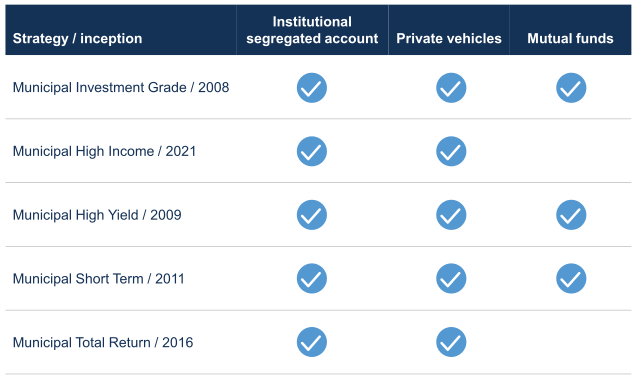
MacKay Municipal Managers offers flexible municipal strategies that seek to capitalize on market inefficiencies, build yield advantage, and pursue attractive after-tax total return opportunities across changing market conditions.
Figure 3: MacKay Municipal Managers™ strategies
Where structural constraints leave value on the table
The case for adding flexibility to a passive municipal allocation rests on a recognition that many of the most attractively priced segments of the muni market are structurally inaccessible to rules-based mandates. Passively managed buy and hold portfolios are notable as much for what they cannot hold as for what they do hold. Their guidelines typically constrain them to a narrow set of bond types, credit qualities, and maturity buckets, regardless of the relative value picture in adjacent segments. Two structural inefficiencies warrant particular attention.
The first is curve positioning. Much institutional municipal exposure still rests on passively managed, buy-and-hold portfolios that allocate to predetermined maturity points rather than to where relative value actually resides. These approaches serve an important purpose, but by design their static, rules-based construction tends to concentrate exposure in well-trafficked segments of the curve, leaving attractively priced opportunities elsewhere out of reach.
That distinction matters more than ever. A buy-and-hold portfolio positions along the curve mechanically; a flexible, actively managed strategy positions deliberately, moving dynamically across the full curve based on relative value, rolldown potential, and valuation, while accessing structurally complex segments that passive construction systematically passes over. This is precisely where active management adds value.
The second is sector access. Areas such as Alternative Minimum Tax (“AMT”) bonds, electric and natural-gas prepaid structures1, and housing securities remain underrepresented in passive portfolios. The reason is structural complexity rather than credit concern; passive methodologies are generally not equipped to evaluate variable cash flows, embedded optionality, or non-standard credit structures. Lower-coupon bonds trading through the market discount threshold and hard-put structures2 present a similar set of opportunities. Active managers with the analytical capacity to underwrite these structures can target segments that rules-based vehicles systematically pass over, with the opportunity to capture the relative value that the resulting demand imbalances tend to create.
A bolt-on strategy: the natural evolution at the next maturity
Most institutional allocators with established municipal exposure are unlikely to overhaul their portfolios in a single decision. The more practical entry point is to ask whether the next allocation should replicate what came before or whether a portion should be redeployed into a strategy with greater flexibility and return potential. Positioned this way, a flexible municipal allocation functions as a bolt-on to the existing core, not a wholesale reconstruction of it. Even modest additions to a portfolio may begin to address the structural gaps that buy-and-hold portfolios leave behind, expanding access to underrepresented sectors, improving curve positioning, and introducing a yield profile less constrained by index mechanics.
For institutional investors navigating an environment in which yield, dispersion, and structural complexity matter more than they have in years, we believe flexible municipal strategies represent a forward-looking allocation decision grounded in active management and disciplined risk management. They are designed to complete the institutional municipal allocation framework, complementing the role of passively managed exposure rather than substituting for it, and to access the full opportunity set that the municipal market presents in 2026 and beyond.
1. Alternative Minimum Tax (AMT) bonds are municipal bonds issued to finance certain private-purpose projects whose interest may be subject to the federal Alternative Minimum Tax, often resulting in higher yields than comparable non-AMT municipal bonds. Energy prepay bonds are municipal bonds that finance long-term prepaid electricity or natural-gas supply agreements and often offer yield premiums due to their structural complexity and specialized credit analysis requirements.
2. “Hard-put structure” generally means a municipal bond with a firm contractual put or mandatory tender date before the bond’s final maturity. On that date, the bondholder can require the issuer or a designated third party to buy the bond back, typically at par, rather than holding it to final maturity. Not to be construed as tax advice. Neither MacKay Municipal Managers nor MacKay Shields LLC advise clients on tax matters. Consult your tax advisor for further information.
IMPORTANT DISCLOSURE
Availability of products and services provided by MacKay Shields may be limited by applicable laws and regulations in certain jurisdictions and this document is provided only for persons to whom this document and the products and services of MacKay Shields may otherwise lawfully be issued or made available. None of the products and services provided by MacKay Shields are offered to any person in any jurisdiction where such offering would be contrary to local law or regulation. This document is provided for information purposes only. It does not constitute investment advice and should not be construed as an offer to buy securities. The contents of this document have not been reviewed by any regulatory authority in any jurisdiction. All investments contain risks and may lose value and these materials do not undertake to explain all of the risks associated with any investment strategy referred to herein. Clients and investors should not invest in any strategy referred to herein unless satisfied that they and/or their representatives have requested and received all information that would enable them to evaluate the merits and risks thereof. Any forward-looking statements speak only as of the date they are made, and MacKay Shields assumes no duty and does not undertake to update forward looking statements. Any opinions expressed are the views and opinions of certain investment professionals at MacKay Shields which are subject to change without notice. There may have been, and may in the future be, changes to the investment personnel responsible for the management of the strategy(ies) described herein, as well as changes to the investment process utilized by such investment personnel. Past performance is not indicative of future results.
Information included herein should not be considered predicative of future transactions or commitments made by MacKay Shields LLC nor as an indication of current or future profitability. There is no assurance investment objectives will be met.
Past performance is not indicative of future results.
NOTE TO UK AND EUROPEAN UNION AUDIENCE
This document is intended only for the use of professional investors as defined in the Alternative Investment Fund Manager’s Directive and/or the UK Financial Conduct Authority’s Conduct of Business Sourcebook. To the extent this document has been issued in the United Kingdom, it has been issued by NYL Investments UK LLP, 200 Aldersgate Street, London UK EC1A 4HD, which is authorised and regulated by the UK Financial Conduct Authority. To the extent this document has been issued in the EEA, it has been issued by NYL Investments Europe Limited, 77 Sir John Rogerson's Quay, Block C Dublin D02 VK60 Ireland. NYL Investments Europe Limited is authorized and regulated by the Central Bank of Ireland (i) to act as an alternative investment fund manager of alternative investment funds under the Alternative Investment Fund Managers Directive (Directive 2011/61/EU) and (ii) to provide the services of individual portfolio management, investment advice and the receipt and transmission of orders as defined in Regulation 7(4) of the AIFMD Regulations to persons who meet the definition of “professional client” as set out in the MiFID Regulations. It has passported its license in additional countries in the EEA.
This document only describes capabilities of certain affiliates of New York Life Investment Management and/or MacKay Shields LLC. No such affiliates will accept subscriptions in any funds not admitted to marketing in your country or provide services to potential customers in your country, including discretionary asset management services, except where it is licensed to do so or can rely on an applicable exemption.
MacKay Shields LLC is a wholly owned subsidiary of New York Life Investment Management Holdings LLC, which is wholly owned by New York Life Insurance Company. “New York Life Investment Management” is the brand name and service mark used to represent a group of affiliated investment advisors of New York Life Insurance Company, including New York Life Investment Management LLC, a registered investment advisor.
NOTE TO CANADIAN RECIPIENTS
The information in these materials is not an offer to sell securities or a solicitation of an offer to buy securities in any jurisdiction of Canada. In Canada, any offer or sale of securities or the provision of any advisory or investment fund manager services will be made only in accordance with applicable Canadian securities laws. More specifically, any offer or sale of securities will be made in accordance with applicable exemptions to dealer and investment fund manager registration requirements, as well as under an exemption from the requirement to file a prospectus, and any advice given on securities will be made in reliance on applicable exemptions to adviser registration requirements.
Information included herein should not be considered predicative of future transactions or commitments made by MacKay Shields LLC nor as an indication of current or future profitability. There is no assurance investment objectives will be met. Past performance is not indicative of future results.
NOTE TO JAPANESE RECIPIENTS
In Japan, this is issued by New York Life Investment Management Asia Limited (Financial Instruments Business Operator, Kanto Local Finance Bureau (FIBO) No. 2964, Member of Japan Investment Advisers Association and Type 2 Financial Instruments Firms Association) for institutional investors only. As costs and/or fees to be borne by investors vary depending on circumstances such as products, services, investment period and market conditions, the total amount nor the calculation methods cannot be disclosed in advance. All investments involve risks, including market fluctuation and investors may lose the principal amount invested. Investors should obtain and read the prospectus and/or information set forth in Article 37-3 of the Financial Instruments and Exchange Act carefully before making investment decisions.
MacKay Shields LLC is a wholly owned subsidiary of New York Life Investment Management Holdings LLC, which is wholly owned by New York Life Insurance Company. “New York Life Investment Management” is the brand name and service mark used to represent a group of affiliated investment advisors of New York Life Insurance Company, including New York Life Investment Management LLC, a registered investment advisor.
SOURCE INFORMATION
“Bloomberg®”, “Bloomberg Indices®”, Bloomberg Fixed Income Indices, Bloomberg Equity Indices and all other Bloomberg indices referenced herein are service marks of Bloomberg Finance L.P. and its affiliates, including Bloomberg Index Services Limited (“BISL”), the administrator of the indices (collectively, “Bloomberg”) and have been licensed for use for certain purposes by MacKay Shields LLC (“MacKay Shields”). Bloomberg is not affiliated with MacKay Shields, and Bloomberg does not approve, endorse, review, or recommend MacKay Shields or any products, funds or services described herein. Bloomberg does not guarantee the timeliness, accurateness, or completeness of any data or information relating to MacKay Shields or any products, funds or services described herein.
Institutional Municipals Reimagined: The Case For Flexible Municipal Strategies.
Related Thought Leadership