
Markets have responded most clearly in the MBS market, where the GSE announcement drove a tightening in spreads.
The effectiveness of these initiatives is uncertain: MBS purchases are limited in scale, while the credit card proposal is non-binding and any lower-rate offerings would likely be confined to higher-quality cardholders.
We believe agency MBS may benefit from explicit policy support and a clear affordability transmission channel. In evaluating new opportunities among financials, it is our view to modestly favor those issuers with lower exposure to affordability-related headline risk.
Affordability has moved to the forefront of the administration’s domestic policy agenda, shaping a broad range of actions spanning trade, monetary policy, and debt management. Recent initiatives have included targeted tariff exemptions, sustained public pressure on the Federal Reserve to lower interest rates, and adjustments to Treasury debt management practices aimed at limiting increases in long-term yields that could feed through to higher borrowing costs for households.
Figure 1: The approaching midterms shine a spotlight on affordability concerns
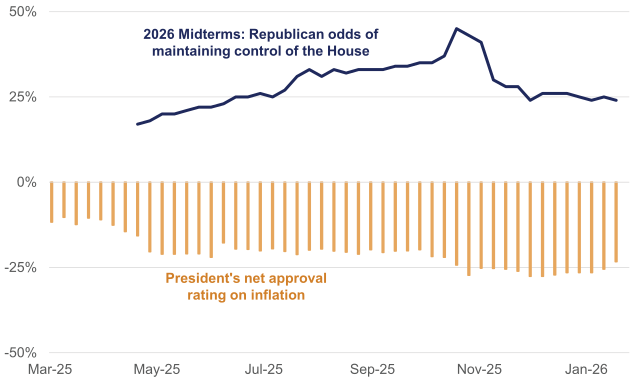
Source: RealClear Politics, Kalshi. Through January 19, 2026.
The political backdrop to this renewed focus is the approaching November midterm elections, with the administration facing weak approval ratings on the economy and inflation and the risk that Republicans could lose control of the House of Representatives—an outcome that would significantly constrain the President’s legislative agenda in the final two years of his term.
In this note, we focus on two prominent elements of the administration’s affordability push: mortgage-backed securities purchases by the government-sponsored enterprises (GSEs) Fannie Mae and Freddie Mac, intended to place downward pressure on mortgage rates, and the proposal to cap credit card interest rates at 10 percent. In addition to outlining these initiatives, we assess their potential market impact and discuss the implications.
GSE MBS purchases
The administration has directed Fannie Mae and Freddie Mac to expand agency MBS purchases by up to $200 billion, framing the effort as a means to lower mortgage rates, reduce monthly payments, and improve home affordability. This builds on GSE buying already underway in the second half of 2025 and remains within existing portfolio caps, though key details around pace, product mix, and execution are still unresolved. The intent is clear: increased GSE demand is designed to compress agency MBS spreads and translate directly into lower primary mortgage rates, independent of Treasury yield moves.
Markets reacted quickly to the GSE announcement on January 8. In the 24 hours following the headline, current coupon agency MBS spreads tightened sharply—from roughly 110 basis points over Treasuries to approximately 95 basis points—despite modest increases in volatility and ongoing supply. This tightening has already flowed through to lower primary mortgage rates, underscoring the effectiveness of spread compression as an affordability channel. Market estimates suggest that, absent offsetting rate moves, this magnitude of tightening is consistent with mortgage rates moving back below 6%.
From an affordability standpoint, the impact is tangible in the near term. A decline from roughly 6.5% to just under 6% on a $400,000 30-year mortgage lowers monthly payments by approximately $130–$160, depending on assumptions—meaningful relief for rate-sensitive borrowers at the margin. We remain attuned to any signals that the administration looks to raise the GSEs’ securities portfolio cap, which would open the door to additional MBS purchases and spread narrowing. While this could lower mortgage rates further, it is worth noting that this initiative works only on the demand side of the housing market. Absent a housing supply response, an increase in housing demand resulting from lower mortgage rates may add to home price appreciation, pushing against overall affordability.
Figure 2: Current coupon MBS spread around the announcement of GSE purchases
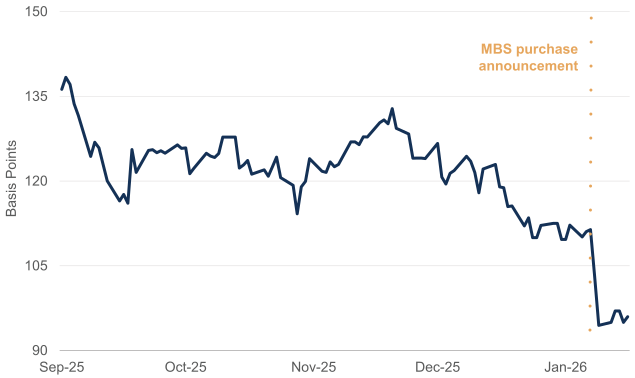
Data through January 16, 2026.
Source: Bloombergle.
We believe the GSE announcement reinforces agency MBS as a sector with explicit policy support and a clear affordability transmission mechanism. Agencies benefited from the rapid post-announcement tightening, and at current spread levels we are closely monitoring valuations and policy follow-through, recognizing that additional upside will depend on execution details and the durability of GSE demand.
Credit card interest rate cap proposal
President Trump has recently floated the idea of imposing a 10 percent cap on credit card interest rates, though no formal policy proposal or implementation framework has been provided. At this stage, the concept remains preliminary and politically uncertain, but it has nevertheless attracted market attention given its potential implications for bank earnings, credit availability, and consumer borrowing costs. By way of context, average credit card interest rates are currently well above the proposed cap, running in the low-20 percent range.
Considerable uncertainty surrounds how such a cap would be implemented, if at all. There has been no guidance on whether compliance would be mandatory, whether the cap would apply to existing balances or only to new credit, or whether it would be enforced through regulation, legislation, or voluntary issuer participation. Market participants broadly expect that binding implementation would require Congressional action, particularly given that similar bipartisan proposals introduced last year failed to gain traction. In the absence of legislation, the proposal appears more likely to function as a political signal than as an imminent regulatory change.
Figure 3: Interest rates on credit card balances near record highs
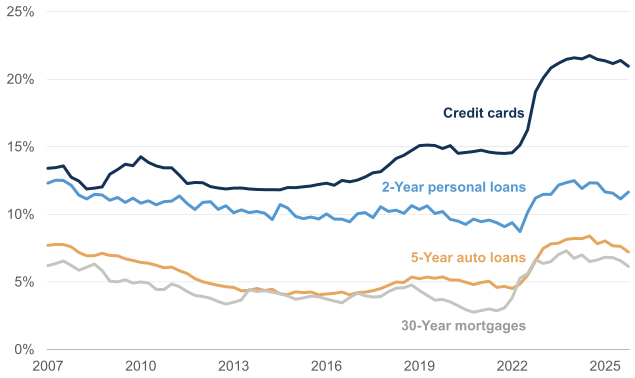
Quarterly data through end-2025.
Source: Board of Governors of the Federal Reserve System, Freddie Mac
From an economic perspective, a strict and binding 10 percent cap would entail meaningful tradeoffs. According to the Federal Reserve Bank of New York, elevated credit card rates reflect three main factors. 1 First, default risk varies sharply by borrower quality, with annual charge-off rates ranging from roughly 9.3 percent for borrowers with FICO scores near 600 at origination to about 1.3 percent for those with scores around 850. Second, this default risk is largely non-diversifiable: charge-offs across FICO segments move together and rise in downturns, and credit card losses are highly correlated with other bank loan and corporate bond defaults. Third, operating expenses are exceptionally high—around 4–5 percent of balances annually—accounting for roughly half of default-adjusted annual percentage rates. Marketing costs are a key driver, with credit card banks spending roughly 1–2 percent of assets annually on marketing, about ten times the share spent by other banks. Institutions with higher operating costs charge materially higher spreads for a given FICO score and earn higher gross margins, pointing to meaningful pricing power supported by elevated operating expenses. Taken together, these dynamics imply that a uniform 10 percent interest rate cap is not economically viable for issuers serving borrowers across a wide range of credit profiles, and would likely result in tighter credit availability or a reallocation toward higher-quality cardholders rather than broad-based affordability gains. Reduced credit availability, particularly for non-prime borrowers, could push some consumers toward higher-cost or less-regulated forms of credit.
One possible pathway that has been discussed would involve voluntary issuer participation rather than a blanket cap. National Economic Council Director Kevin Hassett has suggested that large banks could offer new capped-rate products—so-called “Trump cards”—with interest rates limited to 10 percent. Such an approach would allow issuers to target these products to higher-quality borrowers while maintaining existing pricing on outstanding balances, materially limiting the financial impact relative to a universal cap. While details remain sparse, this framework would likely be far less disruptive to issuer economics than a mandatory across-the-board ceiling. It would also have less of an impact on credit card affordability, as the lower rate would only be available to borrowers who are less likely to maintain balances.
Market reaction to the proposal has been measured. Credit card issuer bond spreads initially widened, with the largest moves concentrated among issuers with greater exposure to non-prime borrowers. As investors reassessed the likelihood of enactment and the scope for issuer workarounds, spreads have since stabilized and now remain modestly wider—by roughly 5 to 8 basis points—than prior to the announcement, recouping about half of the initial move. The credit card ABS market has also seen minimal immediate reaction, with limited trading activity and benchmark spreads largely unchanged. While headline risk has increased, most large bank card trusts operate with charge-off rates well below the proposed cap, limiting near-term structural stress.
We expect credit card issuers to push back and adapt in ways that limit the longer-term spread impact. The more salient risk at this stage is continued political and media focus on credit card affordability rather than near-term regulatory change. Going forward, it is our view to modestly favor financial issuers with lower exposure to affordability-related headline risk, including select regional banks, when evaluating new opportunities.
In unsecured consumer ABS, our response has also been muted. While the policy discussion introduces longer-term uncertainty around yields and excess spread—particularly for retail-focused platforms—we see limited near-term incentive to reposition our view given structural protections, issuer support tools, and the lack of material market repricing to date.
Overall, the proposed 10 percent credit card interest rate cap appears unlikely to be implemented quickly or unilaterally. Even if the idea continues to gain political visibility, potential issuer adaptations and legislative hurdles should constrain its ultimate impact on markets. We will continue to monitor developments closely.
1. Itamar Drechsler, Hyeyoon Jung, Weiyu Peng, Dominik Supera, and Guanyu Zhou, “Why Are Credit Card Rates So High?,” Federal Reserve Bank of New York Liberty Street Economics, March 31, 2025, https://libertystreeteconomics.newyorkfed.org/2025/03/why-are-credit-card-rates-so-high/
IMPORTANT DISCLOSURE
Availability of products and services provided by MacKay Shields may be limited by applicable laws and regulations in certain jurisdictions and this document is provided only for persons to whom this document and the products and services of MacKay Shields may otherwise lawfully be issued or made available. None of the products and services provided by MacKay Shields are offered to any person in any jurisdiction where such offering would be contrary to local law or regulation. This document is provided for information purposes only. It does not constitute investment advice and should not be construed as an offer to buy securities. The contents of this document have not been reviewed by any regulatory authority in any jurisdiction. All investments contain risks and may lose value and these materials do not undertake to explain all of the risks associated with any investment strategy referred to herein. Clients and investors should not invest in any strategy referred to herein unless satisfied that they and/or their representatives have requested and received all information that would enable them to evaluate the merits and risks thereof. Any forward-looking statements speak only as of the date they are made, and MacKay Shields assumes no duty and does not undertake to update forward looking statements. Any opinions expressed are the views and opinions of certain investment professionals at MacKay Shields which are subject to change without notice. There may have been, and may in the future be, changes to the investment personnel responsible for the management of the strategy(ies) described herein, as well as changes to the investment process utilized by such investment personnel. Past performance is not indicative of future results.
At the time of writing, MacKay Shields LLC maintains investments in the securities, issuers and/or companies cited herein. References to such securities, issuers and/or companies for educational and informational purposes only, and are intended to convey factual information and current market conditions. Such names are not intended, nor should they be construed as, a recommendation to buy and sell any individual security.
Information included herein should not be considered predicative of future transactions or commitments made by MacKay Shields LLC nor as an indication of current or future profitability. There is no assurance investment objectives will be met.
Past performance is not indicative of future results.
NOTE TO UK AND EUROPEAN UNION AUDIENCE
This document is intended only for the use of professional investors as defined in the Alternative Investment Fund Manager’s Directive and/or the UK Financial Conduct Authority’s Conduct of Business Sourcebook. To the extent this document has been issued in the United Kingdom, it has been issued by NYL Investments UK LLP, 200 Aldersgate Street, London UK EC1A 4HD, which is authorised and regulated by the UK Financial Conduct Authority. To the extent this document has been issued in the EEA, it has been issued by NYL Investments Europe Limited, 77 Sir John Rogerson's Quay, Block C Dublin D02 VK60 Ireland. NYL Investments Europe Limited is authorized and regulated by the Central Bank of Ireland (i) to act as an alternative investment fund manager of alternative investment funds under the Alternative Investment Fund Managers Directive (Directive 2011/61/EU) and (ii) to provide the services of individual portfolio management, investment advice and the receipt and transmission of orders as defined in Regulation 7(4) of the AIFMD Regulations to persons who meet the definition of “professional client” as set out in the MiFID Regulations. It has passported its license in additional countries in the EEA.
This document only describes capabilities of certain affiliates of New York Life Investments and/or MacKay Shields LLC. No such affiliates will accept subscriptions in any funds not admitted to marketing in your country or provide services to potential customers in your country, including discretionary asset management services, except where it is licensed to do so or can rely on an applicable exemption.
MacKay Shields LLC is a wholly owned subsidiary of New York Life Investment Management Holdings LLC, which is wholly owned by New York Life Insurance Company. "New York Life Investments" is both a service mark, and the common trade name of certain investment advisers affiliated with New York Life Insurance Company. Investments are not guaranteed by New York Life Insurance Company or New York Life Investments.
NOTE TO CANADIAN RECIPIENTS
The information in these materials is not an offer to sell securities or a solicitation of an offer to buy securities in any jurisdiction of Canada. In Canada, any offer or sale of securities or the provision of any advisory or investment fund manager services will be made only in accordance with applicable Canadian securities laws. More specifically, any offer or sale of securities will be made in accordance with applicable exemptions to dealer and investment fund manager registration requirements, as well as under an exemption from the requirement to file a prospectus, and any advice given on securities will be made in reliance on applicable exemptions to adviser registration requirements.
Information included herein should not be considered predicative of future transactions or commitments made by MacKay Shields LLC nor as an indication of current or future profitability. There is no assurance investment objectives will be met. Past performance is not indicative of future results.
NOTE TO JAPANESE RECIPIENTS
In Japan, this is issued by New York Life Investment Management Asia Limited (Financial Instruments Business Operator, Kanto Local Finance Bureau (FIBO) No. 2964, Member of Japan Investment Advisers Association and Type 2 Financial Instruments Firms Association) for institutional investors only. As costs and/or fees to be borne by investors vary depending on circumstances such as products, services, investment period and market conditions, the total amount nor the calculation methods cannot be disclosed in advance. All investments involve risks, including market fluctuation and investors may lose the principal amount invested. Investors should obtain and read the prospectus and/or information set forth in Article 37-3 of the Financial Instruments and Exchange Act carefully before making investment decisions.
MacKay Shields LLC is a wholly owned subsidiary of New York Life Investment Management Holdings LLC, which is wholly owned by New York Life Insurance Company. "New York Life Investments" is both a service mark, and the common trade name of certain investment advisers affiliated with New York Life Insurance Company. Investments are not guaranteed by New York Life Insurance Company or New York Life Investments.
SOURCE INFORMATION
“Bloomberg®”, “Bloomberg Indices®”, Bloomberg Fixed Income Indices, Bloomberg Equity Indices and all other Bloomberg indices referenced herein are service marks of Bloomberg Finance L.P. and its affiliates, including Bloomberg Index Services Limited (“BISL”), the administrator of the indices (collectively, “Bloomberg”) and have been licensed for use for certain purposes by MacKay Shields LLC (“MacKay Shields”). Bloomberg is not affiliated with MacKay Shields, and Bloomberg does not approve, endorse, review, or recommend MacKay Shields or any products, funds or services described herein. Bloomberg does not guarantee the timeliness, accurateness, or completeness of any data or information relating to MacKay Shields or any products, funds or services described herein.
Subscribe to get MacKay Shields insights delivered to your inbox.
Related Thought Leadership